
Get all your news in one place.
100’s of premium titles.
One app.
Start reading
Space
Space
Science
Anthony Wood

Comet 24P/Schaumasse makes its closest approach to the sun today: But will you be able to see it?

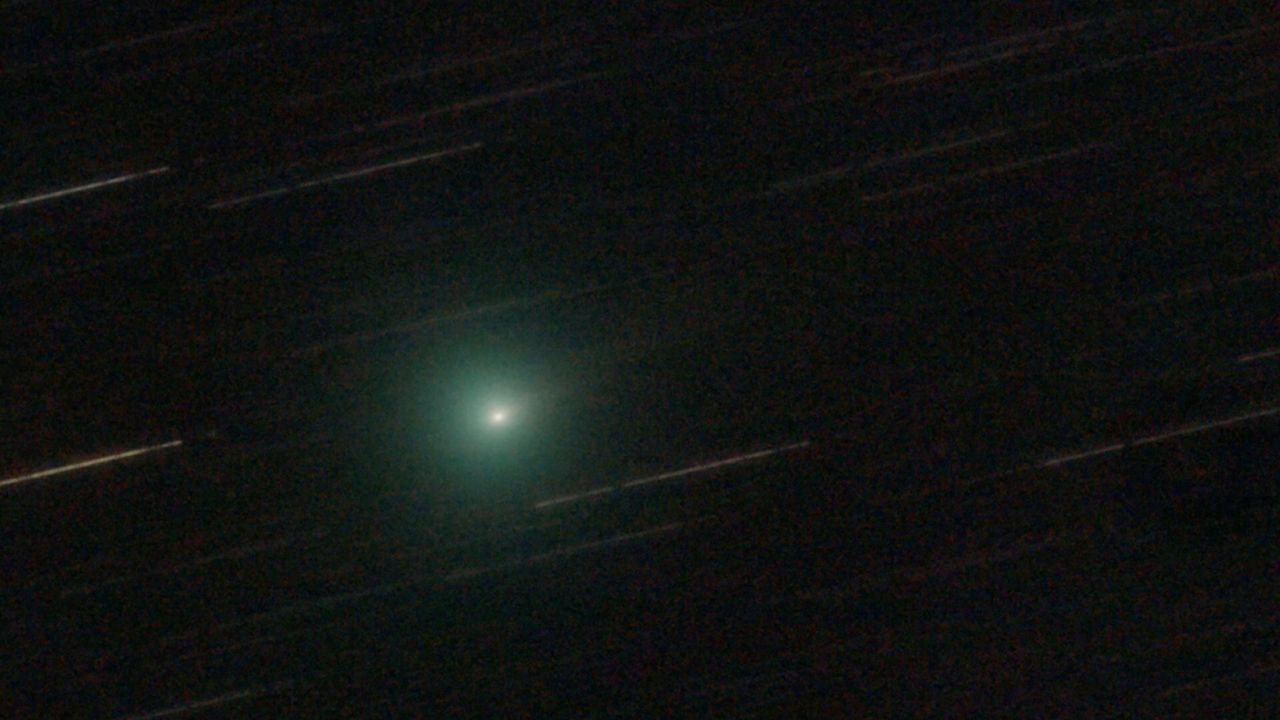
A fuzzy green blob on a black background crossed with white streaks.

Heads up! The solar system comet 24P/Schaumasse will make its closest approach to the sun in its current orbit on Jan. 8 during an event known to astronomers as perihelion. Here's what to expect from the icy wanderer as it reaches peak visibility over the coming days.

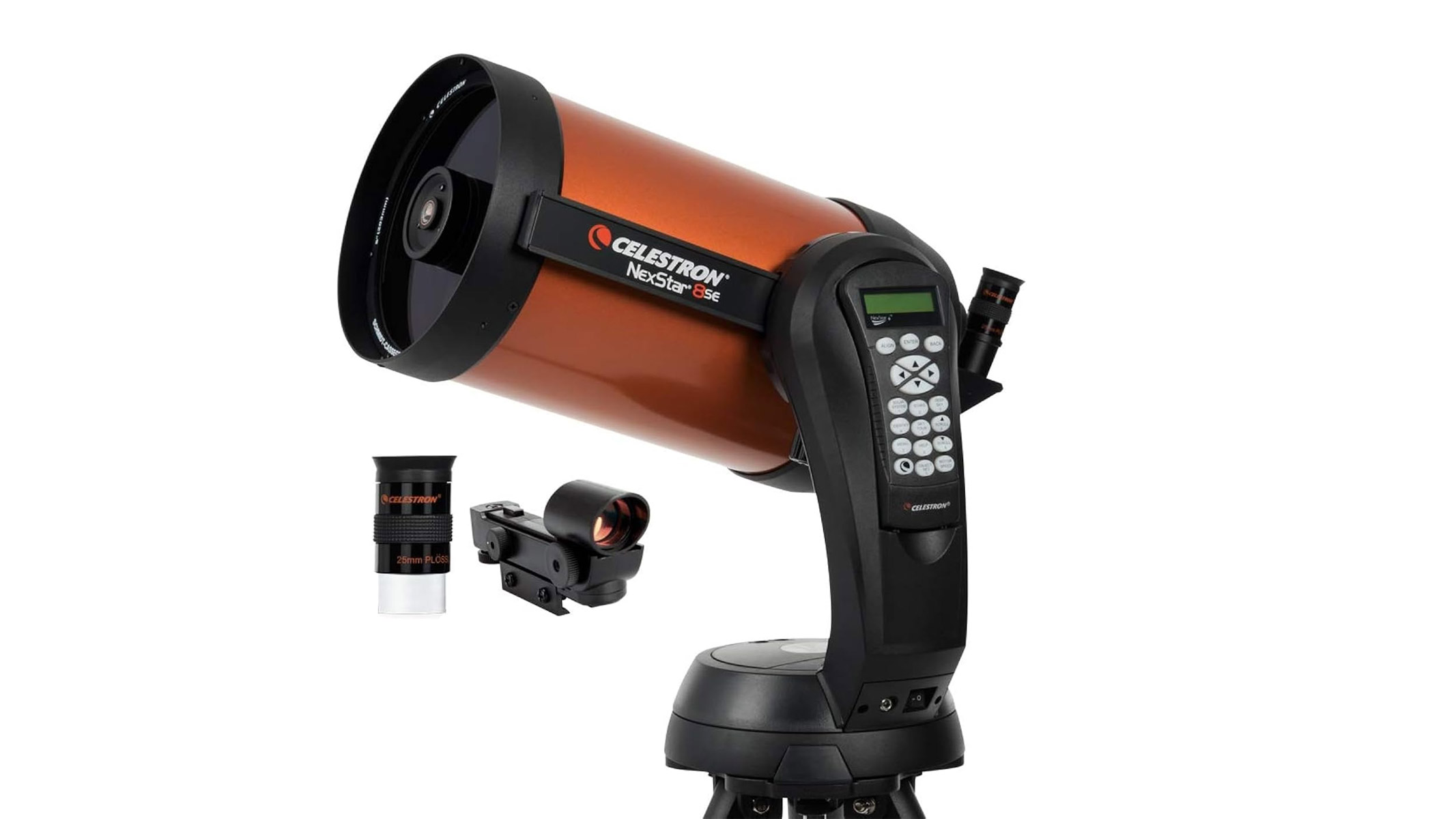
Celestron NexStar 8SE
(Image credit: Amazon)

We reckon the Celestron NexStar 8SE is the best motorized telescope out there as it's great for astrophotography, deep-space observing and it offers stunning detailed imagery. It is a little pricey but for what you get, it's good value. For a more detailed look, you can check out our Celestron NexStar 8SE review.

The short-period comet was discovered by astronomer Alexandre Schaumasse in December 1911 using a 16-inch (400 mm) telescope situated at an observatory in Nice, France. The primordial object has an orbit that takes it beyond the path of Jupiter before careening back inwards towards the sun — a journey that it makes roughly once every eight years, according to NASA.

Comets tend to be at their brightest around perihelion, when the increase in solar heating causes icy material in their central coma to vaporize and feed the envelope of gas surrounding the solid nucleus. This gas catches and reflects the sun's light, which can cause the comet to brighten significantly, occasionally rendering them visible to the naked eye in Earth's night sky.

Will comet 24P/Schaumasse be visible to the naked eye?

Magnitude

Magnitude is the scale used to measure the apparent brightness of objects in the night sky. The lower the number, the brighter the object! For context, the brightest stars are around Mag +1, while a full moon is -13 and the sun is -27.

24P/Schaumasse will make its closest pass of the sun on Jan. 8, according to In-the-sky, when it will pass 109.7 million miles (177 million kilometers) from our parent star. The comet currently has an observed brightness, or magnitude, of approximately +10.8, per the Comet Observation Database (COBS) run by the Crni Vrh Observatory in Slovenia.

That places it well beyond the detection threshold of the unaided human eye, which is capable of resolving objects with a magnitude of around +6.5 under dark sky conditions (on the magnitude scale used by astronomers, lower numbers signify brighter objects). A telescope with an aperture of at least 6 inches (152 mm) should help resolve the comet as a hazy patch of light under dark skies, though these efforts will be made more challenging by the light of a waning gibbous moon, which will brighten the sky during the early hours of Jan. 8.

An illustration of 24P/Schaumasse in Virgo on the evening of Jan. 8, 2025. (Image credit: TheSkyLive.com)

To find 24P/Schaumasse, first locate the stars of the constellation Virgo high above the southern horizon. The best time to hunt for the comet is in the predawn hours, when the constellation Virgo will have risen high in the sky. Once you've found Virgo, pick out the magnitude +2.8 star Vindemiatrix. 24P/Schaumasse can be found in the patch of sky 5 degrees — roughly the width of your three middle fingers held at arm's length — to its left.

To help you locate Virgo and 24P/Schaumasse, it may be easiest to use a smartphone astronomy app. Check out our list of the best stargazing apps for 2026 to help you find the right one for you and your device.

Want to explore the wonders of the solar system for yourself? Then be sure to check out our picks of the best telescopes available in 2026, where we lay out the top options for a range of categories to ensure that you find the scope that meets your astronomy needs.

Editor's Note: If you capture an image of 24P/Schaumasse and want to share your astrophotography with Space.com's readers, then please send your photo(s), comments, and your name and location to spacephotos@space.com.

Sign up to read this article
Read news from 100’s of titles, curated specifically for you.
Already a member? Sign in here
Related Stories
Top stories on inkl right now
Our Picks
Fourteen days free
Download the app
One app. One membership.
100+ trusted global sources.