Get all your news in one place.
100's of premium titles.
One app.
Start reading
Latin Times
Latin Times
World
S. H. Lee

Colombia Puts Its Democratic Guardrails to the Test Ahead of Sunday's 2026 Presidential Elections

Colombia's presidential candidates Ivan Cepeda, of the Pacto Historico party, speaks during a press conference in Bogota on May 21, 2026. Colombia is to hold presidential elections on May 31. (Photo by Luis ACOSTA / AFP via Getty Images) Colombia's presidential candidate Abelardo de la Espriella, of the Defensores de la Patria party, speaks behind bulletproof glass during his closing campaign rally in Medellin, Colombia on May 24, 2026. Colombia will hold presidential elections on May 31. (Photo by Jaime SALDARRIAGA / AFP via Getty Images) Colombian opposition senator Paloma Valencia delivers a speech a day after the inauguration of leftist Gustavo Petro as President in Bogota, on August 8, 2022. Gustavo Petro, the first left-wing president in Colombia's history, was sworn in on Sunday in front of hundreds of thousands of people in Bogota, calling on armed groups to sign peace and end the "war against drugs". (Photo by DANIEL MUNOZ / AFP) (Photo by DANIEL MUNOZ/AFP via Getty Images) (Credit: AFP via Getty Images)

When Colombians head to the polls this Sunday, May 31, they will do so amid one of the most heavily guarded elections in the country's recent history. Following weeks of escalating pre-electoral violence that claimed the lives of campaign workers and left multiple candidates under death threat, the government has rolled out a comprehensive security architecture designed to protect both voters and the democratic process itself — and to prove that the dates enshrined in the constitution are, as National Registrar Hernán Peñagos insisted, simply immovable.

"Plan Democracia 2026": An Army at the Ballot Box

At the center of the government's response is "Plan Democracia 2026," an operational framework under the command of Defense Minister Pedro Sánchez. The government announced the deployment of 408,000 members of the security forces — military and national police combined — across the country's 13,489 polling stations for the presidential vote. Of those, more than 48,000 are exclusively dedicated to voter security, with the remainder forming a broader territorial deployment by land, sea, and air. The National Police identified 67 high-risk municipalities where special rapid-response units will concentrate to contain any disruption to the vote.

Sánchez presented the plan's four operational pillars: protection of all 13 presidential candidates and their families; security at polling stations based on the risk map; transparency and anti-fraud measures; and cybersecurity capacity. On May 26, the Defense Minister convened a final coordination meeting with the armed forces leadership, the Registraduría, the MOE, and the Ombudsman's Office to review the risk assessments built into Plan Democracia ahead of election day. The departments of Valle del Cauca, Cauca, Nariño, Guaviare, Bolívar, and Norte de Santander were identified as the highest-threat zones, drawing the heaviest troop concentration — particularly in the southwest, where dissident FARC factions and criminal organizations remain most active.

Attorney General Gregorio Eljach sought to reassure citizens that state institutions are coordinated and prepared. "We are working to ensure that the 2026 elections are carried out safely," he said, adding that candidate protection measures — including heavy security details for the leading contenders — would remain in place through election day.

On the cybersecurity front, the Ministry of Information and Communications Technologies has taken over technical preparations for the electronic components of election day, a necessary step given that Colombia faces more than 3,000 cyberattacks per week, making it the third most targeted country in Latin America after Brazil and Mexico. El Tiempo has warned that criminal actors are using artificial intelligence to run more sophisticated deception campaigns against voters.

"No matter the public order situation, the election dates are immovable. They are defined by the Constitution and cannot be altered." — National Registrar Hernán Peñagos

International observers have also mobilized in force. The National Electoral Council has accredited 86 U.S. Embassy observers under Resolution 2090 — the first time the United States directly observes a Colombian presidential election — while the European Union's Electoral Observation Mission, led by MEP Esteban González Pons, completed a five-day assessment visit ahead of the vote. The OAS observation mission, headed by former Dominican president Leonel Fernández, has also deployed across the territory. González Pons acknowledged the stakes plainly: "The mission is fully aware that in some parts of the country the electoral process will take place in a context of violence, threats, and population displacement."

Armed Groups Declare Ceasefires — With Caveats

In a development that offers cautious relief, both of Colombia's largest illegal armed organizations announced separate unilateral ceasefires around election weekend. The National Liberation Army (ELN) declared a halt to operations running from midnight on May 30 to midnight on June 2, pledging to respect citizens' right to vote. Separately, the Central General Staff — the largest dissident FARC branch — announced a broader suspension of military operations against state forces running from May 20 through June 10.

The Clan del Golfo, Colombia's largest criminal organization, also said it would instruct its members to stay out of the political process entirely and refrain from pressuring voters. Taken together, the declarations represent a meaningful, if unverified, reduction in the risk of outright armed disruption on voting day.

Critics, however, warn that the truces should not be mistaken for peace. Former president Álvaro Uribe Vélez has publicly alleged that ELN and FARC dissident factions were using the pre-electoral period to pressure communities in Cauca to favor left-wing candidate Iván Cepeda — allegations the groups have denied. The controversy highlights what security analysts have long noted: state authority in Colombia's most conflict-ridden departments remains tenuous, and verifying coercion in remote territories is an enormous logistical and institutional challenge.

The broader security picture remains grim. Indepaz has confirmed 48 massacres and 249 deaths in the first four months of 2026 alone — the highest pre-electoral body count in a decade — with armed groups now active in more than 700 municipalities across the country.

The Race: Cepeda Leads, but the Right Is Consolidating

With Sunday's vote just days away, all available polling points to a first-round result that sends the two top finishers into a runoff on June 21 — no candidate is expected to clear the 50-percent-plus-one threshold needed to win outright.

The most recent large-sample survey — Invamer's Colombia Opina #21, conducted between April 15 and April 24 among 3,800 respondents — placed Pacto Histórico senator Iván Cepeda at 44.3 percent, with Abelardo de la Espriella at 21.5 percent and Paloma Valencia at 19.8 percent. Cepeda's figure represented a 7.2-point jump from February, the largest single-cycle move recorded for any candidate in this race.

Colombia's presidential candidates Ivan Cepeda, of the Pacto Historico party, speaks during a press conference in Bogota on May 21, 2026. Colombia is to hold presidential elections on May 31. (Credit: Photo by Luis ACOSTA/AFP via Getty Images)
Candidate Party / Movement Invamer (Apr 26)
Iván Cepeda Pacto Histórico (Left) 44.3%
Abelardo de la Espriella Defensores de la Patria (Far-right) 21.5%
Paloma Valencia Centro Democrático (Center-right) 19.8%
Claudia López Independent (Center) 3.6%
Sergio Fajardo Independent (Center) 2.5%

But the final stretch has scrambled those numbers. By late May, prediction markets had swung sharply toward de la Espriella, with some platforms pricing him as the frontrunner based on a late-campaign surge. The City Paper Bogotá described the final week as a "highly competitive contest for second place between Valencia and de la Espriella," noting that the outcome could shape what analysts are calling one of the most polarized second-round races in Colombia's modern political history.

A Congressional Research Service analysis noted that a weighted average of polls suggests Cepeda could narrowly lose to Valencia and tie de la Espriella in a runoff — a scenario that would pit Colombia's left against two candidates who have vowed to join the Trump administration's Americas Counter Cartel initiative and overhaul the Total Peace framework. De la Espriella has endorsed El Salvador-style security measures; Valencia has proposed a modernized Plan Colombia partnership with Washington.

Colombia's presidential candidate Abelardo de la Espriella, of the Defensores de la Patria party, speaks behind bulletproof glass during his closing campaign rally in Medellin, Colombia on May 24, 2026. Colombia will hold presidential elections on May 31. (Credit: Photo by Jaime SALDARRIAGA/AFP via Getty Images)
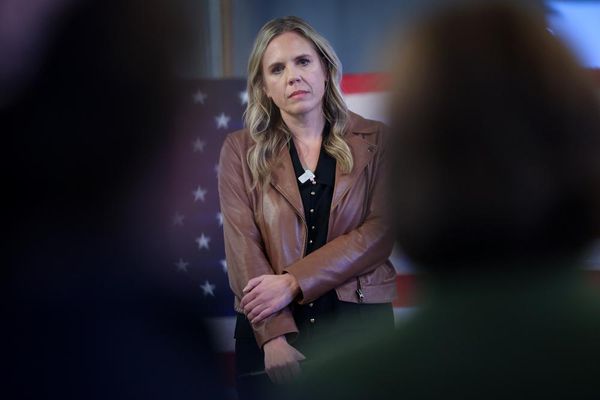
Colombian opposition senator Paloma Valencia delivers a speech a day after the inauguration of leftist Gustavo Petro as President in Bogota, on August 8, 2022. Gustavo Petro, the first left-wing president in Colombia's history, was sworn in on Sunday in front of hundreds of thousands of people in Bogota, calling on armed groups to sign peace and end the "war against drugs". (Credit: Photo by DANIEL MUNOZ / AFP) (Photo by DANIEL MUNOZ/AFP via Getty Images/AFP via Getty Images)

Cepeda, by contrast, is running on continuity — offering to sustain Petro's peace negotiations with guerrilla groups. His favorability of 51.1 percent among voters who know him is unusually high for a left-wing candidate in a country where President Petro's disapproval rating exceeded 50 percent for most of his term. Petro's late-term approval recovery — reaching 49 percent in the Invamer April poll — has provided the foundation for Cepeda's surge.

The election has become a referendum on the legacy of President Gustavo Petro and the future direction of the South American nation after four years marked by failed social reforms, diplomatic friction, fiscal pressures, and a deteriorating security situation.

Overseas Colombians: Voting Underway, Results on Sunday

For the 1.4 million Colombians registered to vote abroad — a figure that represents a 45.42 percent increase over the overseas electoral roll in the 2022 presidential election — voting began on Monday, May 25, and runs through Sunday, May 31. A total of 253 polling stations have been activated across diplomatic and consular posts in 67 countries, operating from 8:00 a.m. to 4:00 p.m. local time each day.

In keeping with Colombia's tradition of following the international date line, New Zealand was the first country in the world to open its polling station — a consular post in Auckland — on what was already Monday morning there when it was still Sunday afternoon in Bogotá. Japan, China, and other nations across East Asia and Oceania followed in the hours after, their openings monitored live from the Palacio de San Carlos by Chancellor Rosa Villavicencio and National Electoral Council president Cristian Quiroz.

The United States and Spain account for more than half of all overseas registered voters: 454,262 Colombians are enrolled to vote in the U.S., and 307,996 in Spain. On election day itself, the number of polling tables abroad will expand to 2,181 to handle the final surge of in-person voters.

All ballots — whether cast Monday through Saturday or on election day itself — are counted together and announced simultaneously once the May 31 polling closes nationwide. There are no early or partial overseas results prior to that moment. Voters abroad use the same cédula de ciudadanía — either the yellow hologram version or the digital card on a mobile device — as their only valid voting document.

Chancellor Villavicencio framed the moment in terms that captured both the scale and the gravity of the process: "Voting is not just a right — it is a duty, a responsible exercise of trust."

With the first round now hours away, the question that remains is whether Plan Democracia 2026 can deliver what Colombia's constitution promises but its geography and history have so often complicated: a free, safe, and accepted vote. The answer will come Sunday night.

This is a follow-up to "Violence Escalates in Colombia as Presidential Election Nears," published May 18, 2026. If no candidate clears 50 percent plus one vote on May 31, a second-round runoff will be held on June 21, 2026.

Sign up to read this article
Read news from 100's of titles, curated specifically for you.

Already a member? Sign in here
Related Stories
Top stories on inkl right now
One subscription that gives you access to news from hundreds of sites
Already a member? Sign in here
Our Picks
Fourteen days free
Download the app
One app. One membership.
100+ trusted global sources.