
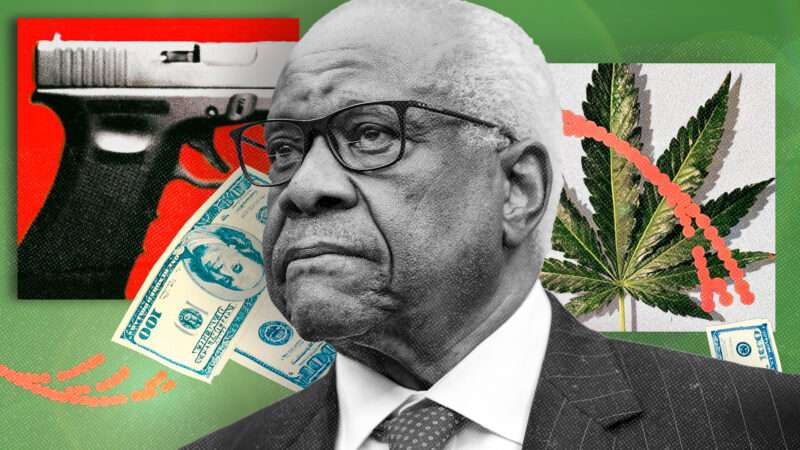
Last week in United States v. Hemani, the Supreme Court unanimously ruled that the government may not strip people of their Second Amendment rights or prosecute them for illegal gun possession simply because they are marijuana users. Justice Clarence Thomas, the longest-serving current member of the Court, joined his colleagues in upholding the Second Amendment rights of cannabis consumers threatened with prosecution under 18 USC 922(g)(3), which makes it a felony for an "unlawful user" of "any controlled substance" to possess a firearm. But Thomas perceived another constitutional problem with that law, arguing that it exceeds the federal government's power to regulate interstate commerce.
As Reason's Damon Root notes, Thomas' understanding of the Commerce Clause underlies a "lonely crusade" that he has been waging for decades. But the fact that Thomas has not mustered much support for his position from his colleagues does not mean he is wrong. To the contrary, it is hard to deny that laws like Section 922(g)(3), which applies to gun possession "in or affecting commerce," rely on a highly elastic interpretation of the Commerce Clause that converts it into a license for nearly anything Congress wants to do.










