New Delhi, By Monday evening, the protest site at Jantar Mantar had been wiped clean - the stage dismantled, tents cleared and shoes scattered across the road - hours after police baton-charged protesters marching towards Parliament.
The road leading to the Jantar Mantar protest site was closed from both sides. The stage from where activist Sonam Wangchuk had addressed supporters and observed a hunger strike was gone. So were the black tarpaulins, student camps, tents, banners, posters, carpets, and mattresses that had marked the site of the Cockroach Janata Party's (CJP) month-long protest.

ALSO READ | Rahul Gandhi backs CJP protesters, calls Modi 'most anti-youth' PM over exam paper leaks
The only people left at the site were workers clearing the area, police, and paramilitary personnel, and police vehicles stood nearby.
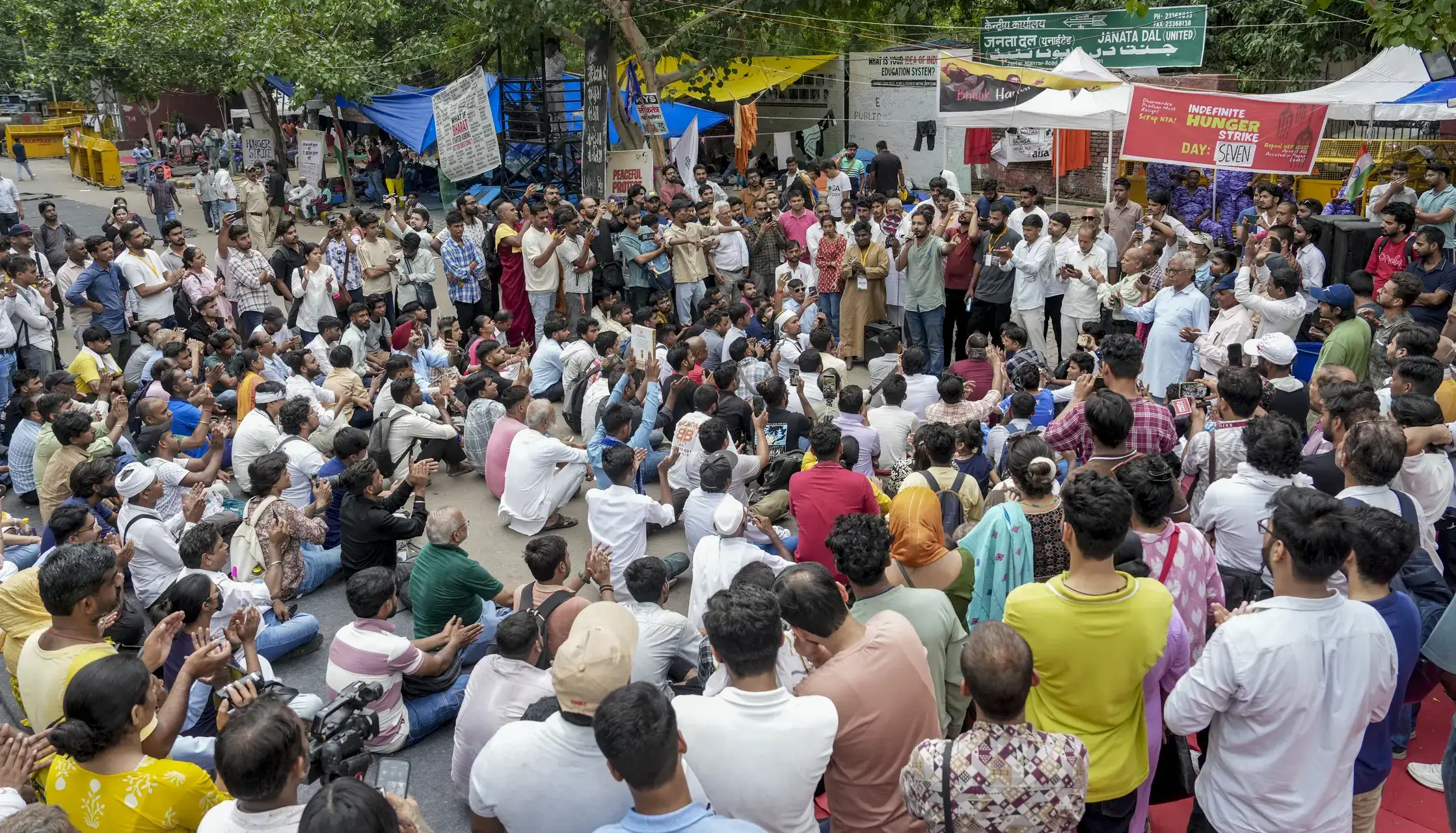
Nearly 200 metres from the protest site, however, over 1,000 protesters remained on the road.
With the stage gone, they gathered on the road and addressed each other through loudspeakers fitted to a tempo. Some stood on top of the vehicle while others raised slogans around it.
ALSO READ | Shabana Azmi joins CJP protest march, backs peaceful demonstration
CJP volunteers said they would rebuild the stage, even as police told the protesters that they could not hold demonstrations anywhere except Jantar Mantar under Section 163 of the Bharatiya Nagarik Suraksha Sanhita.
The day's events, however, had left the protesters divided.
Some were disappointed that the mobilisation had not led to the resignation of Union Education Minister Dharmendra Pradhan, a demand around which the protest had been built. Others, nursing injuries from the police action, said the baton charge and the dismantling of the protest site had only strengthened their resolve to continue.
"We had come here for the resignation of Pradhan, but nothing happened. So many of us were hit with lathis," said Anushka, 25, who had a bandage on her arm.
The police action during the march towards Parliament was the dominant subject among the protesters, who said that they were repeatedly misled as routes were opened and closed before they were confronted with multiple layers of barricades.
"They hit people on their heads and hands. Children were lying on the ground, and they kept hitting them," said 55-year-old Helen, a protester.
Protesters claimed that three to four people suffered fractures and several others sustained bruises.
Manu Singh, a CJP volunteer from Noida, claimed that she suffered a fracture in her foot and bruises on her arm.
Some protesters also said that they were held inside metro stations for nearly 20 minutes after being unable to leave the area because the stations were jam-packed.
The protesters further said that authorities had stopped water supplies to the area and that they were not being allowed to bring water into the protest site. Young volunteers ran to fetch water, which was then shared among those gathered.
"Some children would run and get water, and everyone would have a sip from it," a protester said.
Protesters also said that internet jammers had been installed in the area, cutting off communication and access to information during the protest.
Despite the day's setbacks, some protesters said abandoning the agitation now would mean losing the ground they had gained over the past month.
"If we give up now, it's back to square one. This is the strongest we've been in so long," a protester said.
Another said the protest could rebuild its physical infrastructure but not easily restore the morale of those who had been injured.
"A stage can be built and recreated. What will be difficult to recreate is the morale of the people who have lost it," the protester said.
The protesters also said that speakers were stopped while addressing the gathering and microphones were broken during the day's events.
The CJP had first organised a one-day protest at Jantar Mantar on June 6 before launching a sit-in on June 20, which continued till July 20.
Earlier in the day, thousands of protesters assembled near Parliament Street and attempted to march towards Parliament, demanding accountability over alleged examination irregularities and the resignation of the education minister. Security personnel stopped the march, leading to clashes and a baton charge to disperse the crowd.
The CJP had earlier said one of its key demands had been addressed after a delegation held talks with Union Minister J P Nadda. However, protesters said the agitation would continue until Pradhan resigned.