
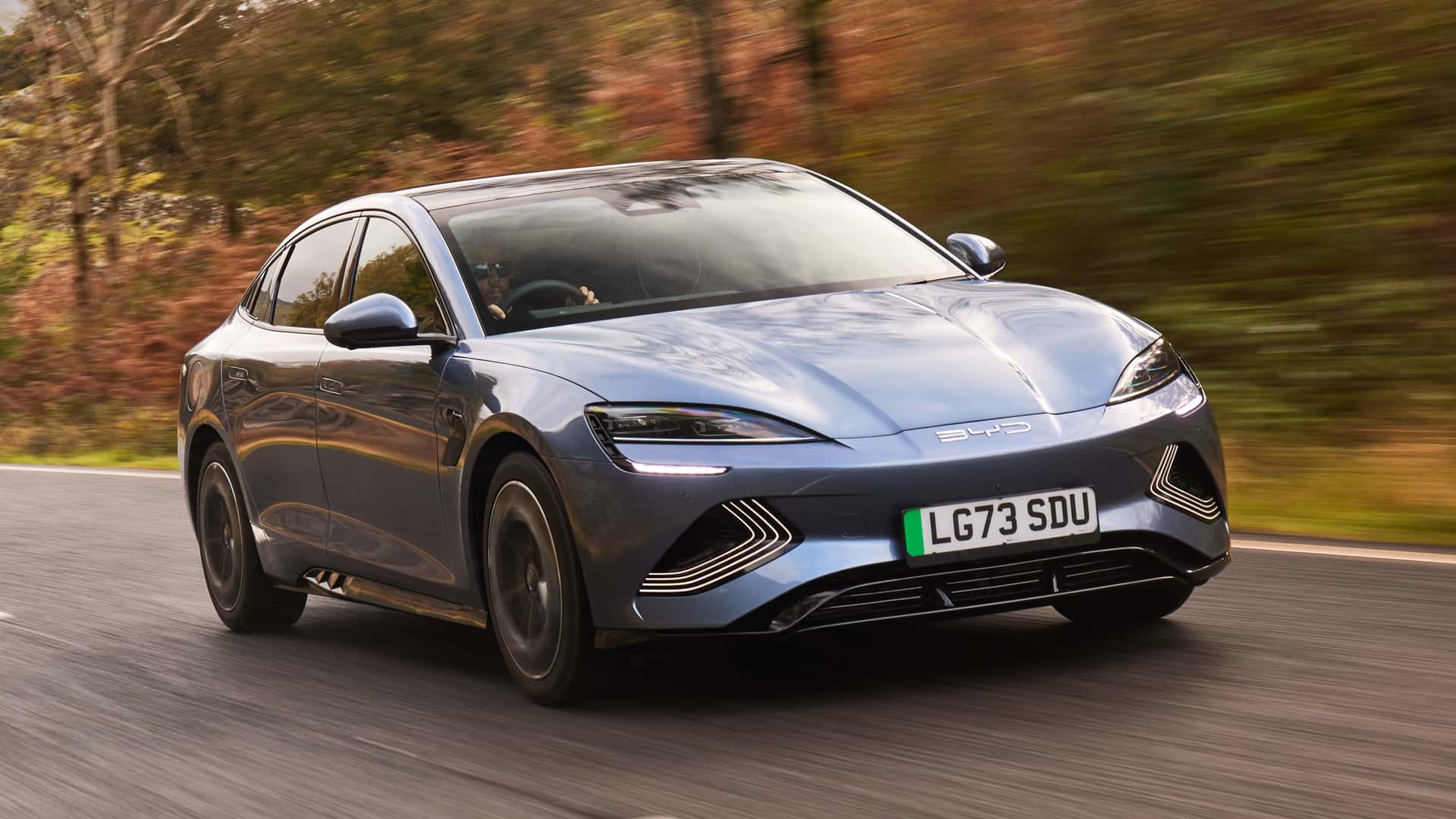
- BYD registered 234,099 cars in Europe through August, just 10,839 behind Ford.
- The Chinese automaker's registrations surged 144.1% year over year, while the Blue Oval's fell by 14.4%.
- SAIC isn't far behind either, with 230,290 registrations through August, just 14,648 fewer than Ford.
Chinese automakers aren’t coming to Europe; they’ve already arrived. Data published today by the European Automobile Manufacturers' Association (ACEA) shows BYD is breathing down Ford’s neck on the continent. Registrations of cars made by Build Your Dreams (yes, that’s what BYD stands for) surged by 144.1 percent in the first eight months of the year, reaching a record 234,099 units. Meanwhile, the Blue Oval continues its free fall, dropping 14.4 percent to 244,938 through August.

Yes, BYD is only 10,839 vehicles behind Ford, and if the trend continues, we won’t be too surprised if the two switch positions on the leaderboard even before the end of the year. BYD’s market share in Europe is now at 2.5 percent, compared to 1.1 percent in the January-August 2025 period. This shouldn't come as a huge surprise, though. BYD has been doing the exact opposite of what Ford has done in Europe: expanding its lineup at a rapid pace.
Ford, meanwhile, has spent the past few years shrinking its traditional European lineup. The Ka, Fiesta, Focus, and Mondeo have all been axed, leaving the Blue Oval with fewer mainstream nameplates to work with. CEO Jim Farley once said these cars "were loved by a lot of customers" but not profitable enough to warrant new investments. Additionally, surviving models such as the Puma and Kuga are getting long in the tooth, having been around since 2019.
Ford Aims To Bounce Back In Europe
But Ford has a plan to fight back by teaming up with Renault for a series of electric vehicles. The French company will build these cars, possibly including a Fiesta revival based on the Renault 5 and a small crossover related to the Renault 4. These won’t be just rebadged models, as Ford has pledged to give them its own designs and make some tweaks underneath the skin, too.
The two models are part of a five-car lineup of “rally-bred vehicles tailored to Europe” coming by the end of the decade. The remaining three models will be a Euro-specific Bronco and two multi-energy crossovers, possibly replacements for the Puma and Kuga. Meanwhile, the future of the Volkswagen-based Explorer and Capri EVs remains uncertain.
BYD Isn't The Only Threat
But BYD isn’t the only Chinese automaker getting dangerously close to Ford in Europe. MG owner SAIC isn’t far behind, with 230,290 registrations through August, or 19.7 percent more than in the first eight months of last year. Geely has already overtaken Ford, with 289,128 registrations, rising 11.6 percent year over year. However, it’s not an apples-to-apples comparison since the numbers include all Geely Group brands, such as Volvo, Polestar, Lotus, and others.
Yet another Chinese conglomerate is rising fast in Europe. Chery, including the Jaecoo, Jetour, and Omoda brands, is up 279.7 percent through August, reaching 207,871 registrations.
If we do the math, Geely, BYD, SAIC, and Chery now have a 10.4 percent market share in Europe. That's right: one in 10 cars registered in Europe now has a Chinese connection. We should mention that by Europe, ACEA means all 27 EU member states, Iceland, Liechtenstein, Norway, Switzerland, and the UK. While it’s not the entire continent, the numbers accurately reflect the broader trend since they take into account all the major markets.
Motor1's Take: While the possibility of BYD overtaking Ford in Europe would've sounded pretty wild not too long ago, the writing has been on the wall. One company has been adding models and expanding its reach, while the other has been cutting back its lineup. The latest registration figures simply show how quickly that gap in strategy is translating into actual sales.
And this goes well beyond BYD. Other Chinese automakers are no longer a curiosity on European sales charts; they’re becoming a meaningful part of the market. Established automakers are facing a competitive force that is getting harder to ignore. Whether that momentum continues will depend on everything from pricing and product launches to tariffs and how European buyers respond to these increasingly familiar Chinese brands.