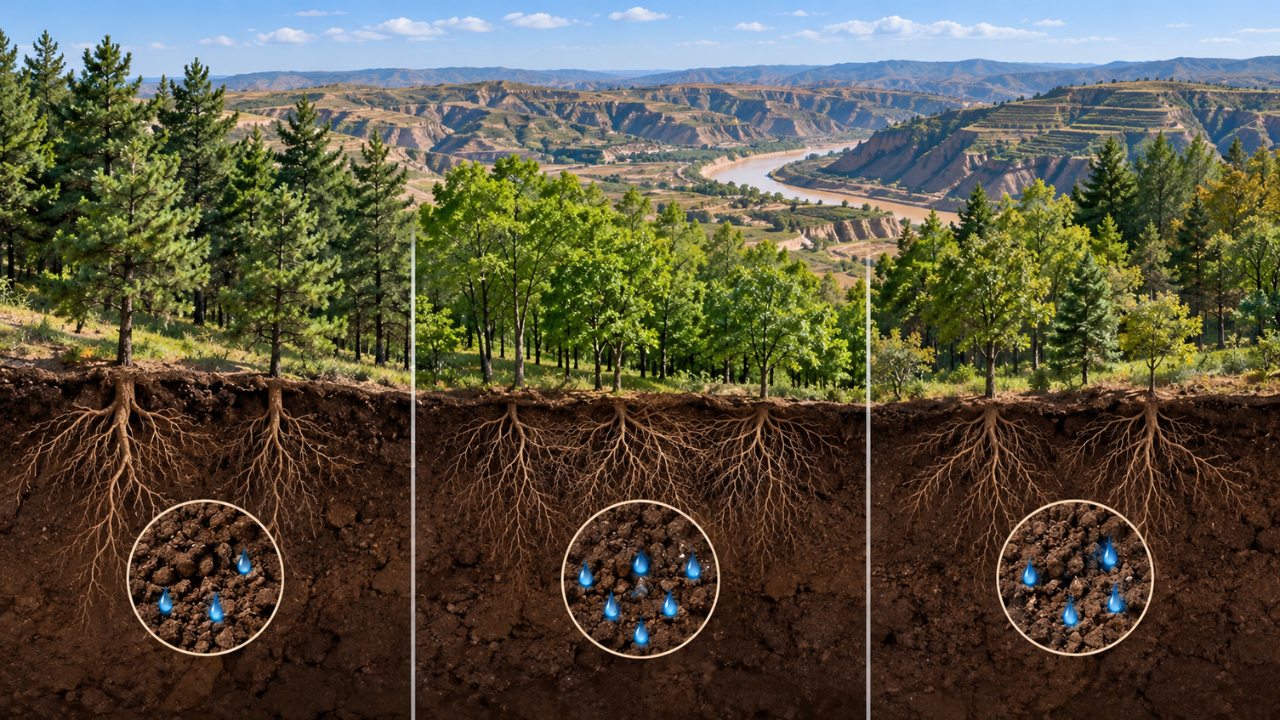
China’s long-running effort to restore the degraded Loess Plateau has revealed a difference between forests planted by people and those allowed to regenerate naturally. Researchers spent 18 years monitoring four forest types in the region, comparing plantations of Pinus tabuliformis, Platycladus orientalis and Robinia pseudoacacia with a natural secondary forest. The results showed that the natural forest had 8% higher soil moisture than the planted forests, while recording greater macroporosity and stronger water movement through the soil. Its soil held more water after rainfall, with average soil water storage reaching around 6 mm, compared with 3–4 mm in the planted forests. Over the 2006–2024 monitoring period, the natural forest consistently maintained higher soil water content, while Robinia pseudoacacia and Platycladus orientalis showed declining moisture trends. The researchers also found that natural forest soils had lower bulk density and higher levels of soil organic carbon and total nitrogen.
Get breaking news anytime, anywhere. Download the TOI app now!