Get all your news in one place.
100's of premium titles.
One app.
Start reading
The Conversation
The Conversation
Sun-Min Yu, Postdoctoral Research Fellow in Polymer Science and Engineering, UMass Amherst

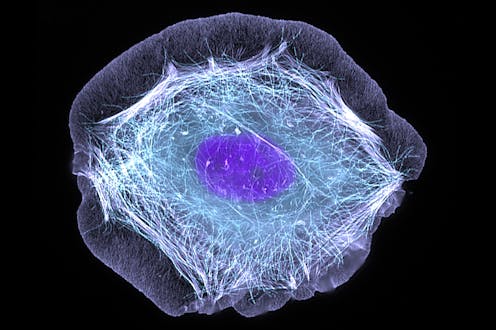
Cells lining your skin and organs can generate electricity when injured − potentially opening new doors to treating wounds

Your skin cells can generate electricity when wounded. Torsten Wittmann, University of California, San Francisco/NIH via Flickr, CC BY-NC

Your cells constantly generate and conduct electricity that runs through your body to perform various functions. One such example of this bioelectricity is the nerve signals that power thoughts in your brain. Others include the cardiac signals that control the beating of your heart, along with other signals that tell your muscles to contract.

As bioengineers, we became interested in the epithelial cells that make up human skin and the outer layer of people’s intestinal tissues. These cells aren’t known to be able to generate bioelectricity. Textbooks state that they primarily act as a barrier against pathogens and poisons; epithelial cells are thought to do their jobs passively, like how plastic wrapping protects food against spoilage.

Sign up to read this article
Read news from 100's of titles, curated specifically for you.
Already a member? Sign in here
Related Stories
Top stories on inkl right now
One subscription that gives you access to news from hundreds of sites
Already a member? Sign in here
Our Picks
Fourteen days free
Download the app
One app. One membership.
100+ trusted global sources.