Get all your news in one place.
100's of premium titles.
One app.
Start reading
Euronews
Euronews
Maria Muñoz Morillo

Casa de México in Madrid unveils 2026 Day of the Dead altar inspired by Michoacán and Agustín Lara

The Casa de México in Spain Foundation is unveiling the ninth edition of its Day of the Dead altar, the institution's most visited exhibition of the year. Under the title "Viva la vida!", the 2026 installation has been designed by Mexican artist Beatriz Redo and pays homage to composer Agustín Lara, with a set design inspired by the cemeteries and mountains of Michoacán.

The set recreates a mountain cemetery in Michoacán on the night of Day of the Dead, when, according to tradition, families gather to symbolically reunite with their deceased loved ones.

Beatriz Redo, the designer of this year's installation, explains that she wanted to pay tribute to the monarch butterfly, one of the region's great symbols: "Michoacán is an area of Mexico that receives the migration of the monarch butterfly, a massive migration that comes from Canada and coincides with the days at the end of October and the beginning of November. Tradition also links it to Day of the Dead," she notes.

Among the Purépecha and Mazahua communities of Michoacán, the arrival of these insects in the region's forests is interpreted as the return of the souls of the departed.

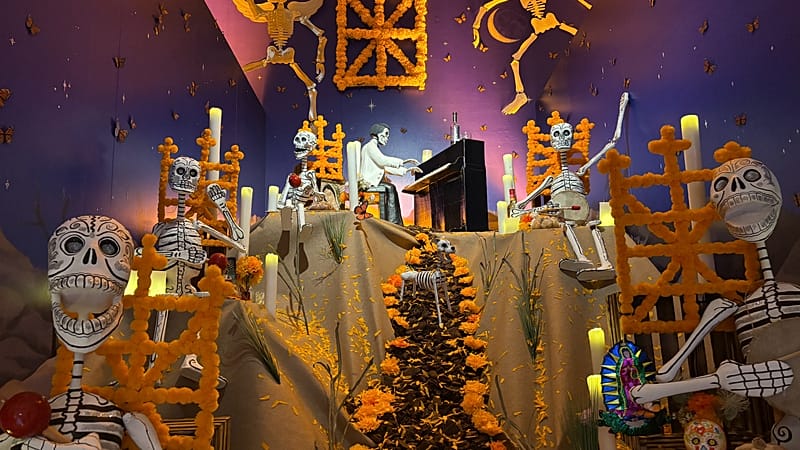
Image of the 2026 Day of the Dead altar at Casa de México in Madrid, with Agustín Lara in the background. (María Muñoz Morillo)

Agustín Lara, the musical protagonist of the tour and a great lover of Madrid

The altar is dedicated to Mexican singer and composer Agustín Lara (1897–1970), who was married to film star María Félix. Lara, known as 'El Flaco de Oro', was a prolific composer and author of classics such as 'Granada', 'Solamente una vez', 'María Bonita' and the emblematic chotis 'Madrid', which reflects his close relationship with Spain.

The artist is depicted at the top of the altar as a papier-mâché skull next to his piano, created by artisans Raimundo Amezcua and Marta Linares. New this edition, the entire tour will be accompanied by his most emblematic songs, something unprecedented in this exhibition and which will guide visitors on a visual and sonic journey through one of the most colourful traditions in the world.

Image of part of Casa de México's 2026 Day of the Dead exhibition with 'skeleton' mermaids made from embossed tin. (María Muñoz Morillo)

Papel picado, a tradition rich in symbolism, and an altar for pets

One of the most representative craft elements on the tour is papel picado, a traditional technique created with hammer and chisel that is also used for patron-saint festivities and birthday parties.

Its role on Day of the Dead goes beyond decoration: "When it is hung up and begins to move, it represents the moment when the souls arrive at the altar to consume everything we have placed in the offering for the deceased," explains Citlali Pérez from Casa de México's Communications Department.

In addition to the main altar, the experience includes a tour with pieces of Mexican folk art and other complementary altars. New for 2026, an altar dedicated to pets has been added to remember the animals that bring so much companionship and happiness to households. On the second floor, visitors can also leave a message for their deceased loved ones; once Casa de México removes the exhibition, these messages are burned in a ceremony.

Image of the altar dedicated to pets for the 2026 Day of the Dead at Casa de México (Madrid). (María Muñoz Morillo)

Beyond Casa de México: altars in Madrid and Santander

The foundation is extending the celebration beyond its headquarters on Calle Alberto Aguilera. In collaboration with Madrid City Council, three other altars will be open to visitors from 23 October to 2 November at:

- CentroCentro, designed by Guillermo González

- La Montaña de los Gatos, in El Retiro park, designed by Fer Ferez

- Arganzuela Greenhouse, designed by the studio Señoritos Creativos

The newly opened Faro Santander cultural centre will also host an altar designed by set designer Cristina Faesler, in collaboration with Casa de México.

A heritage recognised by Unesco

The Day of the Dead celebration in Mexico was declared Intangible Cultural Heritage of Humanity by Unesco on 7 November 2003.

Of pre-Hispanic origin, the tradition understands death as the beginning of a journey to Mictlán and sees the altar not as a reason for sorrow, but as a celebration of memory and the bond between generations, through photographs, candles, cempasúchil flowers and objects that were meaningful to the deceased.

An artisan catrina in the Casa de México (Madrid) exhibitions for the 2026 Day of the Dead. (María Muñoz Morillo.)
Image of a painting made from bone that tells the history of Mexico for the 2026 Day of the Dead at Casa de México (Madrid). (María Muñoz Morillo)

Dates, opening hours and free entry to the 2026 Day of the Dead altar

The altar can be visited from 2 October to 8 November, Monday to Sunday, including the public holidays on 12 October and 2 November. Admission is free.

Monday: 10:00 – 18:45

Tuesday to Friday: 10:00 – 13:45

Saturday and Sunday: 10:00 – 12:30

Guided visit (around 20 minutes, covering the building's three floors): Tuesday to Friday from 14:00 to 20:30, Saturdays from 13:00 to 20:30 and Sundays from 13:00 to 18:30.

Access without a booking is via a queue and is subject to capacity; for the guided visit with booking, you must subscribe to Casa de México's newsletter at casademexico.es.

This text was translated with the help of artificial intelligence. Report a problem : [[email protected]].

Sign up to read this article
Read news from 100's of titles, curated specifically for you.
Already a member? Sign in here
Related Stories
Top stories on inkl right now
One subscription that gives you access to news from hundreds of sites
Already a member? Sign in here
Our Picks
Fourteen days free
Download the app
One app. One membership.
100+ trusted global sources.