
Streaming amplifiers make a lot of sense – they are solutions for people who want convenience but don’t want to sacrifice audio quality.
Historically, Cambridge Audio’s Evo line has provided just that – and it now has a new addition in the shape of the range-topping Evo 300.

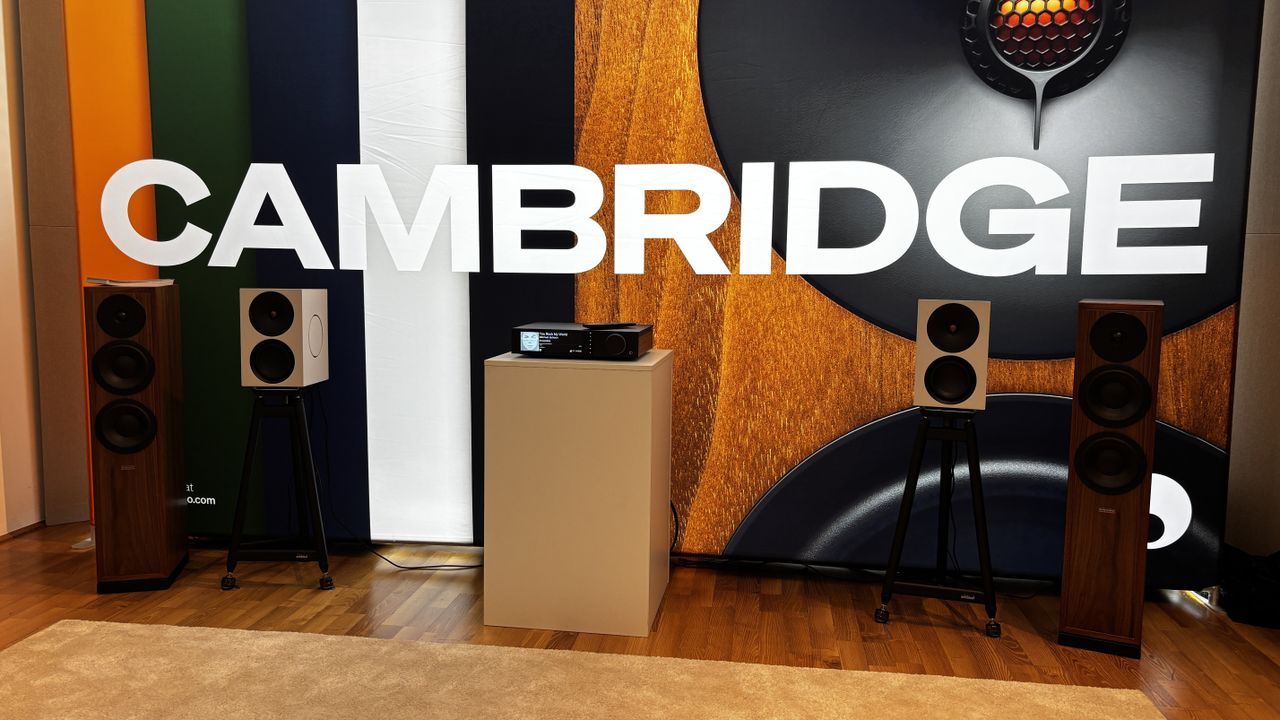
We headed into Cambridge Audio’s demonstration room at High End Vienna 2026 to see and hear it in action.
Price
The Evo 300 costs £3499/€3999/$3999 which places it slightly above our current favourite around that price, the Award-winning Arcam SA35. The Arcam costs £2999 / $3300 / AU$6495 and launched back in May 2024.
To give you some extra context, the Cambridge Audio Evo 75 and Evo 150 launched in 2021 for £1799 / $2250 / AU$3299 and £2249 / $3000 / AU$4299, respectively, while the Evo 150 SE arrived in 2025 with a price tag of £1999 / $3299 / AU$5795.
Design and build
If you’re familiar with any of the previous Evo models, you’ll know what to expect from the Evo 300. And the fact that it takes after its sibling’s is a good thing.
Like the rest of the Evo family that has come before, the new model is a good-looking piece of kit with styling that should look at home in a wide range of listening environments.
It has a premium-looking and feeling black aluminium cabinet which boasts Evo’s party piece – interchangeable side panels. You get two options: a real wood veneer or a black slatted option, should you want a traditional or more modern aesthetic.
On the front of the amp is a 7.8-inch display – the largest Cambridge Audio has used to date. And it seems just as crisp and punchy as the screens we have seen on older Evo products.
Album artwork looks good, and it’s also easy to read, whether you’re looking at track information, changing volume or switching inputs. This is good to see – it isn’t always a given on products of this type.
As with previous Evos, a small strip of buttons runs down the right side of the screen, and at the far right side of the fascia is the volume dial/control wheel combination.
You do get a slender remote control with the Evo 300, although you’re more likely to use Cambridge Audio’s intuitive StreamMagic app for the majority of your interactions.
Features
As the model name implies, the power output of the Evo is 300W per channel. This is provided by Hypex NCOREx power modules.
Under the aluminium chassis, you’ll find a dual-mono layout, a balanced pre-amplifier stage and an ESS Sabre ES9038Q2M DAC, which supports up to 32-bit/768kHz PCM and DSD512.
Streaming comes courtesy of Cambridge Audio’s excellent StreamMagic platform, which provides support for Spotify Connect, TIDAL Connect, Amazon Music, Deezer, Qobuz Connect, Roon Ready, UPnP and Internet Radio. The amp also supports Bluetooth 5.4 (including aptX HD), AirPlay 2 and is Roon Ready.
Around the back of the unit, there are two sets of speaker terminals, RCA and balanced XLR inputs, HDMI eARC connectivity, and a built-in moving-magnet phono stage for a compatible turntable.
You also get an adjustable subwoofer output and an optional high-pass filter for the main speakers.
Sound
All the hi-fi show listening caveats apply here in terms of room design, layout and impact of external noise. In a room full of keen journalists jostling for position, it’s tricky to get the complete picture of a product.
Still, we were treated to a few tracks on the Evo 300 – partnered with a pair of £8000 Dynaudio Contour Legacy floorstanders – to give us a flavour.
We kick things off with a blast of Inertia Creeps by Massive Attack, and there seems to be plenty of power behind the drum thwacks.
The overall delivery appears focused and precise with a good amount of insight. Edges of notes seem well-defined with a good amount of texture.
Switching to Foo Fighters’ Stranger Things Have Happened, and there seems to be good separation in the stereo image with space around both the guitar and Dave Grohl’s vocal.
It’s an open, expansive image, and the guitar strums sound nicely defined with a good amount of weight behind them.
As the intensity of the guitar play and the vocal pick up during the course of the track, the amplifier seems to follow suit.
Initial verdict
A post shared by What Hi-Fi? (@whathifiuk)
A photo posted by on
In terms of build, design and features, it certainly looks as though the Cambridge Audio Evo 300 ticks a lot of boxes.
And, although we aren’t too familiar with the speakers used by Cambridge Audio in the demo, what we hear in our brief time with the streaming amplifier is more than enough to make us keen to get one into our test rooms for a closer listen.
The streaming amplifiers category is growing in size all the time, so it will be interesting to see if Cambridge Audio can set the benchmark for performance at the price.
MORE:
High End Vienna 2026: all the news and what to expect from Europe's biggest hi-fi show
Our pick of the best hi-fi systems for all budgets