
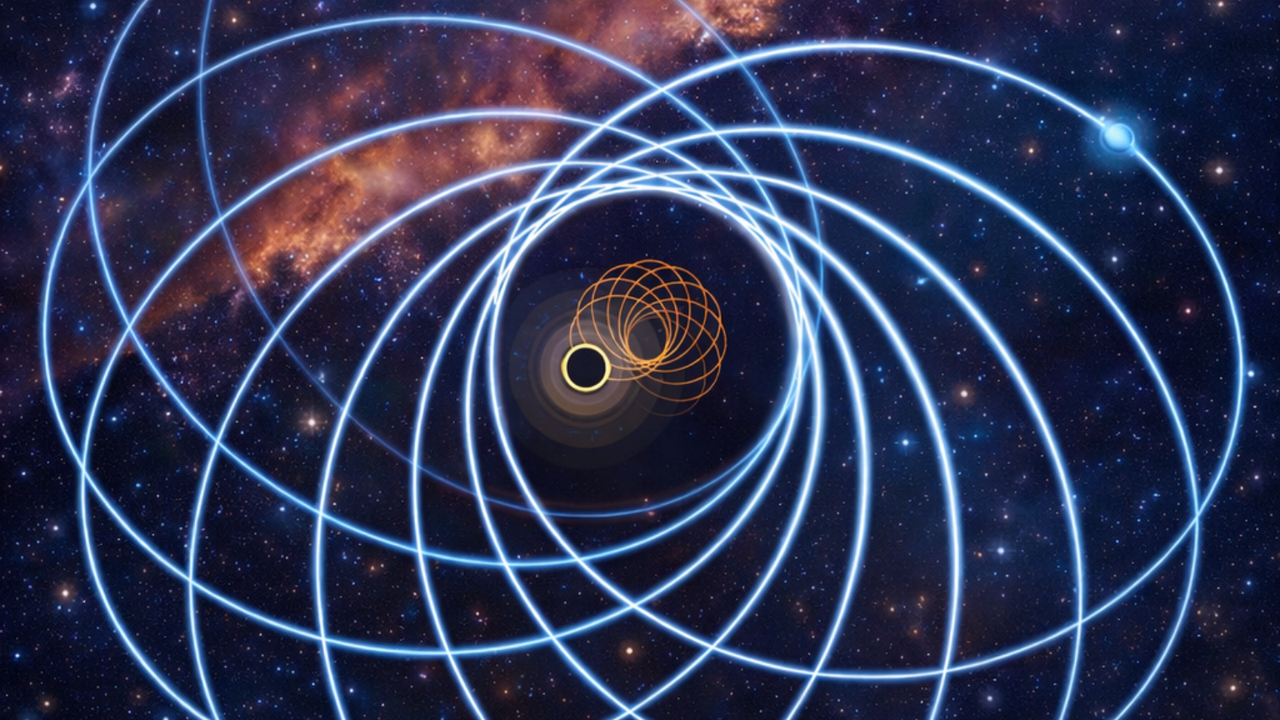
Scientists have discovered that before black holes collide with neutron stars and merge, these extreme stellar remnants can swirl around each other in oval orbits rather than in circular orbits. The revelation demonstrates another way in which black holes and neutron stars push the laws of physics, and casts doubt on assumptions regarding the formation and evolution of these mixed binary systems.
A team of scientists challenged assumptions that black holes and neutron stars approach each other in circular orbits when they studied ripples in spacetime, or gravitational waves, that rang out from just such a "mixed merger." The signal from this merger, dubbed GW200105, was detected by the gravitational wave detectors Laser Interferometer Gravitational-wave Observatory (LIGO) and Virgo. The merger occurred around 910 million light-years away, resulting in the creation of a daughter black hole with around 13 times the mass of the sun.








