
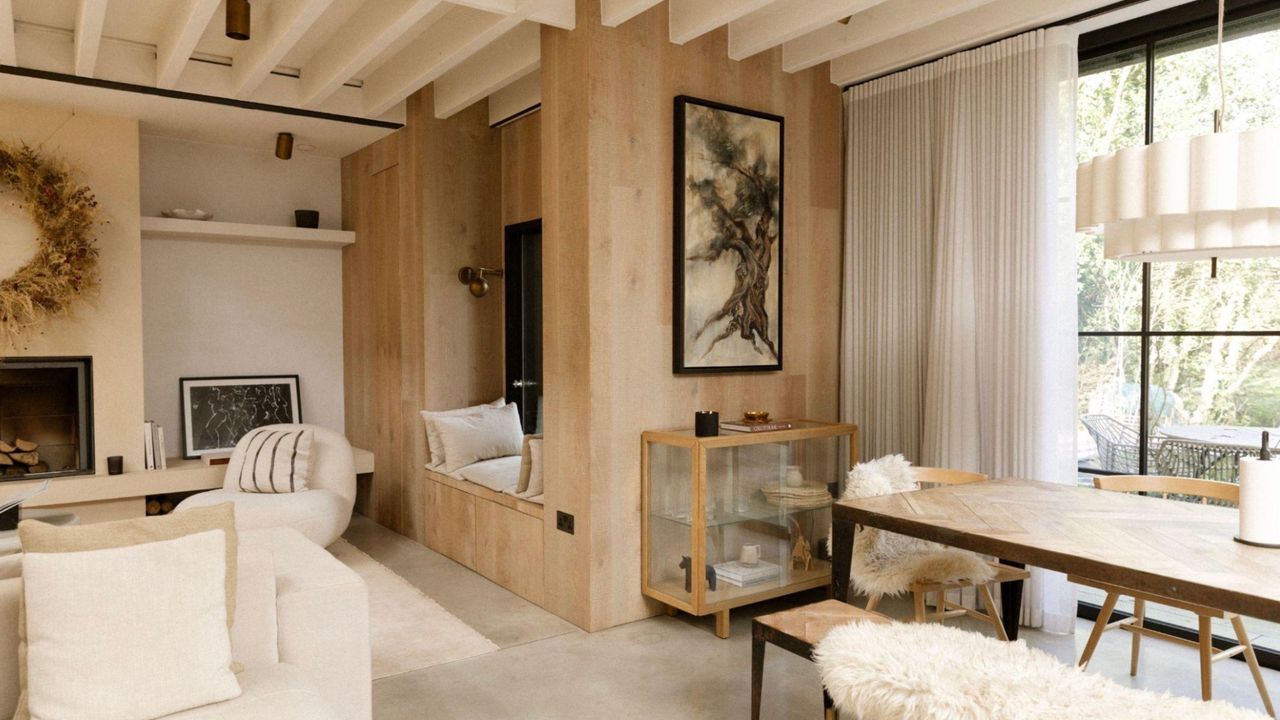
From calming neutral palettes to artfully placed indoor plants, today’s interiors are saturated with the language of wellbeing. Homes are sold as sanctuaries. Offices promise restoration. Hotels advertise sleep-enhancing design. And yet, somewhere between the earthy beige linen curtains and the strategically placed faux fern, you’re left feeling… slightly flat.
Because not all 'wellness' spaces are created equal. Some are thoughtfully designed using biophilic design principles to support how we feel and function. Others are simply very good at looking like they do. Ever found yourself sitting in the car, doom-scrolling, just to delay stepping into your carefully curated home sanctuary? You’re not alone — and there’s a reason why.

This is the paradox of wellness washing: when design borrows the look of health and harmony without delivering the substance. And it’s something worth learning to spot — ideally before investing in a £3,000 “wellness sofa” that is, in fact, just… a green sofa.
Why 'Wellness Interiors' Are Trending Right Now

The surge in wellness-led design is not without reason. In the wake of the pandemic, our relationship with our homes fundamentally shifted. Spaces became offices, gyms, classrooms, and refuges all at once. Naturally, we began asking more of them.
At the same time, social media distilled “wellness” into a highly recognizable aesthetic: soft lighting, pale woods, linen textures, indoor greenery, and the occasional yoga mat that may or may not ever be used.
Developers, brands, and designers have been quick to respond. Wellness sells… and sells well. It promises not just a beautiful home, but a better life within it. It's compelling, sure, if not slightly ambitious for a well-placed houseplant.
But while the intention may be rooted in genuine demand, the execution often falls short.
What is "Wellness Washing"?

Much like greenwashing in sustainable interior design, wellness washing occurs when well-being is used as a label rather than a measurable outcome.
A space might look serene, natural, or restorative. It might include all the expected visual cues: timber finishes, neutral tones, and a few trailing plants doing their best. But if it doesn’t actually support better air quality, natural light, comfort, or sensory balance, then its impact is superficial at best.
In other words, it’s the difference between a room that photographs beautifully and one you actually want to spend time in.
True biophilic design — the concept often referenced in these conversations — is grounded in research around our connection to nature. It considers light, airflow, acoustics, materiality, and spatial experience as an integrated system. Wellness washing strips that complexity away, reducing it to a mood board.
As Reena Simon, creative director and founder of The Intentional Home™, explains: “Wellness-washing works because it mimics a genuine human need: the desire to feel at ease at home. But neither a cold plunge tub nor a paint palette can manufacture calm and wellness on its own.”
Reena has built a framework to help people achieve a true feeling of wellness within the home. “My Intentional Home™ framework is built on six pillars: Scent, Light, Texture, Nature, Space, and Ritual," she explains. "Not a checklist, but a framework for designing homes that hold our rituals, not just our things. How light moves through your rooms. Whether the materials you live with feel honest and tactile. Whether a familiar scent signals safety when you walk through the door."
Her approach reframes the conversation entirely. "Every object, every layer, every ritual has the chance to either add noise or create calm," she says. "Tranquillity doesn't happen by accident. It is created intentionally through every sensorial choice you make."
The 'Wellness Washing' Flags to Look Out For
1. It Looks Natural but Feels Artificial
Surfaces mimic wood or stone but feel distinctly plastic. Plants are overly styled and perfectly arranged. The result feels more controlled than organic. Real environments are rarely that polished.
2. There's No Natural Light Strategy
A room can be drenched in pale tones and still feel oppressively dim. If windows are small, poorly positioned, or cluttered, no amount of organic beige will fix it. Natural light is one of the most powerful regulators of mood… and it’s surprisingly hard to fake.
3. Air Quality Isn't Considered
Behind the visual calm, the air may be doing very little at all. Poor ventilation, synthetic materials and stagnant airflow can leave a space feeling heavy — even if it smells like a spa thanks to a rotation of scented candles. If your “wellness” room feels better the moment you open a window (or leave it), that’s a clue.
4. It Prioritizes Aesthetics Over Comfort
Minimal interiors may look serene, but living in them can feel like an endurance test. If layouts are impractical or seating is sculptural but unsupportive, you won’t fully relax because, quite simply, the space isn’t supporting you (or your back).
5. It's Visual, Not Sensory
Wellness isn’t just something you see — it’s something you experience. If design decisions stop at the visual, the space will always feel incomplete. A room that looks calming but sounds harsh or feels cold will never quite settle the nervous system.
What Biophilic Design Really Is

Authentic biophilic design is less about appearance and more about experience — the kind you notice gradually rather than immediately. It’s the quiet clarity of natural light shifting throughout the day. The subtle movement of air through a space that never feels stale. Materials that feel reassuringly real under your hands, rather than suspiciously perfect.
This idea is echoed by furniture designer Tom Raffield, whose work is rooted in observing nature at its most subtle. “Biophilic design, at its best, isn’t a trend; it’s a response to something deeply human,” he says.
“The risk with wellness-washing is that it reduces nature to an aesthetic — but genuine biophilic design works on a sensory level that goes far deeper than the visual,” he adds.
For Tom, that connection begins at the very start of the design process.“Every design we make starts with observation. It’s rarely one dramatic moment, but a cumulative experience — light filtering through a canopy, the arc of a breaking wave, the way a branch bends under its own weight.”
“No two pieces are identical, just as nothing is in nature," Tom explains of his timber lighting designs. "That gentle unpredictability and warmth signal to the human nervous system that something real is present. That’s something no fast interior trend can replicate."
The designers at Tom Raffield are considerate of every detail. "We hand-form sustainably sourced wood into our iconic curving forms, allowing the natural grain to guide each piece's journey. It's a highly skilled process that requires patience and creativity," he adds. "That multi-sensory immersion is what we're trying to translate into the objects we make. For example, in our Drift Pendant, you'll find the barrel of a wave. In our Shoal Lighting collection, the fluid, layered forms are what you can see beneath the surface of the ocean."

Creating a genuinely supportive environment doesn’t require a complete home overhaul. Start with light. Maximize natural daylight (research 'daylighting') wherever possible and pay attention to how it moves through your space.
“Lighting is perhaps the most powerful tool in biophilic design because it shapes everything from mood, perception, even how a material feels to the eye,” reflects Tom Raffield.
The relationship between lighting and materiality plays an important role in how we feel, too. Choose materials with intention. Opt for fewer, higher-quality finishes that feel authentic, rather than layering imitations.
“We work exclusively with sustainably sourced hardwoods like oak, ash, and walnut, and the steam-bending process we use means every curve is unique," says Tom. "No two pieces are identical, just as nothing is in nature. That gentle unpredictability and warmth in a handcrafted form is what creates a genuinely nurturing environment. It signals to the human nervous system that something real and natural is present. That's something no fast interior trend can replicate."
Next, improve airflow. It’s so often the factor most overlooked and undervalued, as more often than not, it can not be seen. Open windows regularly and think about how air circulates. Plants can help — but they are not, despite their best efforts, a full HVAC system.
And finally, embrace imperfection. Nature is not symmetrical or overly controlled — and spaces that reflect that tend to feel far more comfortable.
Like the 'canary down the coal mine,' this wall decor helps you measure air quality in style. When the bird drops, it's time to open the windows.
Wellness washing isn’t just a harmless trend. As more people invest in spaces marketed around wellbeing, the gap between promise and reality becomes more noticeable — and more frustrating.
Poorly designed environments can affect sleep, concentration, and stress levels. When those environments are presented as beneficial, the disconnect isn’t just misleading; it can be counterproductive.
There’s also a broader consequence. As biophilic design is diluted into a style rather than respected as a discipline — a true spatial philosophy — its real value risks being lost somewhere between the botanical print and the scented candles.
For more, make sure you subscribe to Livingetc's newsletter.