
Get all your news in one place.
100's of premium titles.
One app.
Start reading
Ideal Home
Ideal Home
Molly Cleary

The 1-second trick that will make your stainless steel pans non-stick and easier to cook with – I learnt it from Le Creuset's expert home economist

A cooking class with Le Creuset's home economist .

Stainless steel pans are hot property right now, but cooking with them usually involves a period of adjustment to say the least.

That's because this material isn't inherently non-stick – instead, you need to cook with these pans in a specific way to mimic that kind of surface.

I've tried plenty of stainless steel products in my quest to find the best saucepans and frying pans out there, but it was at a recent cooking class with Le Creuset's chief home economist Alison Haigh that I understood more about how to prep them properly. Here's the quick trick she taught me, while using Le Creuset's version (£145), to get a stainless steel pan ready for use.

The mercury ball test

The first thing to know is: there's no actual mercury involved here (which is lucky, because it is, of course, highly toxic). You wouldn't want it anywhere near your cookware.

The mercury test is simply a quick exercise you can do with droplets of water in order to see if your pan is ready to act like a non-stick surface. It gets its name from the visual effect you're looking for – if your pan is ready at the ideal temperature, the water won't evaporate, it'll bead up like a ball of mercury would.

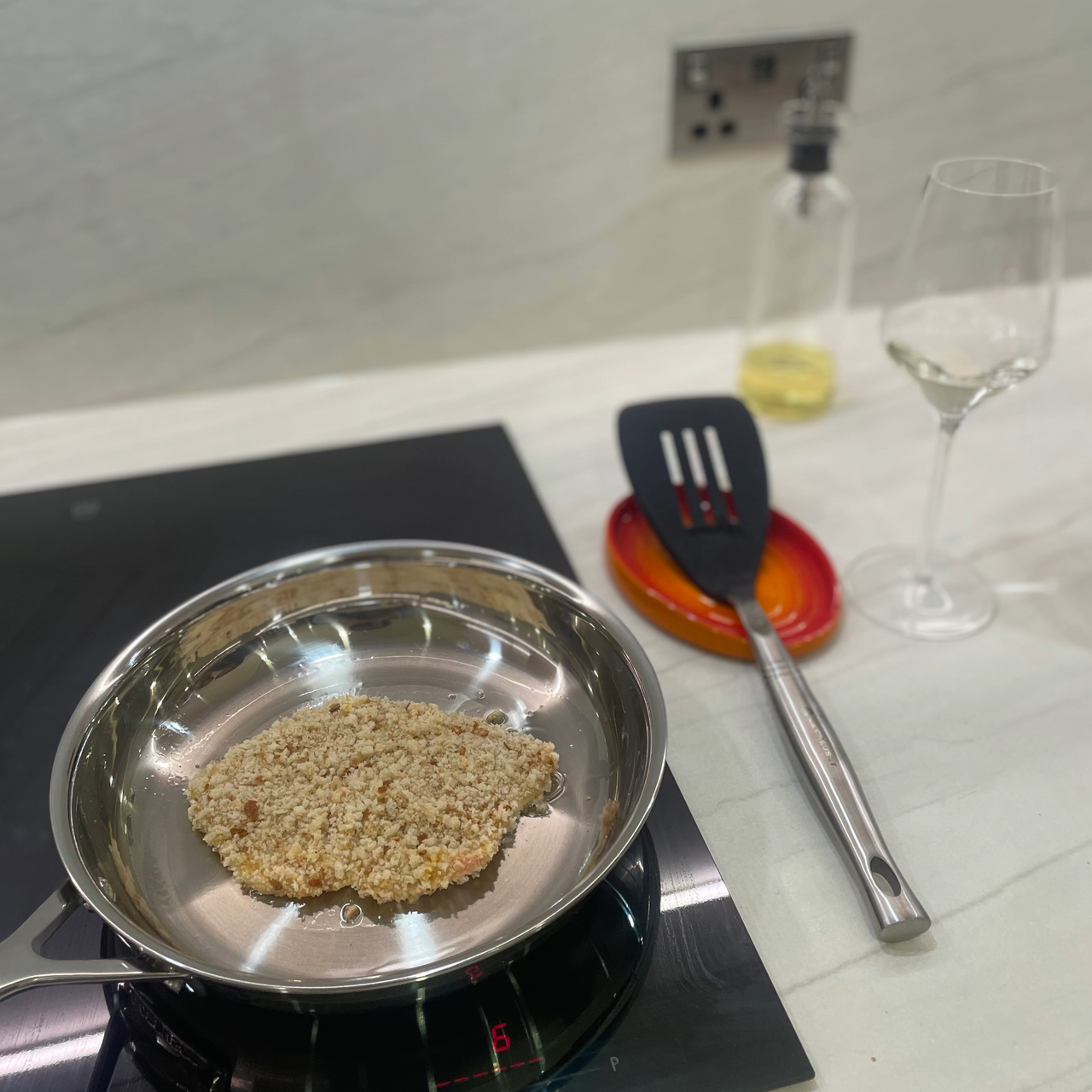
Once my pan was ready, I used it to fry this chicken schnitzel. (Image credit: Future)

The exact temperature you want the pan to reach before you start cooking is approximately 193°C. At this point, the 'pores' in a stainless steel pan (which has a naturally rough surface when cold, unlike a pan with a non-stick ceramic coating for example) close up. Now smooth, the surface is then covered with a micro-thin layer of steam.

That film of steam is what allows you to mimic a non-stick surface, preventing your food from sticking. So how do you achieve it?

In my cooking class, Le Creuset's home economist explained that you need to put your stainless steel pan on to the heat for two to three minutes to begin. It's essential that the pan is dry, free from all oil or fat at this point, in order for what you're about to do to have an effect.

(Image credit: Future)

After a few minutes, sprinkle a few droplets of water onto the pan's surface. If the water instantly evaporates, the pan is not hot enough yet.

If the water forms into visible beads that look as if they're dancing across the surface of the pan, it's perfect – you've completed The Mercury Test.

But Le Creuset's home economist Alison had more advice from here. Rather than adding oil at this point, which was essential for the schnitzel and fried egg I was cooking, turn the heat down slightly.

That might sound counter intuitive, given the time you just spent getting it to the perfect temperature, but it'll prevent your oil from burning in an instant. And then you're ready to begin cooking.

The finished meal in Le Creuset's stainless steel pan. (Image credit: Future)

We've been on a real stainless steel journey recently here at Ideal Home, with our expert reviewer Helen McCue trying lots of popular sets. Here's a round-up of her, and my favourites from the last few months.

So if you've tried and failed to switch over to cooking with stainless steel, then incorporating this quick test into your next try might just be the thing that helps. Seeing as it only involves water, I reckon it's definitely worth a try.

Sign up to read this article
Read news from 100's of titles, curated specifically for you.
Already a member? Sign in here
Related Stories
Top stories on inkl right now
Our Picks
Fourteen days free
Download the app
One app. One membership.
100+ trusted global sources.







