Every EV owner has grown painfully aware of factors that take a bite out of driving range: Bone-chilling cold and bun-warming cabins. Hauling heavy loads, or rocking at 80 mph in the fast lane.
Fewer electric fans are aware of the latest, greatest energy suck. Autonomous and semi-autonomous driving systems demand surprising amounts of electricity to collect and transmit data, train AIs, and run ever-more-powerful computers and sensor suites. In fact, taken to their logical endgame—in which every showroom car or taxi could drive itself—autonomous cars might hoover up more energy than all the world’s data centers consumed in 2023, according to an MIT study from that year.
With fewer than 7,000 self-driving taxis operating in the U.S. and China, we’re decades away from such scenarios. Yet companies like Uber, whose CEO Dara Khosrowshahi has salivated over a “trillion-dollar-plus” market opportunity, are expected to put 700,000 to 3 million robotaxis on the world’s roads by 2035.
For those models, "autonomy directly impacts your range and miles-per-charge, and also how often you have to recharge," Kay Stepper, Lucid Motors’ vice-president of ADAS and autonomous driving, told me. “We’re seeing an exponential increase in memory and compute demands.”

Even the most Adderall-abusing human cabbie requires some shuteye. But robotaxi operators envision AI workhorses trolling for fares nearly around-the-clock. Every minute wasted on charging or driving to a station is a minute with no paying customers.
“As an asset, a robotaxi has the ability to be operated even 23 hours a day, with maybe an hour for DC charging, maintenance and cleaning,” Stepper says.
Lucid and Rivian, two key Uber partners, are among automakers vying to bring Level 4 autonomy to both robotaxis and consumer-owned cars. In April, Uber boosted total investment in Lucid to $500 million. It committed to purchasing at least 35,000 Gravity SUVs and future midsize models for taxi services in dozens of cities, beginning in San Francisco later this year. Rivian will receive a maximum $1.25 billion from Uber to launch robotaxis in 25 cities in the U.S., Canada and Europe through 2031. That debut is set for 2028, with a fleet of up to 10,000 R2 SUVs in San Francisco and Miami.
Considering the stakes, both automakers are counting kilowatts and looking to curb autonomy’s appetites.
“There’s an industry-wide push to be more efficient,” says Rahul Rithe, Rivian’s director of sensing systems.
Stepper points to a single sensor to highlight exploding data demands.
“A typical camera frame rate is 30 frames per second. Then you have five to 8 million pixels per frame. Now multiply that by 14 cameras, and add Lidar, radar and ultrasonic data,” he says. The numbers get dizzying fast.
Those demands rise exponentially as cars move to higher levels of autonomy, and rise again in complex scenarios of urban driving where most autonomous vehicles (or AVs) will operate.
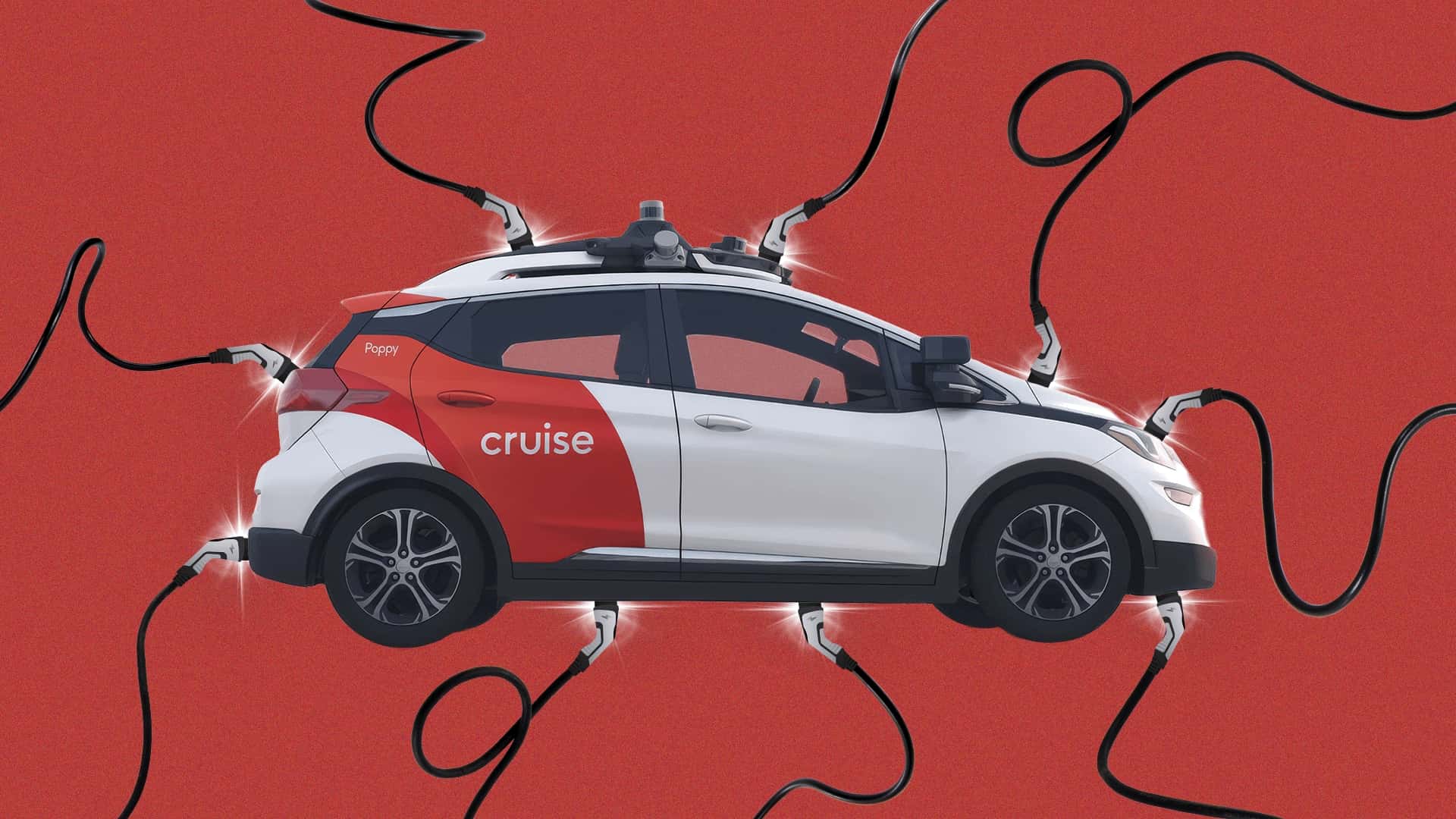
Early entries, such as the Chevy Bolt from General Motors' Cruise division, used an eye-opening 1.5-to-3 kilowatts to perceive surroundings and drive safely, according to Sam Abuelsamid, vice-president of market research at Telemetry. That’s on top of everyday demands for propulsion, HVAC, infotainment and accessories.
That would be no way to run a profitable business. Even at a 2-kilowatt rate, that Cruise taxi would slurp 40 kilowatt-hours over a 20-hour shift to power autonomy alone; or two-thirds of a “tank” with its original 60-kWh battery pack. (Obviously, a taxi would recharge at least once over that long workday. But profligate consumption would still demand more-frequent charging stops.
For the 2022 Ioniq 5-based AV that Hyundai developed for Motional, the mileage penalty is akin to a Ford F-150 Lightning hauling a Boeing 747: The Environmental Protection Agency pegged the Hyundai’s driving range at 168 miles, a 46-percent drop from a consumer version’s 303 miles.
Newer AVs fare better. Rivian is targeting roughly 1.1-kilowatt consumption for Level 4 robotaxis, which equates to 22 kWh over that 20-hour shift. Lucid’s system, in partnership with AI company Nuro, aims for similar usage.
Waymo’s Jaguar I Pace taxis devote about 1 kilowatt of energy to self-driving, even with its retrofitted array of 29 cameras and five Lidar units. Models equipped with Waymo’s latest sixth-generation AI “Driver” might also use about 1 kilowatt, Abuelsamid says. Those include Hyundai’s latest Ioniq 5 AV’s undergoing testing, and Zeekr’s Ojai minivan.
Consider that the human brain is about two percent of typical body mass, but consumes 20 percent of its energy and oxygen. So if you’re talking tens or hundreds of millions of cars, with ever-larger AI brains, that shit adds up. There are more than 1.6 billion passenger cars in the world. And it takes only 19.6 years to turn over 90 percent of that global fleet as older cars retire, according to a Hedges & Company analysis.
So it’s no longer a Minority Report fantasy to imagine a world dominated by self-driving cars by 2050 or 2060, especially when prices for autonomy fall to levels palatable by consumers – or if Silicon Valley and China have any say in the matter.
The 2023 MIT study focused on that potential energy footprint. The research team calculated that if 1 billion AVs drove for just one hour each per day, using 840 watts of power to run autonomy—well below today’s levels—they would use as much energy as the world’s data centers at the time (before the insane AI data center boom really took hold), at the same level of greenhouse gas emissions. In 90 percent of modeled scenarios, to keep AV emissions from exceeding 2023's data-center levels, each vehicle would need to hold computing power below 1.2 kilowatts.
Sertac Karaman, an MIT professor of aeronautics and astronautics, and a study co-author, says the study underscores the need for efficiency gains.
“One kilowatt per car seems a reasonable goal for the next three to five years,” Karaman says. “But we expect that the compute portion of transportation is going to be significant, and in many ways we’re just getting started.”
Karaman notes that onboard energy usage is only part of the story. Data centers tasked with cloud-based training for AVs, or to monitor and manage autonomous traffic systems — including “smart city” functions — would surely have to boost capacity to oversee a global AV fleet. It’s also too early to confidently predict secondary effects. A world of 24/7 access to autonomous cars for everyone, young or old, license or no, might sharply increase the number of miles driven, or lessen them through ridesharing or reduced congestion.
“It’s still sort of anyone’s guess,” he says.
Like other players, Lucid and Rivian are firmly in the AI training stage. Their AI driving models are expanding toward 10 billion parameters.
“We’ve only scratched the surface for deploying physical AI,” Stepper says. “The progress of that, compared to the amount of data they need to train, is absolutely astonishing, and surprised many of us.”
A raft of redundant safety subsystems — power supply, network and comms, compute, sensors, steering and braking — adds complexity that Lucid is “working very, very hard to reduce,” including by reducing sensor count.
“So what you’ll see in taxi applications is these two beautiful, high-performance computers, in case the primary system goes down,” Stepper says.
Rivian founder and CEO RJ Scaringe calls the company’s “data flywheel” critical to autonomy. Real-world driving data is ingested from Rivians in the field, with owners required to opt in. That data is offloaded to the Rivian Cloud and used to train the AI. Validated and improved versions of its “Large Driving Model” are sent to customer cars via OTA updates.
An AV might generate or deal with several terabytes of data a day. Fortunately, as AVs masters every nook and cranny of the globe, the training-data demands should ease. For Rivian’s model, Rithe says, onboard recording and transmission is only triggered by unusual scenarios: A unique intersection in the boonies, a never-before-seen obstacle. Such edge cases are notoriously difficult to capture in simulation.
“We’re constantly running perception on the vehicle, but a computer decides if this is a really interesting event, a camera or lidar frame that’s unique,” Rithe says.
As processors grow superpowered, measured in part via TOPS—trillions of operations per second—automakers are making sure that energy use isn’t their kryptonite.
“Watts per TOPS is a key factor,” Stepper says.
Efficiency, in several forms, is a big reason that Rivian decided to develop custom silicon in-house. It ditched previous Nvidia Orin processors, and the new Nvidia Drive Thor now being adopted by companies such as Lucid, Mercedes, Volvo, BYD and Zeekr. That Thor chip operates between 40 and 130 kilowatts.
Rivian’s powerful “RAP1” system-on-a-chip (or “SOC”) is a linchpin of its ambitious plans. The silicon can compute 800 trillion operations per second for sparse data. Rivian will combine a pair of these chips to power a Gen3 autonomy module that will debut in the R2 late this year—along with the company’s first onboard Lidar unit. The R2’s high-fidelity perception stack features 11 high-resolution cameras and five radars. For the R2, that hardware and software will initially allow a Level 2++, “point-to-point” hands-free system, akin to Tesla’s FSD, but not until late this year. By adding more RAP1 chips and software, Rivian says the system can steadily scale and become capable of Level 4 driving.

Rithe says Rivian creates an energy budget for every vehicle system, including autonomy, with engineers strictly tasked with meeting targets. And Rivian’s in-house control over its full autonomy stack gives it a big competitive edge in performance and efficiency. Versus its previous Nvidia Orin unit, the Gen3 module has four times the computing power, and a further 2x gain in TOPS utilization over end-to-end deployment of its Large Driving Model. Rivian did not disclose the absolute power demands of that RAP1 SOC, but says it achieves those computing gains while using just 50 percent more power.
“Power wasn’t an afterthought,” Rithe says. “We saw an 8x improvement in performance without exploding our power budget.”
Lidar itself was once a notorious energy hog, not just for motorized mirrors or spinning housings, but for the aerodynamic drag of that excrescent hardware that delivered 360-degree views. Solid-state circuitry has sharply reduced Lidar’s bulk, costs and power needs, including for the streamlined unit that will tuck within the roofline of the R2. Vidya Rajagopalan, Rivian's senior vice-president of electrical hardware engineering, says its power usage can now be measured in the “tens of watts.”
For its part, Lucid is leaning on its goal of “radical efficiency” in batteries, motors and aerodynamics to offset autonomy’s losses. That includes a philosophy of shrinking batteries to create a chain of efficiency gains. Lucid says its sleek Lunar—a two-seat robotaxi concept—could deliver up to 6 miles of driving range for every kilowatt-hour of battery. A battery as small as 55 kWh, versus 69 kWh in its forthcoming Cosmos model, could still deliver a roughly 310-mile charge. With Lucid targeting ultra-fast charges, adding perhaps 200 miles of range in 15 minutes, operators would cut downtime and squeeze more money from each car.
Stepper says the industry is coalescing around a target of 500 watts to support self-driving tech.
“We’re working to cut today’s power requirement by half, and get it down to 500 watts,” he says. “That’s a working target, not published in any Lucid product plan, but a community and industry target.”
Abuelsamid agrees 500 watts is a reasonable goal. He says automakers are unlikely to get much lower anytime soon, given their exploding compute needs.
“Still, it’s crucial to get that number as low as possible to maintain decent range for an electric AV.”
Lawrence Ulrich is an award-winning freelance automotive journalist based in Brooklyn, New York. He's also the former chief auto critic of The New York Times and a contributing editor at Road & Track.