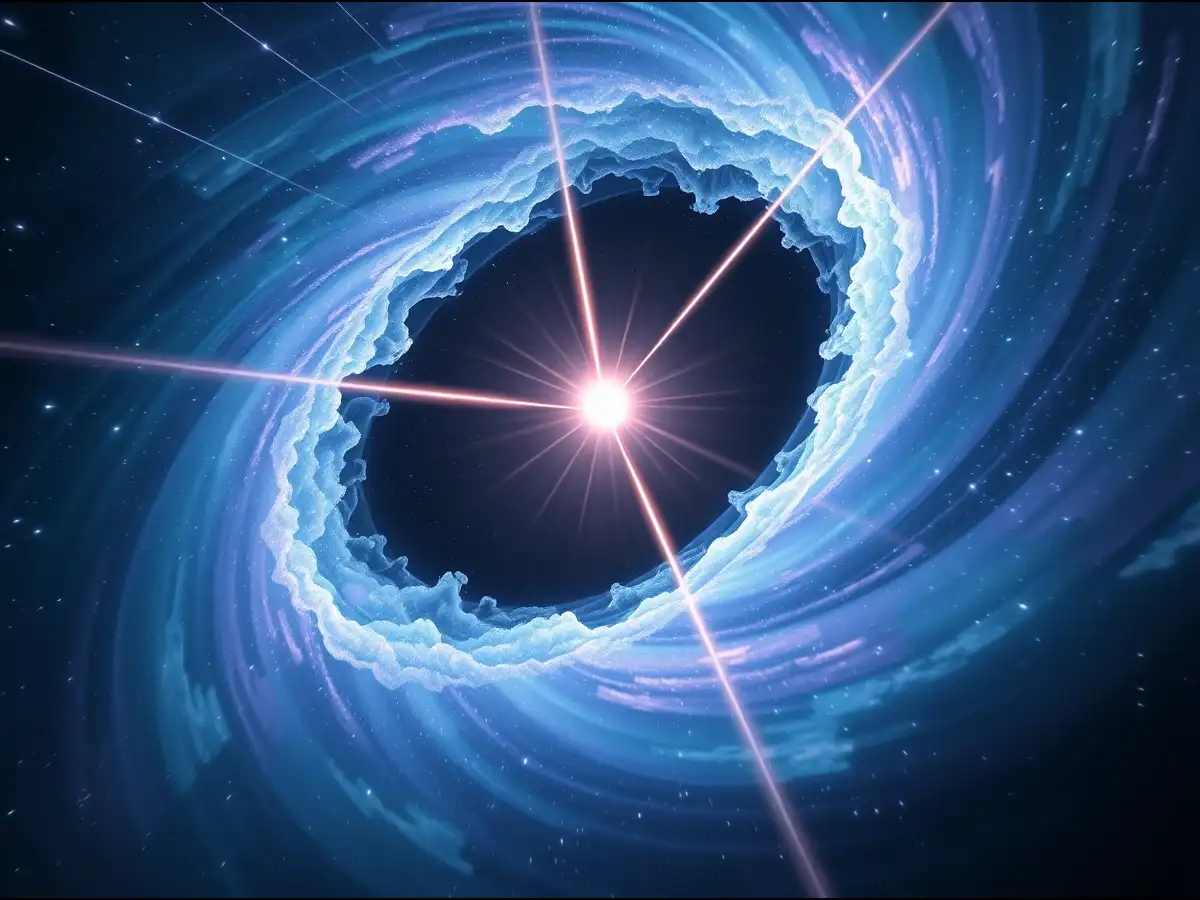
An international team of astrophysicists has captured what appears to be concrete observational evidence of a quantum mechanics concept proposed nearly nine decades ago. Utilizing NASA's Imaging X-ray Polarimetry Explorer (IXPE) alongside ground-based radio observatories, researchers detected light polarization behavior surrounding a distant magnetar that indicates absolute space is far from empty.
The groundbreaking study, published in Nature , confirms that extreme magnetic environments can force the quantum vacuum to act like a physical prism—refracting X-ray photons as they pass through invisible subatomic fluctuations.
Deciphering the 90-year-old quantum vacuum hypothesis
In the 1930s, theoretical physicist Werner Heisenberg posited that a complete void does not exist in our universe. According to Quantum Electrodynamics (QED), a vacuum constantly churns with short-lived "virtual particles" that pop in and out of existence faster than direct observation allows.
Under standard conditions on Earth, this quantum foam remains invisible. However, Heisenberg predicted that subjecting a vacuum to hyper-intense magnetic forces—exceeding 100 million times the strength of any terrestrial lab setup—would force these virtual subatomic particles into alignment.
When electromagnetic radiation travels through this polarized vacuum, the light experiences vacuum birefringence, splitting and bending depending on its direction of oscillation.
The perfect cosmic laboratory
Because terrestrial technology cannot generate magnetic fields of required magnitude, researchers turned to magnetars—collapsed stellar cores possessing magnetic fields over a trillion times stronger than Earth’s.
Dr. Marcus Lower from Swinburne University of Technology and an international scientific collaboration focused their efforts on 1E 1547.0-5408, a rapidly spinning radio-emitting magnetar. Using supercomputer analysis at Swinburne’s Ngarrgu Tindebeek facility alongside radio data from Australia’s CSIRO Parkes observatory (Murriyang), the team determined two key structural factors:
- Geometric Alignment: The magnetar’s rotational axis and magnetic poles align almost identically.
- Pole-On Perspective: Earth sits in an ideal viewing trajectory, looking almost directly down into the star's magnetic axis.
This rare alignment provided an unobstructed line of sight to measure how the surrounding vacuum distorts departing radiation.
Observational proof
When NASA's IXPE instrument and the International Space Station's NICER telescope measured X-ray emissions coming off 1E 1547.0-5408, they recorded unprecedentedly high polarization levels—reaching up to 80% in specific energy bands.
Crucially, the direction of X-ray light oscillation remained locked to the magnetar’s spinning magnetic field in exact agreement with radio frequency patterns. This precise lockstep behavior provides direct physical evidence that virtual particles aligned in the magnetic field altered the path and orientation of the outgoing light.
While researchers continue refining computer simulations to rule out alternative plasma interactions, this observational milestone marks the closest science has ever come to proving Heisenberg's famous prediction about the true nature of empty space.