Get all your news in one place.
100's of premium titles.
One app.
Start reading
Newslaundry
Newslaundry
National
Tapasya

As climate firm sells to Big Tech, a Gujarat grassland is left behind

In January last year, Gurgaon-based climate-tech company, Varaha ClimateAG Private Limited, struck the largest ever biochar carbon removal deals with Google and Microsoft. It was to sell 100,000 carbon removal credits each to the tech giants.

Biochar is a charcoal-like material made by burning biomass with low oxygen. This process locks away carbon that the biomass would otherwise release when it rots or burns. Applied to soil, biochar can increase fertility, by helping it hold water and nutrients.

Varaha has generated 2,65,203 biochar-based carbon removal credits since its formation in 2022, according to the Global C- Sink Registry data at the time of writing this report. This means it prevented as many tonnes of carbon dioxide from entering the atmosphere. Each tonne translates to one carbon credit, ready to be sold in the carbon market to polluting companies to help them meet their climate pledges. The money has followed.

The company’s revenue jumped almost 97 times between FY 2022-23 and 2024-25. In the last fiscal year, it recorded a profit, of over Rs 1 crore, for the first time.

But Varaha sells more than carbon. For example, in the Banni grasslands of Gujarat’s Kachchh district, its pitch to buyers is that its biochar also brings back degraded grassland, improves soil and supports the communities that make it. This is also one of the projects linked to Google’s credits.

Though that same promise stands tested in what was once Asia’s finest tropical grassland before it was dominated by Prosopis growth. Newslaundry visited four villages in Banni, interviewed more than 20 people involved in biochar production, and studied Varaha’s project documents. We found that the benefits of biochar production evaded both the grasslands as well as its people.

First, consider the benefits for the locals.

Prosopis, a perennial shrub native to South America and Mexico, was introduced to the grasslands in the sixties by the forest department to check the spread of the Great Rann of Kachchh. But the department in 2019 started a restoration project as Prosopis took up nearly half of the grasslands. The species made its way into the lives of local communities, with some of them involved in Varaha’s “community-led” Prosopis business. Though they got a fraction of the profit.

Villagers cut these trees in common lands and burned them in open metal kilns. They doused the fires with tankers of water in a region that has little to spare. While Varaha earned nearly Rs 25 per kg of biochar, it gave Rs 10 at most to villagers producing the biochar, as per our assessment based on one liberal set of available data-estimates and interviews with locals and an NGO.

Villagers still don’t know how much Varaha earns from the trees taken off their commons. The company, meanwhile, is moving on to industrial gasifiers that can consume 50 tonnes of Prosopis a day. In that model, Banni’s communities may be little more than suppliers of wood.

Second, the Prosopis has grown back denser, say villagers. Soil studies by Sahjeevan, a Bhuj-based NGO that facilitated Varaha’s projects, were inconclusive and some even showed a negative impact.

Third, consider the environmental damage. Each biochar kiln needed about 500 litres of water in a region short of it. Varaha says it offsets the methane from biochar production by planting trees. We could not find those plantations on the registry meant to validate them. Mongabay India had reported on some of the issues before.

Banni’s ‘mad tree’

Prosopis juliflora, in the local dialect, is called “gando bawar” or “mad tree” due to its resilience in drought-prone climate and saline soil. Its roots go deep and can suck 36 litres of water a day from the soil, making it difficult for other vegetation to grow. In Banni, it has caused a serious decline in the grassland flora and fauna. Its leaves, roots and seeds produce biochemicals that reduce seed germination and growth of other plants.

A villager in Dedhiya village in Banni walks among Prosopis thickets.

The Banni region consists of 48 villages divided into 19 local self-governance bodies or panchayats. Its population was 21,338 in 2011-12, according to a 2022 research at ICAR, Rajasthan.

The semi-nomadic community in Kachch, including Banni, and some parts of Rajasthan, is known as Maldharis (cattle-owners). They are landless and not allowed to carry out agricultural activities on the villages’ common lands that are vested with the panchayats. Though they do have access to the commons to graze animals and collect non-timber produce.

Maldharis are also known for breeding the Banni buffalo, a breed that got official recognition in 2010. They breed these buffaloes predominantly, since they can feed on Prosopis’ seedpods and don’t get hurt by its thorny thickets. Villagers told us that their cows turned sick or died after eating Prosopis seedpods.

According to a 2021 research, cows feeding on the Prosopis developed “weakening and dislocation of jaws” and “gradual death”. On the other hand, Banni buffalo population saw a growth rate of 457 percent between 1977 to 2012.

The pilot projects begin

In 2022, a local NGO Sahjeevan, along with village Community Forest Resource Management Committees, started pilot projects in Banni to restore the grasslands by removing Prosopis and burning it in a conical metal container to produce biochar.

The biochar is produced using the artisanal method of burning it in a conical metal container (kon tiki) that is wide and open at the top. The biomass is added layer by layer and set on fire. The idea is to contain the oxygen entering the kon tiki. This reduces the emission of greenhouse gases. Though methane emissions are a problem depending upon the moisture present in the biomass.

“Earning from carbon credits helps in financing grassland restoration. It creates livelihood opportunities, a carbon sink and also helps build a reserve that can be used to finance removal of Prosopis that grows back,” said Kavita Mehta, Executive Director of Sahjeevan. “Unfortunately, we couldn’t manage the financing for subsequent years. So the Prosopis has grown back.”

In response to Newslaundry’s written queries, Sahjeevan informed us that in total they had cleared more than 11 square kilometres in five villages and produced 800 metric tonnes of biochar. It did not disclose how much it was paid, nor did it give a village-wise breakdown of the pilots. Sahjeevan said that Varaha, the company they worked with, has agreed to provide additional support for which discussions are underway.

Varaha joined Sahjeevan on the pilot projects in 2023-24. These projects were conducted in several villages, including Gorewali, Dedhiya, Vagura, Sanganara, and Lakhara.

The Prosopis has grown back denser, say villagers. Soil studies by Sahjeevan, a Bhuj-based NGO that facilitated Varaha’s projects, were inconclusive and some even showed a negative impact.

In its project design document for “carbon sequestration and grassland restoration in India”, submitted with the Swiss-based standards body Carbon Standards International, Varaha described its “community-led biochar project” as “one of the world’s largest”.

Following the money

Varaha used different models for biochar production in Banni’s villages.

It initially handled all the operations itself, Kaushal Bisht, Varaha’s Director of Partnerships and Strategic Alliances told Newslaundry. This meant seeking permission from village committees to remove Prosopis and paying villagers for it, arranging earthmovers to uproot Prosopis, water-tankers to douse the kon tikis at the end, and hiring workers to operate kon tikis. In Vagura and Dedhiya villages, it paid the village committees Rs 2.2 and Rs 1.7 per kg of raw biomass, respectively, according to the minutes of meetings of village committees accessed by Newslaundry.

Bisht said Varaha later realised that it would be better to pay for the finished biochar instead.

So the firm began striking agreements with Sahjeevan-village committees or individual village contractors for production. Sahjeevan confirmed this, but said the payment mechanisms varied. It said that in Dedhiya, Varaha initially paid on a daily wage basis before moving to another method where a fixed amount was paid for a fixed volume of production. In these agreements, the village committees would provide access to the common lands and hire contractors to produce the biochar. Sahjeevan provided research inputs on what lands should be cleared of the mad tree. They also conducted studies to check the impact of biochar on soil health.

These agreements, and the payments Varaha made per tonne of biochar, varied across villages.

Neither Sahjeevan nor Varaha agreed to share records of what village committees were actually paid, so Newslaundry reconstructed the money trail through conversations with village committee members and Sahjeevan.

In Dedhiya, for example, a Sahjeevan employee told us: Varaha paid Sahjeevan’s Charobar Foundation Rs 10 per kg of biochar. Charobar passed on Rs 8 per kg to the village committee to pay for operations and Rs 2 for further restoration work. Kavita Mehta confirmed Charobar’s intermediary role in the financing structure, and said the “original idea was to help the village committee to save Re 1 per kg of biochar” to cover post restoration, maintenance costs.

On paper, this looked like a fair exchange: Varaha would buy the biochar, become its owner, and profit from selling carbon credits while villages would get financed for removing Prosopis and gain employment. But the numbers raise some questions.

Rs 10 per kg paid for biochar in Dedhiya – the highest rate we found paid to any village committee – is a benchmark to understand what Varaha made from the same kilogram.

Sahjeevan’s annual report put the output of the pilots in 2023-24 at 2,000 carbon credits, from 800 tonnes of biochar, which were sold on the European voluntary market at $120 each, earning around Rs 2 crore. Though Mehta said these were “speculative estimates” based on standard industry conversion ratios and the “final figures may differ from these speculations”. At Rs 82 to the dollar, going by the 2023-24 average, this could work out to around Rs 24.6 per kg for Varaha.

So more than twice what was given to the village committees that ran the whole operation. Village committees and contractors used it to pay kon tiki workers around Rs 500 a day, earthmovers around Rs 700 an hour to uproot Prosopis, and Rs 500 per tanker to douse the kilns at the end

While this gives a sense of how payments were split, there was another issue.

The agreements between village bodies and Varaha soon fell apart as the company reduced the prices it would pay for the biochar.

Village committee members and Sahjeevan told us that Varaha brought the prices down to around Rs 7. This was also reported in the Mongabay piece. This also happened in the direct agreement with local contractors.

In Gorewali, a contractor said he was paid Rs 7-8 per kg of biochar. From this, he was supposed to pay for the workers, water tankers, biomass sourced from others’ lands etc. He found the money insufficient and negotiations with the company hit a dead-end.

“The company should give at least Rs 15 per kg of biochar,” said Jakab Haji Sumra, the Chairperson of Dedhiya’s village committee.

What was fixed in the soil?

Prosopis spreads fast. Once it is uprooted, it can grow back again due to seed stock still present in the ground. To remove it completely, a land patch needs to be cleared consistently for two to three seasons.

In the case of the villages we visited, Prosopis was removed during the pilots, the company earned carbon credits, but the restoration did not happen. Not only did the shrubs return, the promise of improved soil health also stood on a shaky ground.

During field visits, the reporter found bags of biochar buried in the soil, or lying out in the open, in two villages. But, the company and Sahjeevan claim that the biochar was mixed with manure and water and then applied to the soil. Though Sahjeevan’s initial public reports claim that biochar was dumped inside ground for carbon sequestration.

Biochar lying in the open in Lakhara village.

Dr Sagar Jadhav, Soil Scientist and Senior Research Officer BAIF Development Research Foundation, Pune (Bharatiya Agro Industries Foundation), said the “best way to apply biochar to soil is to add it to manure and to do it in the non-rainy season. Otherwise it can drain away with water, since it has low density, or blow away with wind.”

Biochar dumped in a bag in Gorewali village.

Sahjeevan conducted a study to understand the effect of biochar application on soil’s electrical conductivity (EC), pH and organic carbon. While there was an increase in organic carbon, the electrical conductivity and pH of the soil also shot up for the worse.

“If biochar application causes the pH to settle around the neutral value of 7, then it has worked well. But if it increases in already high pH (alkaline) or already low (acidic) soil, then it is bad for soil health. The increase in organic content sounds promising, but an increase in electrical conductivity would mean more salts, which reduces water available to plants,” said Jadhav.

Then there is the question of water use.

Banni grasslands fall in the water scarce region of Kachchh district in Gujarat. The region experiences low and erratic rainfall and high soil salinity. This also causes fodder scarcity and affects the livelihoods of the pastoralist communities. In a region like this, operating kon tikis that require around 500 litres per kiln becomes a financial hurdle as well as a social dilemma. “When so many water tankers came here to quench the kon tikis, the villagers would express their reservations since we were using so much water when they were not getting much,” said a biochar contractor from Gorewali.

Methane emissions

Biochar production can cause methane emissions if the feedstock has high moisture content. According to Varaha, its biochar production process ensures that the biomass is dried first, not stored in a pile over one metre high and that its moisture content is checked using a moisture meter before it is burnt in a kon tiki kiln. The company has kept a cap of 15 percent on the acceptable moisture level in the biomass.

But the verification audits and interviews with Banni’s locals and Sahjeevan tell a more complicated story.

In March 2026, the auditor found that “there was a clear case of black smoke especially at their site”. The auditor said the “reasons for black smoke leading to CH4 emissions” could be that the biomass was not stored or cleaned properly. Varaha later informed that it had conducted retraining “to reinforce the correct implementation”.

“Biochar production caused smoke. It caused problems for the workers, not the residents. There was a lot of heat plus smoke around the kon tikis,” said Saifi, the chairperson of Vagura village’s committee.

A tonne of biochar produces 30 kg methane. The portion of biochar that acts as a temporary carbon sink can compensate for 23 percent of methane emissions caused during biochar production. Varaha said it will compensate for the remaining 77 percent methane emissions by planting trees.

In October 2025, the company said that its biochar production of 46,000 tons had caused 1,366 tons of methane emissions. It said that instead of planting 59,582 trees as per requirement, they planted 1,92,184 trees in 2024 and were planning to plant 50,000 more in 2025.

These plantations had not been officially validated by the Global Tree C-Sink but the company maintained it was in the process of registering them. We checked the registry online but could not find Varaha’s plantations registered on it.

Kaushal Bisht told us that the plantations under Varaha’s agroforestry projects were used to offset methane emissions, but the company has not responded to questions on plantations raised specifically to that end.

While the company posits its biochar production as a solution to emissions from burning Prosopis for charcoal or fuelwood, it does not talk of women, who are at the receiving end of the smoke emerging from chulhas in Banni’s villages.

A local woman preparing tea using wood from Prosopis Juliflora.

Varaha’s Project Design Document accepts that villagers might have to travel further to harvest Prosopis once it is removed in villages. It said that going further would not have a net climate impact. But, our fieldwork shows that women would bear the brunt if Prosopis becomes hard to access.

The women of Dedhiya and Vagura told us that they go out to cut the Prosopis almost everyday since there are no gas cylinders. They carry it back in heaps over their heads. They spend around four hours before noon collecting, gathering and hauling Prosopis wood back home. The women there told us that they have never used a gas cylinder. They cook in the smoke of the burning Prosopis. One of the women told us that it causes coughing but they do not have any other option.

When asked what they would do if the Prosopis is cleared, one of them said with a smile, “We can use gas cylinders.”

Sahjeevan informed us that, to their knowledge, no studies were conducted to assess the impact of the biochar projects on women.

Industrial plant: From community-led to industry-focused

As villagers deal with an invasive plant as well as from the remedies offered to them, Varaha has found an inlet into the grasslands and eyes expansion from “community-led” to industrial-scale biochar production that would reduce community members to far-off spectators and suppliers of Prosopis.

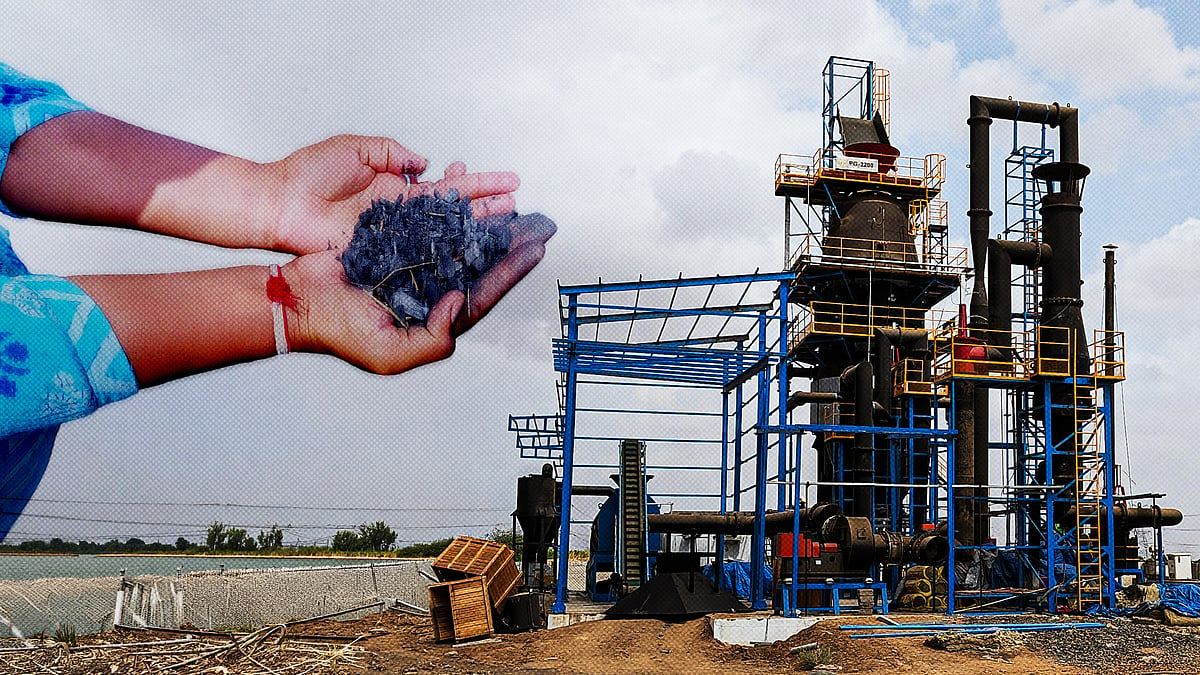
It has set up an industrial plant in Loriya village at the outskirts of Bhuj city in Kachch district. The plant works on pyrolysis gasification technology, which converts the Prosopis biomass into biochar and syngases. The machinery includes a dryer that brings biomass moisture content below 15 percent, a gasifier where the biomass is incinerated, and pipes that allow the residual gases to flow out.

Varaha’s industrial plant in Loriya village.

It can consume 50 tonnes of biomass and produce around 12.5 tonnes of biochar per day.

“We can use the hot gases to run the drier. We are also thinking of putting up a turbine to convert the gases to electricity which we might sell to other other companies,” said Adrish, the Supply Chain Manager stationed at the plant.

“We should potentially get revenue from three sources, sale of physical biochar, carbon credits and the power we create from syngases. We are not there yet, but as the market matures we will be doing all of this,” said Kaushal Bisht from Varaha.

In Loriya, the company plans to set up another gasifier next to the one that stands there. “We will have up to six gasifiers in this region. For now, all the biochar is going to villagers free of cost,” Adrish told us.

“We get Prosopis from both contractors and individual suppliers. This combination helps us maintain a consistent supply and keep the prices in check,” he said.


The Global Forest Coalition, an international coalition of NGOs and Indigenous Peoples’ Organisations, supported the research and reporting of this story.

Newslaundry is a reader-supported, ad-free, independent news outlet based out of New Delhi. Support their journalism, here.

Sign up to read this article
Read news from 100's of titles, curated specifically for you.
Already a member? Sign in here
Related Stories
Top stories on inkl right now
One subscription that gives you access to news from hundreds of sites
Already a member? Sign in here
Our Picks
Fourteen days free
Download the app
One app. One membership.
100+ trusted global sources.