Get all your news in one place.
100’s of premium titles.
One app.
Start reading
T3
T3
Technology
Matt Kollat

Arc’teryx Beta AR (2025) Jacket review: Iconic mountain shell gets a major upgrade

Arc’teryx Beta AR (2025) Jacket review.

Arc’teryx updated its legendary Beta AR jacket for its 25th birthday earlier this year, and I was lucky enough to be sent one. It’s one of the best waterproof jackets I've tried this year, and certainly one of the most rugged shells from the brand.

It shocked me slightly when the news broke in July about the jacket, which reminded me of just how long the Beta line has been going. I can’t say I’ve been present throughout its lifetime – in 2000, I was too busy being a teenager listening to Justin Timberlake’s Señorita on repeat.

A quarter-century reset

I have been testing waterproof jackets for the better part of a decade, including Arc’teryx models such as the Arc’teryx Beta Lightweight Jacket. I like the company’s utilitarian approach and its clean lines; you can recognise an Arc’teryx shell well before you can spot the logo.

The Arc’teryx Beta AR (2025) Jacket is the same in this regard, but comes with a ton of updates, with the headliner feature update being the switch to GORE-TEX PRO ePE. This is the top-tier ePE membrane within the GORE-TEX range, offering maximum durability and a focus on sustainability (i.e., it contains no ‘intentionally added’ PFAS).

The new ePE membrane is everywhere right now. You can find versions of it in the Fjallraven Keb GTX Jacket, Montane’s latest Phase and Phase Lite jackets, the excellent Rab Namche Gore-Tex Jacket and the T3 Awards-winner Mountain Equipment Makalu Jacket, to name a few.

Without going into much detail, ePE is GORE-TEX’s best effort to match the performance of its PFAS membrane, and even though it isn’t on par with it, the PRO version is pretty darn good in keeping you dry while allowing moisture to leave your body. Just make sure to wash and heat it occasionally.

Cut for the high places

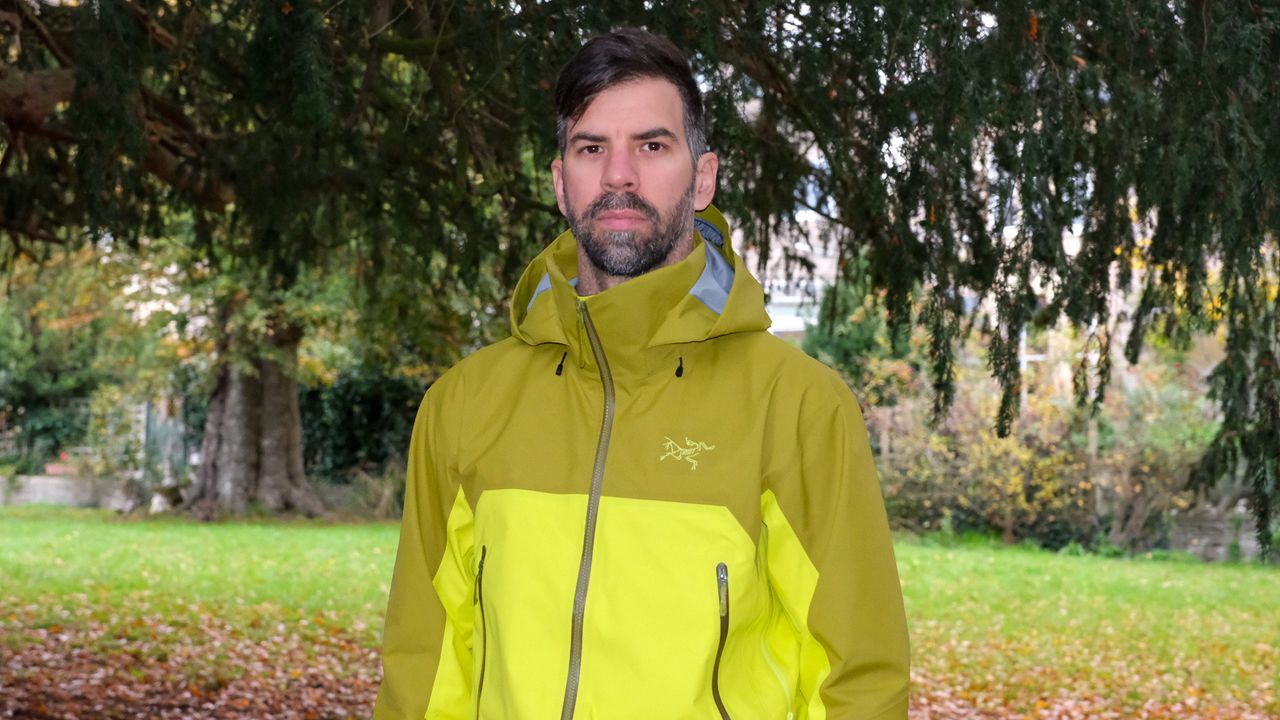
As the brand’s mountain-ready all-rounder, the Beta AR (2025) Jacket (as in, ‘All Round’) Jacket packs a ton of features that make activities more bearable (and safer) in alpine environments. The shell has a hybrid fabric construction, with heavier-duty fabric on the yoke and arms and a lighter fabric on the body to reduce weight and bulk.

(Image credit: Matt Kollat)

The Beta AR’s DropHood is designed to be standalone from the collar for better ventilation and can be adjusted to keep the rain out, with or without a helmet. The brim stays firm, helping keep moisture away from your face and the sun out of your eyes. The collar comes up high, providing ample protection from the wind/elements.

(Image credit: Matt Kollat)

The jacket has two large hand pockets and an internal chest pocket – good for layering and stashing essentials. The pit zips let you dump heat during high-output activities, but they add a bit of weight. Speaking of weight, my men’s medium model comes in at 457g, approximately 27 per cent lighter than the original Beta AR from 2000.

(Image credit: Matt Kollat)

In addition to using GORE-TEX PRO ePE, which doesn’t pollute the environment with forever chemicals (*cough* but yes, still microplastics *cough*), Arc’teryx claims that the new patterning “minimises fabric waste, saving 800 metres of material (the equivalent of 400 jackets) during production.”

The brand also has its ReBird initiative to help reduce unnecessary waste, so the question of better sustainability has certainly come up when redesigning the Beta AR.

Shelter in motion

In use, the jacket feels sturdy but not stiff, and certainly element-ready. I used it for various activities throughout the months, from general walking to hiking (with some scrambling), and unlike the Beta Lightweight, I never felt that the jacket wouldn’t protect me from the elements.

(Image credit: Matt Kollat)

I love the tall collar, the DropHood, and the general adjustability that help keep the wind and rain from your fleece jacket (or whatever layers you have under the shell). The length is pretty much perfect, but I would have appreciated a two-way zipper on the front to let the legs move more freely when trekking uphill.

That said, I appreciate that zips are the first thing that breaks on jackets, and two-way zips are even more prone to breaking. You don’t want to be stuck on a mountain with a broken zip, that’s for sure. Ventilation is excellent, and if things get heated under the membrane, you can always use the pit zips to let in more air.

A summit-level price tag

The only thing that might deter people from getting the Arc’teryx Beta AR (2025) Jacket is its price. At £600 / $650 / €600 / AU$1,000, it’s one of the most expensive shells, and costs often twice as much as quality waterproof jackets from other brands.

The price is intentional: Arc’teryx not only signals that the Beta AR is its top-of-the-range shell, but it also communicates that the jacket will fulfil its purpose in the most demanding environments on the planet. And for that, people will pay the premium.

(Image credit: Matt Kollat)

Arc’teryx has built its reputation on creating outdoor gear that works well in the mountains. The Beta AR (2025) Jacket is an excellent example of what makes the company still one of the most sought-after brands in alpine circles. (There’s also the Arc’teryx Alpine Academy, but that’s a different story).

If you can afford it and need a reliable outer shell in demanding environments, the Arc’teryx Beta AR (2025) Jacket is a solid choice. For walking the dog in the rain, you might want to pick something more affordable.

The Beta AR (2025) Jacket is available now at Arc’teryx UK, Arc’teryx US, Arc’teryx EU and Arc’teryx AU.

Sign up to read this article
Read news from 100’s of titles, curated specifically for you.
Already a member? Sign in here
Related Stories
Top stories on inkl right now
One subscription that gives you access to news from hundreds of sites
Already a member? Sign in here
Our Picks
Fourteen days free
Download the app
One app. One membership.
100+ trusted global sources.