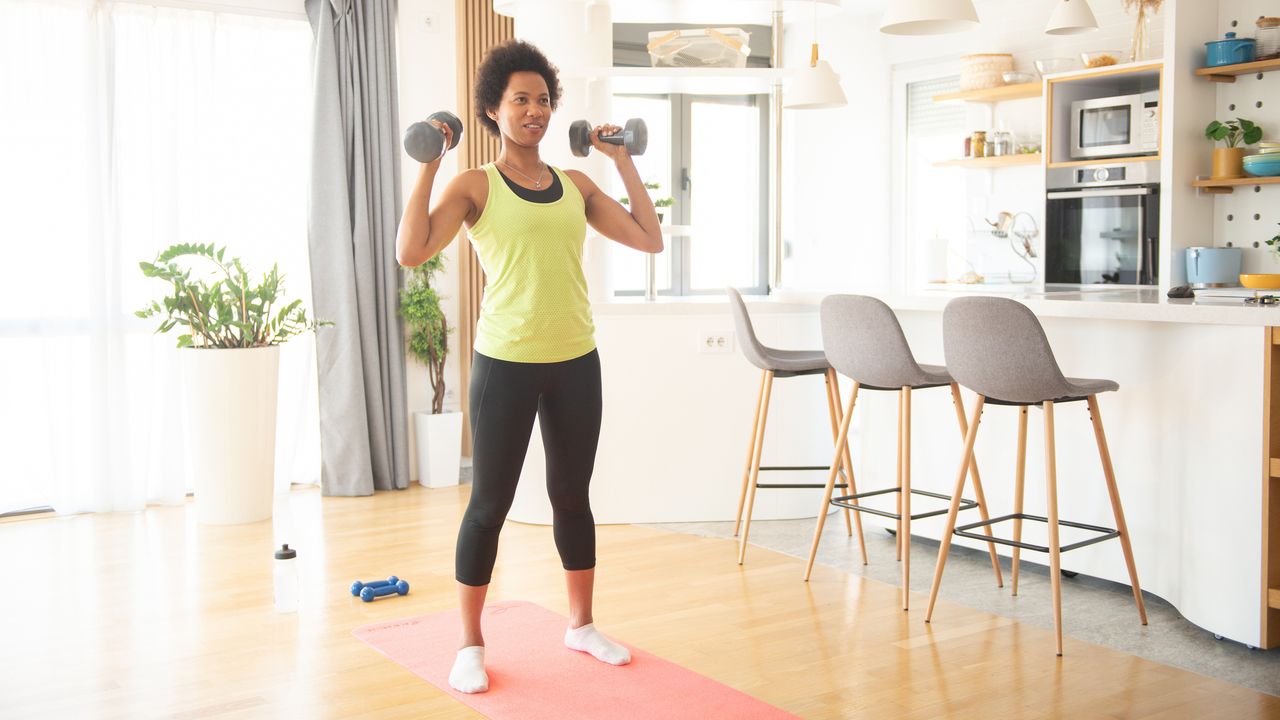
From the age of 30, we naturally lose lean muscle mass as well as bone density, and this process speeds up for women in menopause. Other physiological changes can mean exercise routines that were once a source of strength no longer work, too. But all is not lost—far from it.
“The key to aging well is to build muscle,” says Antonietta Vicario, chief training officer at fitness app Pvolve, which recently launched a six-week fitness program called Menopause Strong. It’s designed for women in perimenopause, menopause and post-menopause to improve strength, mobility, energy levels and mood.

“Menopause is a natural biological evolution, not a pause,” Vicario, tells Fit&Well. “The Menopause Strong plan provides a structured, evidence-based roadmap to help women reclaim strength, confidence and vitality during this stage of life.”
Vicario says there are four main areas it’s worth menopausal women working on.
- Muscle mass: Preserving muscle supports metabolism, energy, insulin sensitivity, daily function and overall strength.
- Bone health: Declining estrogen increases the risk of bone density loss. Weight-bearing and plyometric (jumping) exercises are essential for prevention.
- Joint health and mobility: Maintaining mobility and stability reduces pain, improves posture and decreases fall risk.
- Pelvic floor strength: Supports bladder control, core stability and overall movement efficiency.
The programme addresses all four, and adds recovery work too.
Vicario recommends strength training three to four times a week to preserve muscle, and boost your bone health and metabolism. Then prioritize mobility work two to three times to keep joints healthy and flexible. Recovery sessions are also important to reduce stress, regulate hormones and boost energy, she says.
“The key is to focus on strength and high-intensity intervals while starting small and building gradually. Enjoyable exercises help create sustainable habits, and even 20-30 minutes a few times a week can make a meaningful difference.”
Vicario, who has created a taster workout of what to expect from Menopause Strong. Scroll down to give her mini workout a try.
Five moves will boost muscle, bone strength, mood and mobility in midlife women
1. Internal rotation deadlift
Sets: 1 Reps: 15-30 each side
How to do it:
- Stand in a split stance, with your right foot in front of your left, with a slight bend in your knees and holding heavy (10-15lb) dumbbells.
- Keeping your hips pointing forward, turn your right foot in.
- Shift your weight into your right leg and hinge forward from your hips, lifting your left leg behind you and letting your arms hang down, keeping your hips and shoulders square to the floor as you hinge.
- Pause, then push your hips forward to stand up, lowering your left foot to tap the floor behind you.
Vicario says: “This exercise builds stability to help us have better control of our bodies and prevent debilitating falls. It also increases the mobility in our hips, which is so important for hip, low back and pelvic floor health, especially because the loss of estrogen during menopause can make our joints feel stiffer.
“Aim for 15-30 repetitions and then hold the balance at the top for 15-30 seconds, building up in repetitions over time. Then swap sides.”
2. Sumo squat to overhead press
Sets: 3 Reps: 20-30 Rest: 2min
How to do it:
- Stand with your feet wider than hip-width apart, holding heavy (10-15lb) dumbbells in front of you. Engage your core and squeeze your shoulder blades together.
- Bend your knees and push your hips back to lower until your hips are as low as your knees (or as far as your mobility allows) and touch the floor with the dumbbells.
- Exhale as you push through your heels to stand up, bending your elbows to raise the dumbbells to your shoulders, then pressing them overhead in one smooth motion, making sure not to arch your lower back.
- Lower the dumbbells to your shoulders, extend your elbows to lower the dumbbells to your thighs and go straight into the next rep.
Vicario says: “This move helps us build metabolically active muscle in our glutes and shoulders, and can also elevate the heart rate if done powerfully, boosting our cardiovascular system.
“It also trains us on how to safely lift heavy objects from the floor, strengthening the glutes and intentionally using our exhale breath to brace through the core so we don’t strain the lower back.
“As you gain strength, you can increase the weight load to build power, which naturally declines with age unless we train it.”
3. 180° jump
Sets: 3 Time: 30sec Rest: 30sec
How to do it:
- Stand with your feet shoulder-width apart.
- Bend both knees, then jump straight up and rotate 180° in the air.
- Land facing the opposite direction. Be sure to land softly through your joints, making contact with the floor through your toes first, then the balls of your feet, then your heels.
- Continue for time.
Vicario says: “In menopause, it’s crucial to maintain heart health, bone density and cognitive function through multi-directional plyometrics (jumping exercises). These stimulate bone density, because our bones respond and strengthen when given stimulus through impact.
“When we incorporate short, high-intensity intervals of cardiovascular exercise, this quickly shunts blood into our brain, which can help with memory, focus and cognitive health.”
4. Alternating lateral power-up
Sets: 3 Time: 30sec Rest: 2min
How to do it:
- From standing, jump straight up.
- Land softly on your right foot and take a big step to the left with your left foot.
- Bring your right foot to meet your left, then jump straight up.
- Land softly on your left foot and take a big step to the right with your right foot.
- Bring your right foot to meet your left, and repeat the above. Moving smoothly from side to side.
5. Diaphragmatic breathing
Sets: 1 Time: 1min
How to do it:
- Either seated upright in a chair, on your knees or even lying down, close your eyes, take your hands to your ribcage and take deep inhales and exhales.
- Feel your ribs expand front to back and side to side as you inhale and hug in as you exhale.
- Slow your breath to a comfortable rhythm, taking full inhales and exhales to calm your nervous system.
Vicario says: “By incorporating mindfulness practices such as breathwork, meditation and recovery, you can stimulate your parasympathetic nervous system—aka the rest and digest response. This will help to calm the nervous system, ground your energy, improve mood, reduce inflammation and regulate your hormones.”
You’ll need Pvolve’s Longevity bundle and dumbbells ranging from 5-15lb pounds to follow the Menopause Strong plan. Now’s a great time to give it a try, with 20% off sitewide with code BF20 for Black Friday.
Pvolve also has studios throughout the U.S. and Canada, so check out Pvolve’s locations to see if there is a studio near you.