We carried out a survey of over 3,000 respondents on the most envied shopping districts in the country. The survey revealed what people value.
Some cities win hearts with luxury storefronts, others with independent makers, and others - surprisingly often - with a really good bookstore.
This isn’t just a list of where people like to shop; it’s a map of what Americans miss, envy, and quietly wish they had closer to home.
Key Findings
California is the most envied retail state in the country.
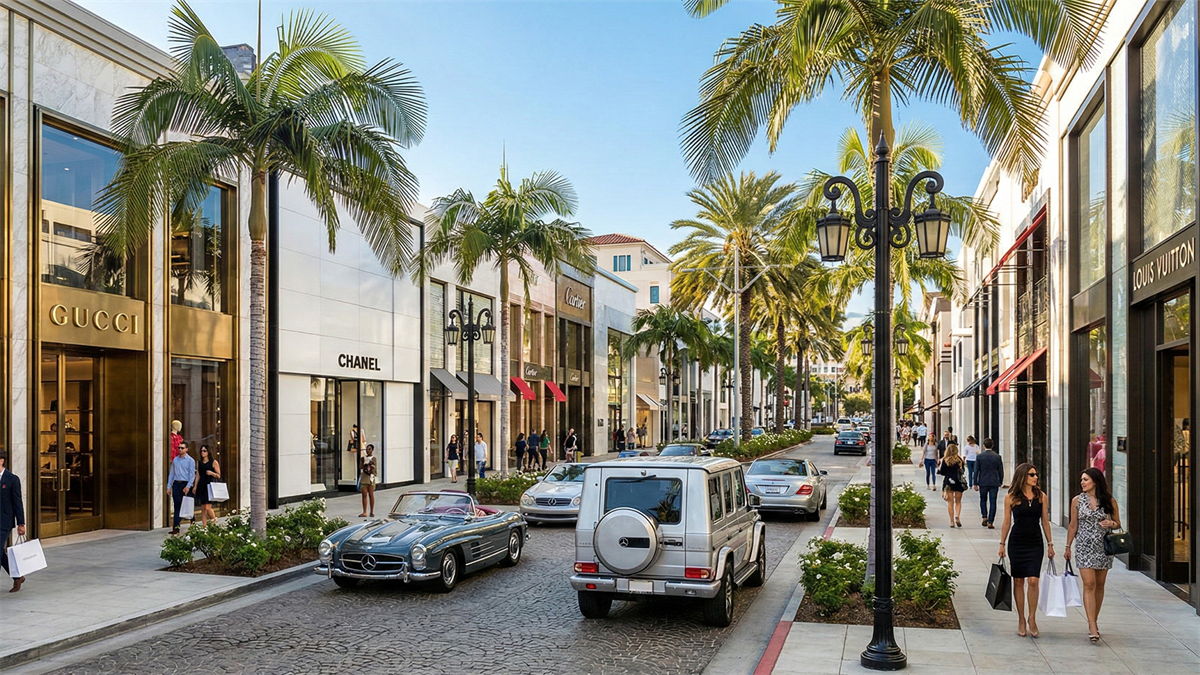
A total of four California districts land in the top 10 alone (Carmel-by-the-Sea, Abbot Kinney, Rodeo Drive, State Street). The appeal ranges from luxury (Beverly Hills) to quirky maker culture (Venice) to art-forward enclaves (Carmel Arts & Design, Hayes Valley). Respondents California’s brand of walkable, creative, slightly dreamy retail clearly travels well nationwide.
New York has two personalities - and America envies both.
New York shows up in two distinct forms:
- The global icons: SoHo and Fifth Avenue (both top five).
- The neighborhood darlings: Williamsburg’s Bedford Ave, Saratoga Springs, Syracuse’s Armory Square, Chapel Hill’s college-town charm, and more.
The split suggests that Americans admire New York’s big, glamorous shopping temples - but also crave the smaller-scale, “liveable” New York that locals brag about.
The South’s strongest entries lean heavily on charm, not luxury.
Tennessee alone places three districts in the top third (12 South, Germantown, Downtown Franklin), all featuring indie boutiques and hyper-local retailers.
The Carolinas follow the same pattern: Greenville, Charleston, Beaufort, Wilmington, and Chapel Hill all rank with small bookstores and long-running local shops.
The South’s retail envy is less about big brands and more about community-first shopping streets with personality.
College towns feature prominently.
Ann Arbor, Chapel Hill, Burlington, Hanover, Princeton, and Providence - all appear with beloved indie bookstores or niche makers.
These aren’t big cities, but their districts rank alongside major metros.
It suggests that walkability + culture + bookstores is a stronger draw than sheer size or spending power.
Hawaii’s shopping districts feature unusually high - and not just because of tourists.
Two Hawaiian districts make the upper tier (Kalākaua Avenue and Haleiwa Town), both blending retail with cultural performance, surf culture, and local makers.
The pattern signals that people envy shopping experiences that feel like a cultural moment, not just a place to buy gifts.
Texas shows a very specific identity: maker-forward, not mall-forward.
The Pearl District in San Antonio, South Congress in Austin, Bishop Arts in Dallas, and The Woodlands all appear, but none are traditional mall corridors.
Instead, the appeal is creativity, reuse, and street-level discovery. Texas districts rank well when they feel handcrafted, not corporate.
Colorado and Oregon form an “outdoor retail” corridor.
Pearl Street Mall (Boulder), Larimer Square and Cherry Creek (Denver), Powell’s and Hawthorne District (Portland), and Whitefish and Bozeman further north all share a pattern:
- Independent outdoor gear
- Artisans
- Strong coffee culture
- Bookstores
Western mountain towns have the strongest “character-per-capita.”
Jackson, Stowe, Whitefish, Bozeman, Ketchum, Moab - all tiny, all memorable.
Their appeal seems to be the combination of tourism + artisan shops + dramatic scenery, which makes even a small main street feel like an event.
Final Thoughts
When we analyzed all 194 envied districts, a clear pattern emerges: Americans don’t envy the biggest or the most expensive places - they envy the most distinctive.
Places with a sense of story. Places where you wander, not just buy. Places with a great bookstore, a beloved coffee shop, a maker’s market, or a street that feels like nowhere else. Luxury still has its place, but identity wins.
Where Should You Invest $1,000 Right Now?
Before you make your next trade, you'll want to hear this.
MarketBeat keeps track of Wall Street's top-rated and best performing research analysts and the stocks they recommend to their clients on a daily basis.
Our team has identified the five stocks that top analysts are quietly whispering to their clients to buy now before the broader market catches on... and none of the big name stocks were on the list.
They believe these five stocks are the five best companies for investors to buy now...
The article "America’s Most Envied Shopping Districts in 2026" first appeared on MarketBeat.