How the Chiefs set up Mahomes extension | QB salaries rising rapidly
There comes a point for an NFL franchise where it should no longer be about leverage or winning a deal, things that come as naturally to most owners as taking their next breath.

Credit to the Chiefs for seeing that much earlier than most would with Patrick Mahomes.
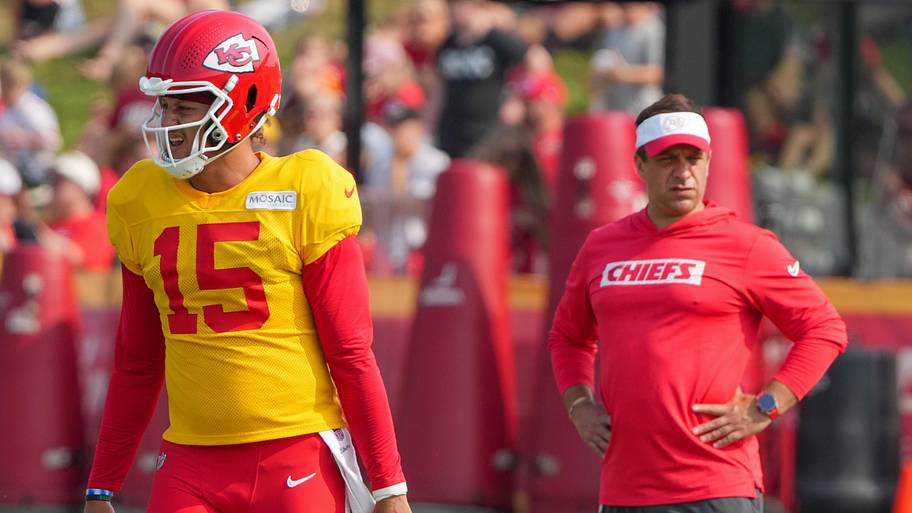
In the summer of 2020, Kansas City struck a historic 10-year, $450 million extension with the then-24-year-old, Super Bowl-winning quarterback. Mahomes’ camp got raked over the coals at the time for signing so much of his future away, at a time when the league’s revenue was headed for the moon and taking the salary cap with it. The first half of the 12-year deal was at $40 million per year, the second half at $50 million per year, and the thinking was that the quarterback market would blow right past that, which has proven to be the case.
We’re now halfway through that timeframe, and it has been 21 months since Dak Prescott pushed the high-water mark to $60 million per year. He’s one of 11 QBs over $50 million.
But what people back then missed was Mahomes’s truth and the Chiefs’ truth in doing that contract. The idea wasn’t to screw a franchise quarterback. It was to forge a partnership that would allow Mahomes to grow the contract and the Chiefs to plan around it. It was to create certainty for everyone for the foreseeable future. And it was with the promise that Brett Veach, Brandt Tilis and Chris Shea were negotiating for Kansas City with Mahomes’s agent, Chris Cabott, not to corner or snooker anyone, but build a dynasty together.
And it was in the midst of a period in which the Chiefs’ belief on how to handle Mahomes as a player and a person was cemented, in part, by virtue of all that was happening around them.
That March, Tom Brady, whose relationship with the Patriots had decayed, left for Tampa via free agency, having given himself the avenue to do so by negotiating a way out in his 2019 contract revision. Months after Mahomes’s deal was done, his draft classmate, Deshaun Watson, asked for a trade out of Houston, and Aaron Rodgers-related drama kicked up in Green Bay.
The idea of franchise quarterbacks bolting was no longer unthinkable. The concept of those players having the agency to force the issue was far more plausible. And the result of the aforementioned situations—the Patriots were the only team of the three that had reason to regret their quarterback’s departure—didn’t matter.
What the Chiefs did was start with chairman/CEO Clark Hunt, realizing how intentional they had to be about having the right sort of relationship—and partnership—with their quarterback. It’s something, internally, they discussed, resolving never to fall into the trap of thinking that the success started with anyone but that quarterback.
Six years later, it’s a big reason why the team has done two new contracts with Mahomes.
Mahomes’s initial intention with the 2020 contract was to make sure he would stay in Kansas City for a long time to come. It was done during the COVID-19 pandemic and amid uncertainty about a salary cap that would almost certainly go down in 2021 (and it did). It was never seen by the team or the player as a deal with terms etched in stone. Rather, it was an agreement that created salary placeholders and flexibility in future years.
It was, again, to create a partnership, one that the Chiefs have shown with their actions that they’ll continue to foster to avoid the sorts of frays that metastasized with those quarterbacks who eventually left Houston, New England and Green Bay.
Chairman and CEO Clark Hunt on Patrick Mahomes’ extension. pic.twitter.com/i4aSQkI4Z4
— Kansas City Chiefs (@Chiefs) June 10, 2026
One example would be how Veach routinely keeps Mahomes informed about how the team is going to address free agency and the draft, detailing plans, not to get Mahomes’s approval, but to give the quarterback a full view of the team’s strategy for building around him. Another would be how, at every turn, he and those closest to him are made to feel at home in K.C. in tangible ways—with one being how his family has a designated area on the sideline, where Mahomes can get to them before a game, and where they can be comfortable before kickoff.
In return, Mahomes lets the Chiefs know what he needs, and almost always, it’s something that won’t be just for him, but his teammates. One such ask, years ago, was that veteran players get the first-class seats on the team plane, a request the Chiefs swiftly fulfilled.
With those lines of communication open and both sides wedded to the other long-term, the contract negotiations, though sometimes complicated, have routinely been smooth.
Three years ago, before the 2023 season, the Chiefs moved $47.05 million from the final five years of the deal into the 2023 to 2026 window, essentially a raise of eight figures per year that didn’t affect the total value of the deal.
This time around, it was a little more complex. Cabott, Veach and Shea—with Tilis since gone to Carolina—huddled after the 2025 draft, more than a year ago, to start discussing how to attack the looming drop in dollars that would come after 2026, with money already moved from 2027 and thereafter to get Mahomes’ pay right in the moment. Since the three have traded concepts and models and kept chipping away at it, which brings us to another key point.
There was no mud slung. Cabott’s role in the negotiation was to be persistent. The Chiefs were, in turn, responsive. There was none of the, “Well, he’s under contract” rhetoric that you usually get when a team is frustrated with talks in these sorts of conversations. And when Mahomes blew out his ACL and LCL in December, the team, in the ultimate show of good faith, the team kept the train moving toward a landmark new agreement.
That agreement came last week, with an affirmation of where the Chiefs stand on their quarterback, reconstructed knee and all, coming in the margins the deal created with the highest-ever total average per year on an NFL contract (a tick over $63 million) and the highest new-money calculation (he gets $239.05 million in new money for adding two new years, which comes out to nearly $120 million per) of all-time.
With eight years left on the revised contract now, the Chiefs and Mahomes will probably be back at the table another three years from now, they hope with another Lombardi Trophy or two in the case, to discuss how to update and improve the deal. And when they get there, they’ll attack that challenge the same way they have all of them—together.
It’s a pretty simple idea, yes, when you have a player that great.
Good on the Chiefs for knowing how good they have it.