Get all your news in one place.
100's of premium titles.
One app.
Start reading
The Economic Times
The Economic Times

After losing Indian steel empire, the Ruias eye another in the US

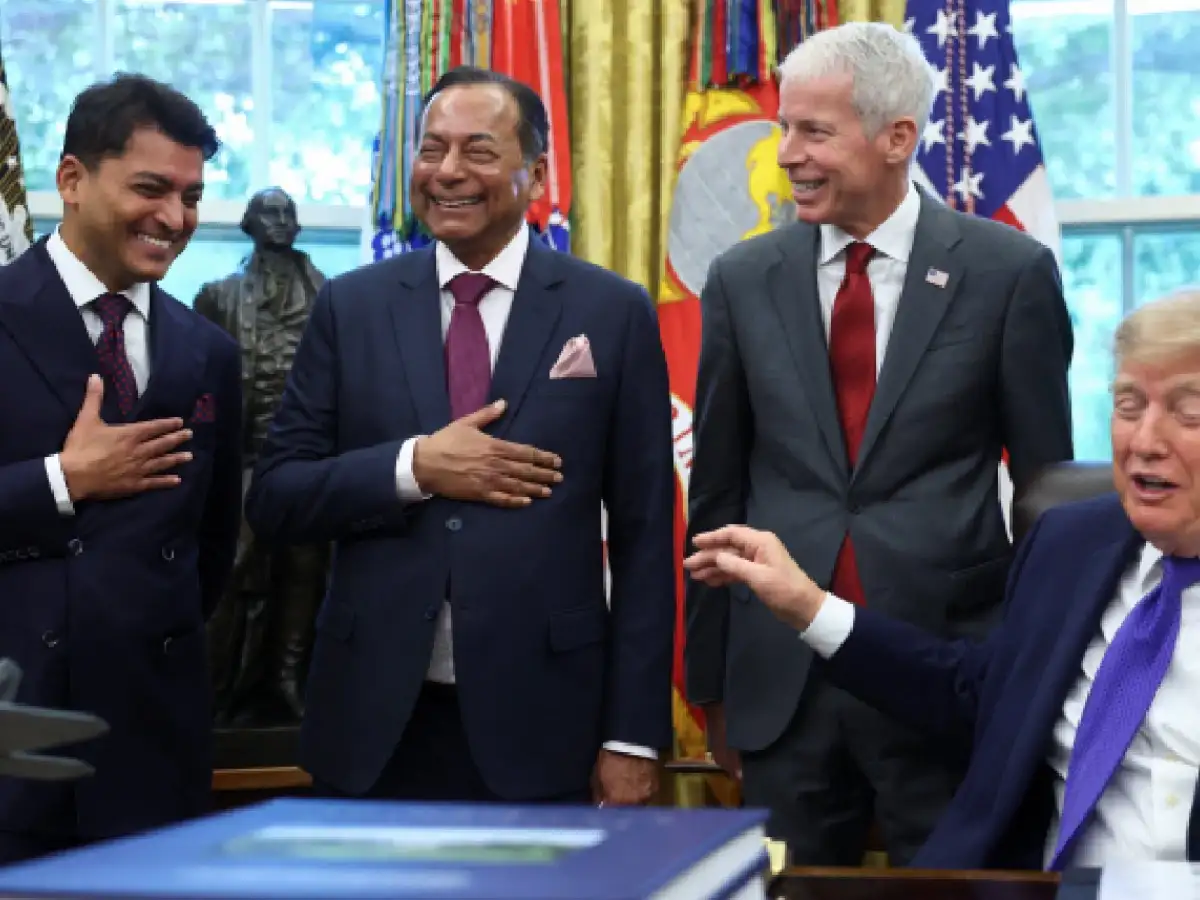
The Ruias built Essar Steel into one of India's largest privately owned steel businesses before it went bankrupt in 2017 and was eventually bought by ArcelorMittal in 2019. Now, almost a decade later, the Ruias are seeking to build a new steel business in the US with an ambitious project President Donald Trump has just announced as "the largest plant in America by far.

The Ruia family business empire began in 1969 when founders Ravi Ruia and his elder brother late Shashi Ruia started a construction and pipeline company in Chennai, which rapidly grew into the sprawling Essar Group. At its peak, the conglomerate owned a massive portfolio spanning steel manufacturing, oil refineries and retail stations, global shipping fleets, telecom networks (Hutchison Essar), power plants and major ports.
Also Read: Essar to invest $18 billion in US, build America's largest steel plant in Iowa

However, under intense regulatory and financial pressure during India's mid-2010s bad-loan crisis, the group lost its crown jewels. It was forced to sell Essar Oil to Russia's Rosneft for $13 billion and lost control of Essar Steel to ArcelorMittal via corporate bankruptcy proceedings, alongside shedding its telecom and telecom-tower assets.

Currently, the transformed group is spearheaded by the second generation of the family, primarily Prashant Ruia (Director) and Rewant Ruia (Director), who are steering the conglomerate's pivot into green energy and global infrastructure.

How the Ruias built and lost Essar Steel

The Indian steel story happened along with the wider expansion of the Essar Group. During the 2000s and early 2010s, the group invested heavily in steel, oil and power. ET reported in 2017 that Essar had spent about $18 billion over the previous decade on its industrial businesses. By March that year, its long-term debt stood at Rs 1.05 lakh crore, with another Rs 30,000 crore of working-capital borrowing. The sale of Essar Oil was subsequently expected to reduce group debt substantially.

Essar Steel was at the centre of this expansion. When it entered India's insolvency process in 2017, financial creditors had filed claims of roughly Rs 49,000 crore.

The company continued operating during insolvency. Its resolution professional reported EBITDA of Rs 4,229 crore during the 600-plus-day resolution period while creditors and prospective buyers worked through its financial problems.

The Ruias had said that external conditions had played a major role in the company's difficulties.

The attempt to retain Essar Steel

The Ruias sought to keep the company rather than simply exit once insolvency began. In October 2018, they offered to pay Rs 54,389 crore to settle Essar Steel's creditors. The proposal included Rs 47,507 crore of upfront cash. The Committee of Creditors did not accept the proposal and ArcelorMittal's resolution plan ultimately prevailed.

In November 2019, the Supreme Court cleared the way for ArcelorMittal's takeover. The resolution plan was worth about Rs 42,000 crore. Rs 2,500 crore of this was earmarked as working capital for Essar Steel, with the balance going towards creditor recovery.

Also Read: AM/NS takes over banks' claims linked to Essar Group promoters' personal guarantees

For the Ruias, the result was the loss of their flagship steel company, and for the lenders, the resolution recovered a large portion of the money owed to them.

The Ruias' American entry

The story of Essar's American steel ambitions began before the Indian insolvency. Essar acquired Minnesota Steel Industries in 2007 and planned an integrated operation at Nashwauk, combining an iron-ore mine, pellet plant and steelmaking facilities. Construction began in 2008.

A combination of project delays, cost increases, financing difficulties and a weak commodities market led to the eventual failure of the Minnesota operation.

ET had reported in 2016 that the original project had been designed for 4.1 million tonnes of annual pellet production at an estimated cost of $1.8 billion. Essar later expanded the planned capacity to 7 million tonnes and the estimated cost rose to about $2.2 billion. The completion date was repeatedly pushed back. ET reported that an additional $260 million of financing was required largely because of EPC cost escalation and interest during construction.

There were also problems on the ground. Reportedly, construction had repeatedly stopped as cash became scarce and contractors went unpaid and workers were pulled from the project.

The market environment was deteriorating at the same time. Iron-ore prices had weakened, Chinese steel imports were putting pressure on the US market and demand for pellets was poor. Essar Steel Algoma in Canada, which was expected to take Minnesota's output under an offtake arrangement, had itself entered bankruptcy protection in 2015.

Financing eventually became the immediate constraint. Davidson Kempner had committed a $450 million financing facility, but about $80 million remained undisbursed after project milestones were missed. Indian lenders also had substantial exposure but were reluctant to provide additional financing.

The project also developed differences with the State of Minnesota. Essar had received state support and was facing demands linked to missed deadlines and payments. The dispute extended to Essar's mineral leases. Minnesota Governor Mark Dayton moved to terminate the company's leases after the project missed deadlines, while Essar challenged the state's action.

By then, the financing problems, construction delays, market conditions and disagreements with state authorities had converged. Essar Steel Minnesota filed for Chapter 11 protection in 2016. Indian lenders led by ICICI Bank pursued the company over defaults on a loan of about $530 million.

Essar Group got the project back

The Minnesota operation was subsequently restructured as Mesabi Metallics, and Essar eventually returned to the project. The mine has since become the foundation for the group's renewed American steel ambitions.

Essar has invested more than $2.5 billion in the Minnesota operation. The mine has been described as Minnesota's first new iron-ore mine in 50 years.

External financing has also been raised for the Minnesota project. Mesabi has secured financing from outside investors including Breakwall Capital and Macquarie, while US government financing has also been associated with the mine's development.

The new Iowa steel project

That Minnesota mine is now intended to supply a new integrated steel operation in Iowa. Trump, along with Ravi Ruia and his son Rewant, announced on Monday Mesabi Metallics' plan for a $15 billion steel plant in Iowa. Reuters reported that the first phase is designed to produce 7.5 million tonnes of steel annually, eventually rising to 10 million tonnes. First steel is targeted for 2030. The project is expected to create about 1,750 permanent jobs, with as many as 6,000 construction jobs during the first phase.

The total Minnesota-and-Iowa investment is approximately $18 billion, with roughly $15 billion associated with the Iowa steel plant. Around $3 billion is associated with the Minnesota operation and the Ruias have already invested $2.5 billion in the operation.

Importantly, the proposed structure is vertically integrated. Iron ore from Mesabi's Minnesota mine would feed the Iowa steel plant, linking the group's American mining and steelmaking operations.

Reuters reported that the US Export-Import Bank had recently committed financing for expansion of the Minnesota mine.

The American venture is a new phase rather than a simple recreation of the old Essar Steel business. The Indian company that the Ruias lost in 2019 was a large operating steelmaker carrying substantial financial obligations. Though the Minnesota venture had its own history of construction delays, financing difficulties and bankruptcy, the proposed Iowa project is being built around the Minnesota iron-ore resource that Essar has spent years developing since returning to the asset.

The new proposal is considerably larger in physical scale than the original Minnesota steel plan, with a proposed 10-million-tonne eventual capacity. Its financing will have to be developed alongside construction, while the Minnesota mine provides the raw-material base. Trump's steep 50% steel tariffs might ensure steady local demand.

Sign up to read this article
Read news from 100's of titles, curated specifically for you.
Already a member? Sign in here
Related Stories
Top stories on inkl right now
One subscription that gives you access to news from hundreds of sites
Already a member? Sign in here
Our Picks
Fourteen days free
Download the app
One app. One membership.
100+ trusted global sources.