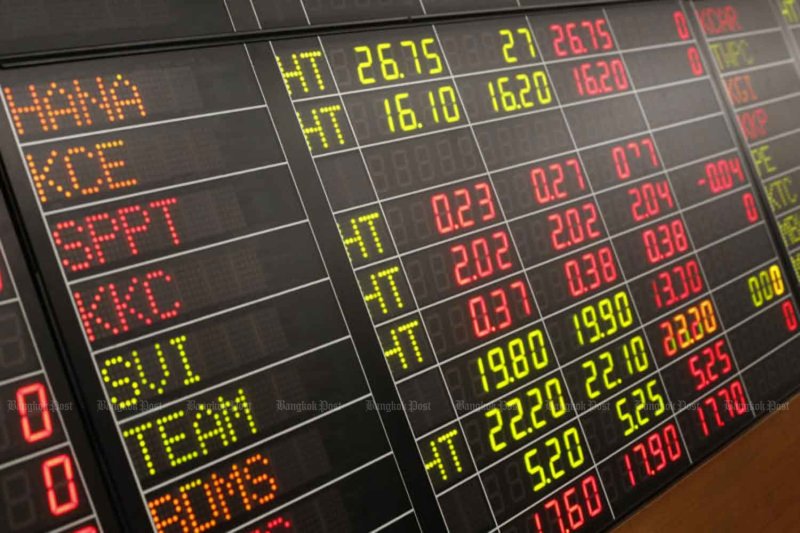
Thailand's bourse is expected to remain a bull market for 1-2 years, with the benchmark index projected to reach 1,700 points by the end of 2026, assuming economic and political fundamentals remain stable, says the Federation of Thai Capital Market Organizations (Fetco).
Fetco chairman Paiboon Nalinthrangkurn said Thai equities have rebounded strongly this year, outperforming many global markets as the country benefits from investment related to artificial intelligence (AI) and the relocation of global manufacturing supply chains.

"We expect the Stock Exchange of Thailand [SET] to remain a bull market for 1-2 years if the underlying fundamentals remain intact," he said.
Fetco recently lifted its SET index estimate to 1,700 points from 1,500 points, citing the government's recent measures and initiatives.
FOUR PILLARS
According to Mr Paiboon, there are four drivers behind the positive outlook. First, the global economy remains resilient despite geopolitical tensions, inflation and elevated interest rates. Meanwhile, Thailand continues to attract foreign direct investment as multinational companies diversify their supply chains.
Thailand's geopolitical neutrality, improving political stability and business environment have made the country an attractive manufacturing hub, he noted.
Third, listed companies are expected to post stronger earnings after years of cost reductions and wider adoption of AI. Analysts forecast annual profit growth of 8-10% this year as economic activities improved.
Finally, long-term investment initiatives, including the tax-deductible Thai ESG funds, are expected to provide structural support through sustained domestic capital inflows, said Mr Paiboon.
Applications for investment promotion submitted to the Board of Investment reached 1.4 trillion baht in the first half of 2026, already exceeding last year's full-year record of 1.3 trillion. Most investment targets new economy sectors such as data centres, advanced electronics and digital infrastructure.
The surge signals foreign investor confidence in Thailand's medium-term growth prospects, although actual investment will be phased in over several years, he said.
STRUCTURAL REFORMS
Fetco views the SET's Jump Plus programme as helping to unlock shareholder value, particularly among companies trading below book value.
More than 470 listed firms, roughly 61% of the SET, currently trade below book value.
Meanwhile, the proposed Thailand Individual Savings Account is expected to become a permanent tax-incentive savings scheme encouraging long-term household investment, with final details expected from the Finance Ministry next month.
Mr Paiboon said Thailand is benefiting from the AI boom through electronics exports, data centre investment and expanding digital infrastructure, although relatively few pure AI companies are listed on the exchange.
Regarding cybersecurity, the recent cyber-attack involving the Thailand Securities Depository had limited impact on institutional and foreign investor confidence because core trading systems remained secure, he noted.
Capital market participants responded by strengthening cybersecurity measures, increasing stress testing and enhancing system monitoring to address sophisticated cyberthreats, according to Fetco.
SAVINGS LOTTERY
In a related development, the Securities and Exchange Commission (SEC) launched a public consultation on draft regulations that would allow Government Housing (GH) Bank's savings lottery certificates to be eligible investment assets for mutual funds.
Under the proposal, GH Bank savings lottery certificates would be classified as deposits or deposit-equivalent instruments, aligning investment rules similar to those already applied to savings lottery products issued by other state-owned specialised financial institutions.
The proposed amendment would apply to retail mutual funds, accredited investor funds and provident funds, while maintaining existing requirements on portfolio diversification, concentration limits, asset suitability assessments and disclosure standards to safeguard investors.
Fund management firms remain subject to investment limits on individual issuers and corporate groups to mitigate concentration risk.
The SEC is accepting comments on the draft regulations until Sept 2 before finalising the rules.