
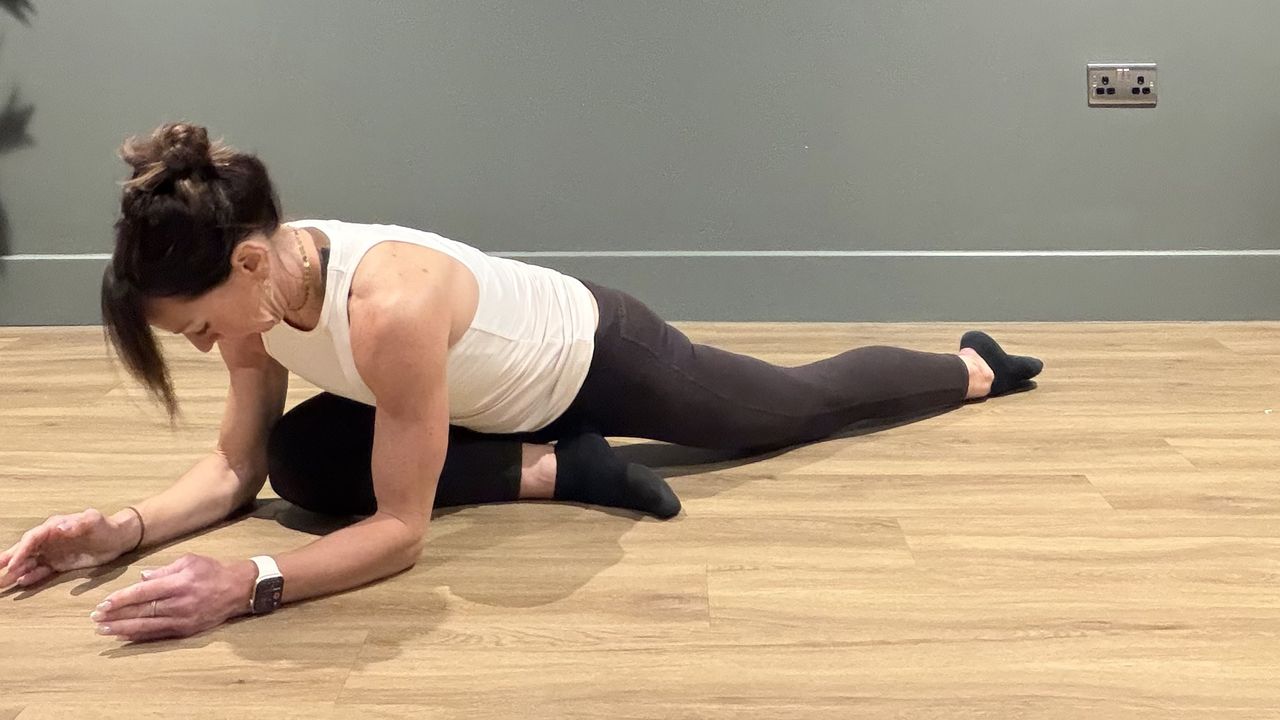
If you’ve spent all day hunched over a desk, run a long session, or just feel tight from life, a quick stretch can feel like magic. But which moves are actually worth your time?
Dr Jordan Ashley, certified Yoga Instructor and Founder of Souljourn Yoga Foundation, says the pigeon pose is one of those exercises.

“Personally, I do it every single day,” she says. “If I had to pick just one stretch for the rest of my life, this is it.”
Dr Ashley says that nothing beats the pose for overall health, mobility, and stability, as it helps stretch the quads, hips, glutes, and lower back in one fell swoop.
"Not only is pigeon a gentle hip opener, but it’s also a forward fold, which is great for calming the parasympathetic nervous system, whilst enhancing flexibility and promoting overall well-being,” she adds.
How to do pigeon pose
- Stand at the front of your mat with your feet hip-width apart and your arms alongside your body.
- Exhale, and come into a standing forward bend.
- Inhale, and go into a forward lunge with the right leg forward and the left leg back.
- Exhale, and place the outside of your right shin on the mat in front of you, with your right heel near your left hip.
- Place the left knee down on your mat with your left foot facing the ceiling.
- Place the palms down in line with your right foot. Inhale, press your palms into the floor, straighten your arms, and simultaneously elongate your spine. Open your shoulders and chest, lift your sternum, and look up.
“Keep your wrists in the same plane as the knee,” suggests Ashley, “and to make the pose less intense, angle your foot closer to your hip.”
“If your sitting bone doesn’t connect with the ground, place a blanket or pillow underneath, and you can also support your heart and forehead by placing a block underneath your sternum and brow bone.”
The benefits of the pigeon pose
If you sit all day, run, cycle, or feel that you live life in a chair, you’ll love pigeon. It helps prevent hip stiffness, improve mobility, ease lower back tension, and reduce the risk of strains or imbalances.
“Pigeon pose involves a deep stretch of the muscles surrounding the hips, including the hip flexors, external rotators, and glutes,” says Ashley.
“These muscles are often tight due to prolonged periods of sitting, lack of movement, or engaging in activities that involve repetitive hip motions like running or cycling,” she says.
As with other yoga poses, pigeon pose also encourages deep breathing and mindfulness, “helping to draw the focus inward and calm the mind,” says Ashley.
“It’s also great for posture, relieving tightness in the lower back and inviting energy to flow through the pelvis, low back, and inner thighs.”
How often should you do it?
“I would definitely recommend doing this stretch at least three times a week, starting with one minute and increasing to five minutes for a more yin-like variation,” says Ashley.