Get all your news in one place.
100's of premium titles.
One app.
Start reading
The Conversation
The Conversation
Daniel Rubenson, Professor of Political Science, Toronto Metropolitan University

A study of close to half a million soccer fans shows how group identity shapes behaviour

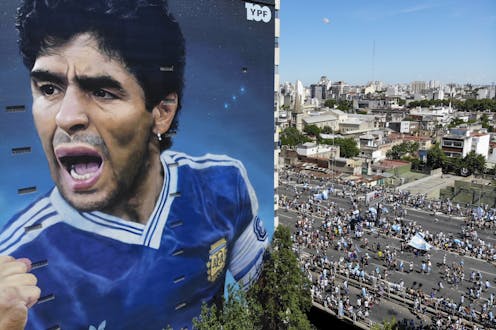
Argentina fans celebrating their team's World Cup victory walk past a mural of Diego Maradona in Buenos Aires. While shared nationality is a factor, most fans typically think about players in terms of their club team. (AP Photo/Mario De Fina)

On Dec. 18, Argentina defeated France after penalties in what some have called the greatest World Cup final ever. For one month the attention of soccer fans from Brazil to Morocco was devoted to their national teams as the Seleção Canarinho, Atlas Lions and 30 other teams battled through the tournament in Qatar.

Now fans’ focus is returning to Real Madrid, Chelsea, AC Milan and other clubs, as the major domestic leagues resume matches. Argentina’s hero, Lionel Messi and France’s superstar Kylian Mbappé, rivals on the pitch in Qatar just a few weeks ago, are now back in their familiar roles as teammates at Paris Saint-Germain.
Sign up to read this article
Read news from 100's of titles, curated specifically for you.
Already a member? Sign in here
Related Stories
Top stories on inkl right now
One subscription that gives you access to news from hundreds of sites
Already a member? Sign in here
Our Picks
Fourteen days free
Download the app
One app. One membership.
100+ trusted global sources.