
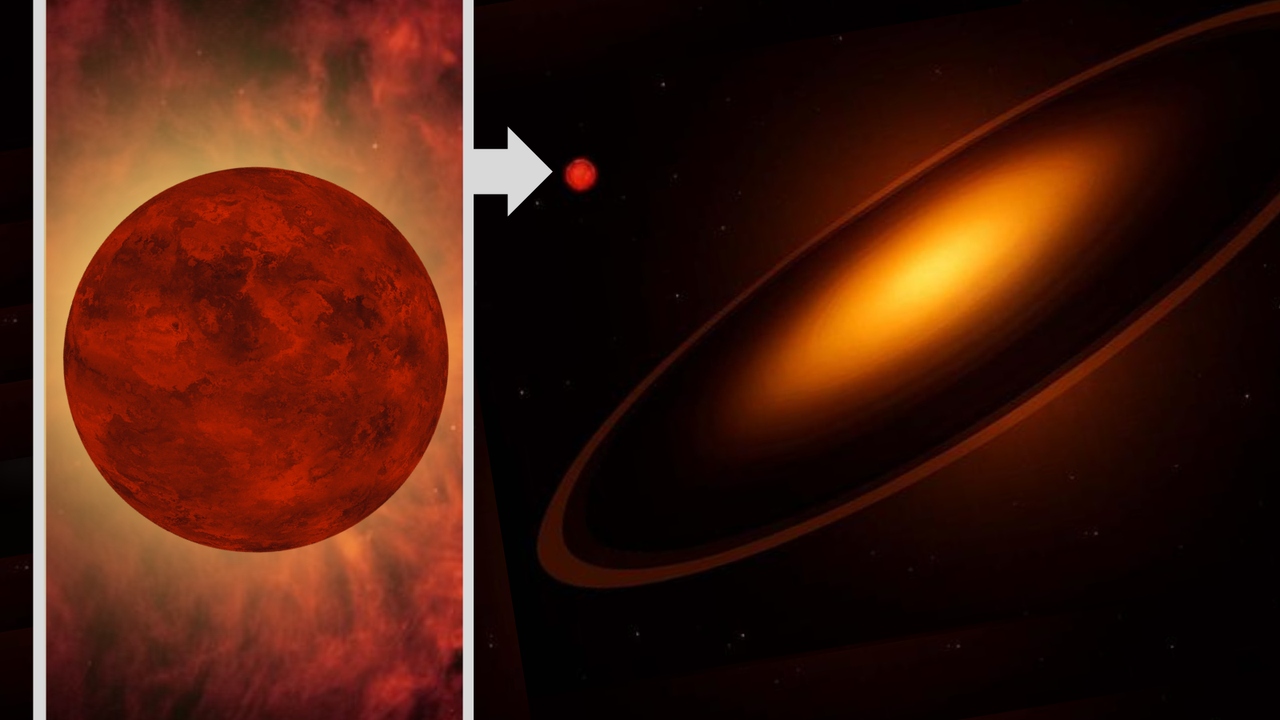
Scientists investigating the puzzling, long-lasting, and extreme dimming of a distant star have narrowed the suspects down to either a so-called "failed star" brown dwarf or a truly massive super-Jupiter exoplanet.
The dramatic fading of this star, located around 3,200 light-years away in the Monoceros constellation, was first spotted at the end of 2024. The dimming came as a surprise, as the star, designated ASASSN-24fw and measuring around twice the size of the sun, had previously been known to be stable. The stellar dimming was one of the longest ever observed, lasting for around 200 days. It was also extreme, with the brightness of ASASSN-24fw reduced by 97%. Such extreme and long-duration dimming events are incredibly rare.
Astronomers deduced that this dimming was caused by the saucer-like rings extending out from 15.8 million miles (26 million kilometers), or about half the distance between the sun and its closest planet, Mercury. The big question is, what is this ring system looped around? The leading suspects have now emerged as a brown dwarf or a massive extrasolar planet, or exoplanet, many times the size of Jupiter, the solar system's largest planet.









