Get all your news in one place.
100's of premium titles.
One app.
Start reading
Fit & Well
Fit & Well
Health
Alice Porter

A kinesiologist and yoga therapist recommends this 10-minute routine for people in their 50s, 60s and 70s who want to feel more confident with exercise

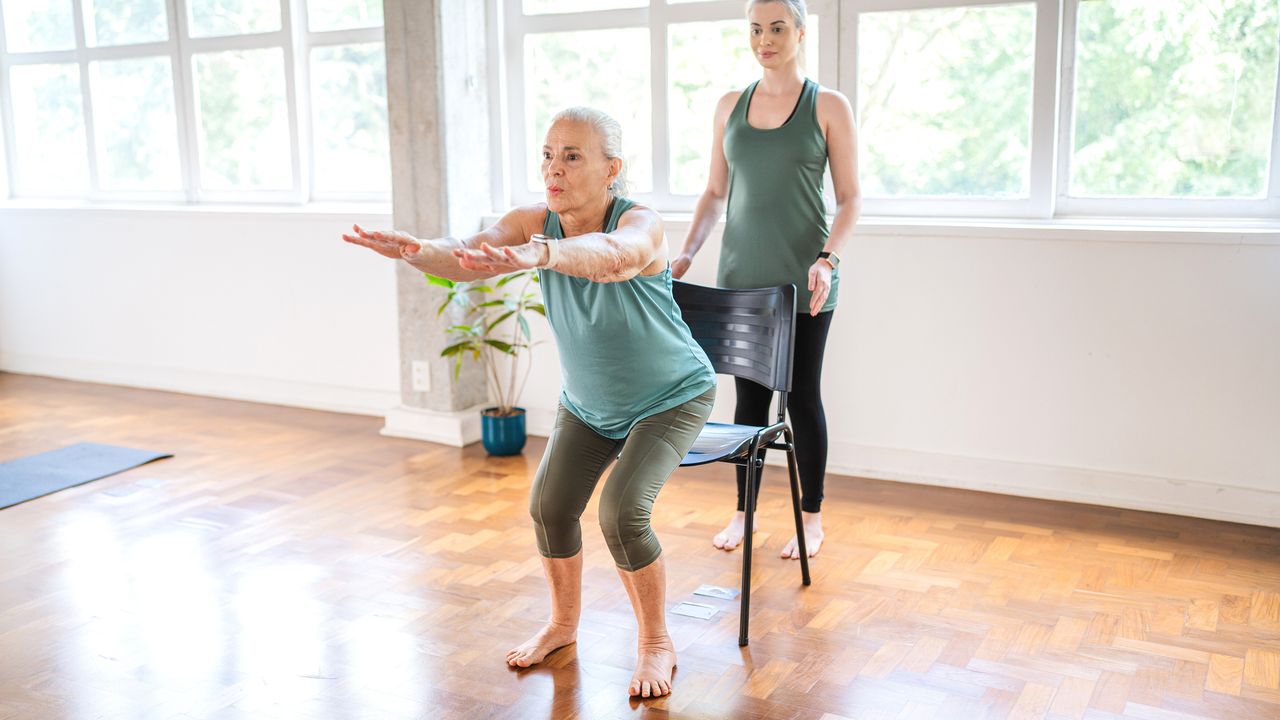
Woman squatting into chair with a personal trainer behind her.

As you get older, you may understandably feel wary of throwing yourself into high-intensity workouts in case you damage your body, and this nervousness may mean you end up avoiding exercise altogether.

If that sounds familiar, kinesiologist and certified yoga therapist Bobbi Lalach recommends building confidence and body awareness.

“I work with people who have often been told they are fine or cleared [to exercise by their doctor], but still don’t feel confident, strong or comfortable in their body,” she tells Fit&Well. “I help them rebuild trust in their body through simple, structured and doable movement.”

Lalach has put together a 10-minute routine for people in their 50s, 60s and 70s who are feeling hesitant about exercise. Perhaps you’re stiff, achy or hesitant to move after injury or long periods of inactivity.

“Rather than focusing on intensity or pushing through discomfort, this routine helps people reconnect with their body through small, manageable movements that build awareness, confidence and ease,” Lalach explains.

“The exercises are beginner-friendly, require minimal equipment and can be done at home in about 10 minutes,” she adds.

10-minute body awareness and confidence-building routine

1. Walking check-in

Time: 15-30sec

Before starting the exercises, slowly walk around your space for 15 to 30 seconds.

As you walk, notice different parts of your body:

  • Feet
  • Ankles
  • Knees
  • Hips
  • Chest
  • Shoulders
  • Neck
  • Head

“There is nothing to fix. The goal is simply to notice what feels tense, heavy, stiff, light, easy or effortful before beginning,” Lalach says.

2. Triangle of support squat

Reps: 5-8

  • Stand near a chair, wall or counter for support with your feet hip-distance apart.
  • Bring awareness to the triangle of support in the soles of your feet: your big toe, the base of the little toe and your heel.
  • Inhale and exhale here, lightly holding your support if needed.
  • Gently bend your knees and hips to lower, as though you’re sitting in a chair.
  • Move within a range that feels comfortable and safe.
  • Return to standing slowly.

Expert tip: “Repeat and notice whether anything changes in your triangle of support and if there’s any tension in your body. If you notice gripping or tightness, pause and take a breath then reduce your depth of movement and try again with less effort. The goal is not a deeper squat—the goal is ease and awareness,” says Lalach.

2. Shoulder blade slide

Reps: 5-8

  • From a seated or standing position, feel your base of support—either through your feet or your hips.
  • Take a slow inhale and exhale.
  • Bend your elbows to 90° in front of your body with your palms facing each other.
  • Gently slide your elbows behind you and back to the starting position.

Expert tip: “Pay attention to your neck, shoulders, jaw and rib cage to notice whether you’re holding or bracing. If you feel any strain or tension, make the movement smaller and slow it down,” says Lalach.

3. Supported hip swing

Reps: 5-10 each side

  • Stand with one foot on a yoga block or thick book with a wall, counter or chair beside you for support.
  • Feel your triangle of support—from your big toe, the base of your little toe and your heel—on your standing foot.
  • Take a slow inhale and exhale.
  • With your moving leg straight, but without locking your knee, gently swing it forward and backward.
  • Allow the movement to come from your hip socket without moving your ribs, chest or lower back.
  • Do all your reps on one side, then switch sides.

Expert tip: “As your leg moves, notice whether your body braces or stiffens, particularly around your ribs and chest. Pay attention to your breathing too. Only move within the range where your leg can move freely in the hip socket without tension elsewhere,” Lalach explains.

4. Supported hip rotation

Reps: 5-8 each side

  • Stand with one foot on a yoga block or thick book with a wall, counter or chair beside you for support.
  • Bring your moving leg next to your standing leg.
  • Slowly rotate your leg inward and outward within the hip socket—this is a very small movement.
  • Keep your hips stable and facing forward throughout the movement.
  • Do all your reps on one side, then switch sides.

Expert tip: “Imagine your pelvic bones have headlights on and these should point forward at all times while your leg rotates. Notice if your pelvis tries to turn or if your ribs shift. Be aware of your jaw tightening and try to keep the movement small and easy,” says Lalach.

5. Foot rolling

Time: 1-2min each side

  • Either sitting or standing, place a weighted ball, tennis ball or another small, firm ball under the arch of your foot.
  • Slowly and gently roll your foot over the ball, controlling the pressure carefully—it should feel like a gentle massage.
  • You can also explore the heel, ball of the foot and outer edge of your foot’s arch.

Expert tip: “Pay attention to pressure changes, tension and sensations in your foot and leg,” says Lalach.

6. Walking check-in

After finishing the exercises, repeat the original walking check-in.

“Does anything feel different?” Lalach says. “Do your feet feel lighter or heavier? Is there less tension anywhere? Do you feel more grounded? Does walking feel smoother or easier?

“There is no right answer. The goal is simply building awareness and helping your body reconnect with movement in a gradual, supportive way.”

Sign up to read this article
Read news from 100's of titles, curated specifically for you.
Already a member? Sign in here
Related Stories
Top stories on inkl right now
One subscription that gives you access to news from hundreds of sites
Already a member? Sign in here
Our Picks
Fourteen days free
Download the app
One app. One membership.
100+ trusted global sources.







