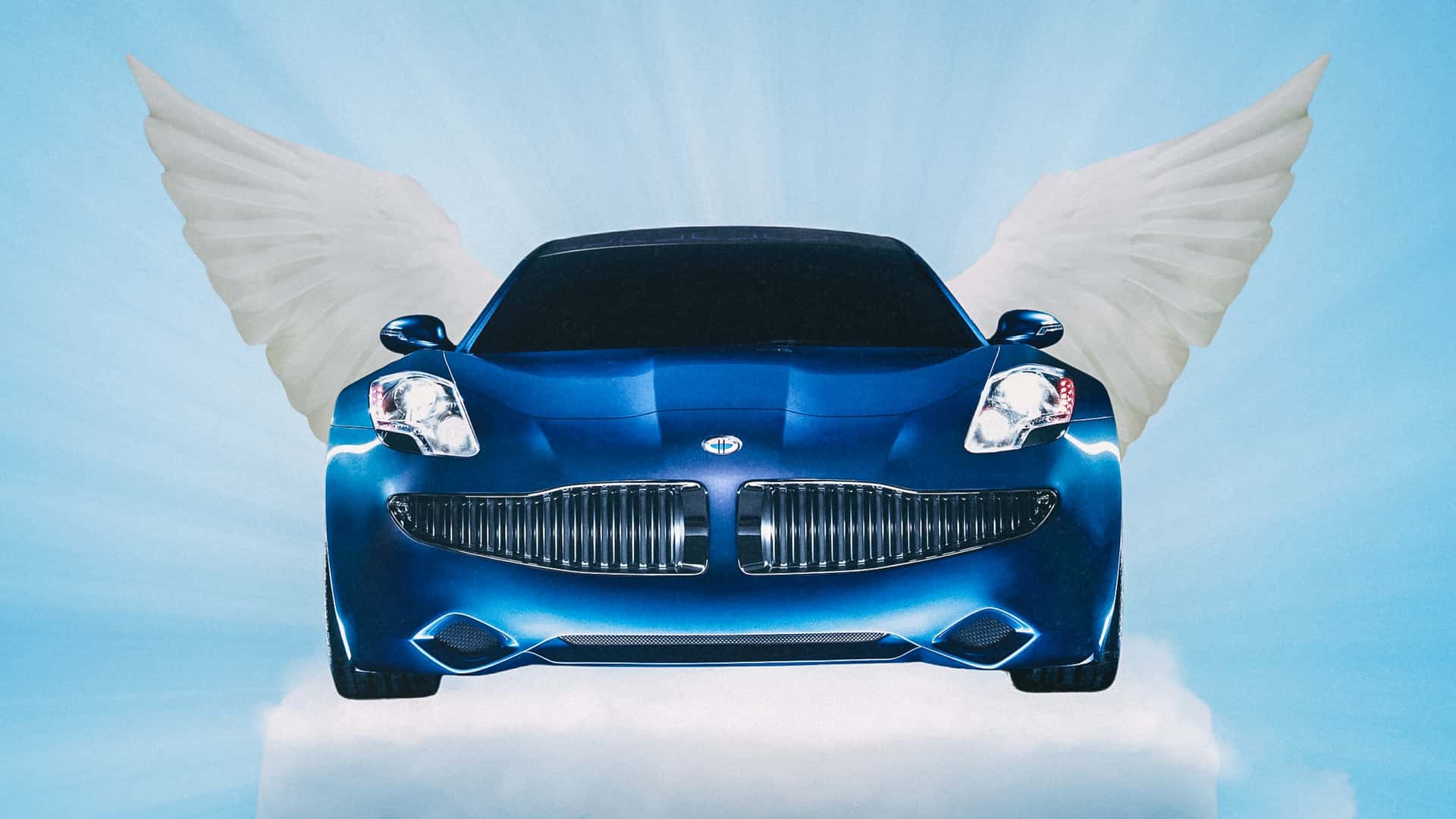
The Karma Revero has died at the age of 14, surrounded by… nobody. Actually, if we want to be technical, the Karma Revero died at the age of nine.

The Revero’s story is a weird one. It sits at the intersection of an ambitious designer, a natural disaster, and a last-minute buy-out by a Chinese car company. If it all sounds complicated, that's because it is.
The story starts with Henrik Fisker. Henrik is an accomplished designer known for such cars as the BMW Z8, the Artega GT, and, most importantly, the Aston Martin DB9, which is often regarded as one of the best-looking cars of the 2000s. One could argue that Henrik had accomplished everything he set out to.
But, oh no, he wanted more. Much more.

In 2007, Henrik founded Fisker Automotive. It originally started as a "coachbuilding" company that would put custom bodywork over existing cars. Fisker created such beauties as the Tramonto, a redone Mercedes SL, and the Latigo, a redone BMW 6 Series. But coachbuilding wasn’t Henrik’s passion. He wanted to make a real car from the ground up.
That’s how we got the Karma. The Fisker Karma launched in 2010 as one of the first luxury hybrids on the market. At first glance, it looked great, both physically and technically.
The design was stunning. Fisker had always been a great designer, and the Karma was no exception. It had a long hood and short hips, and the cabin was littered with faux-leather seats and reclaimed wood accents. And that was just the stuff you could see.

Under the skin, the Karma had a 2.0-liter Ecotec engine paired to a mild-hybrid system that yielded 52 miles per gallon. Performance was fine, but the goal was efficiency, and the Karma hit Prius numbers with ease. Keeping with the eco-friendly theme, the Karma even had roof-mounted solar panels, which quickly became its defining feature.
So, mission accomplished, then. Henrik created a beautiful hybrid that broke the stigma and would send him well on his way to automotive dominance. Right?
Coachbuilding wasn’t Henrik’s passion. He wanted to make a real car.
In many ways, the Karma was the first hybrid that people took seriously. This chic aesthetic caused it to skyrocket in the type of Hollywood circles that care about form over function, and soon everyone from Angelia Jolie to Justin Bieber had a Karma. Before that, hybrids were mostly cheap economy cars lauded by British car journalists and the small children who watched said British car journalists.
The Karma broke the levee. Sure, hybrid technology would inevitably make its way to more exciting and more interesting cars, but someone had to get there before the McLaren P1s and BMW i8s of the world, and that someone was going to be Henrik Fisker and his mustache-you-a-question grille.
Now, it’s time to let you in on a little secret: the Karma sucked.
Despite its exciting arrival, the Karma fell flat on its face from the moment it was released. It was recalled for battery fires less than a year into its production run, and because of the enormous cost to fix them, investors quickly backed out. Fisker went bankrupt.

In two years, Fisker moved just over 2,000 Karmas, a number that fell far below expectations, making it impossible to continue operation. So, Fisker closed up shop and put its unsold inventory in a parking lot in New Jersey… which was then promptly destroyed by Hurricane Sandy.
This is where the natural disaster part comes in. Truthfully, the Karma never really deserved that treatment from Mother Nature; it was a mean punch-down from the powers that be. Nonetheless, in 2014, a deal with some Chinese investors, Fisker (Henrik, not the brand), sold the rights to the Karma to the newly formed Karma Automotive, set up specifically to produce the Karma under its new government name: Revero.
By the time the Revero launched, it was 2017. Keen readers will note that that’s a full seven years after the original Karma was introduced to the public. So, naturally, there had to be a ton of changes, right? Well, sort of.

The first Revero received an updated powertrain… and not much else. The real changes came with the Revero GS-1, released in 2021, which turned the Revero into a plug-in hybrid, making over 580 horsepower, which is no number to scoff at. Alas, despite how many new materials were shoved into the cabin or how many updated powertrains were fitted to the car, the Revero was still, by this point, an 11-year-old vehicle. And nobody really cared.
The Revero spent its final five years of life doing the same thing my grandfather did for his: not much. Harsh, but true. Dealers struggled to sell them, the cars struggled with quality control issues, and crucially, customers simply weren’t interested.
Here and now in 2025, it’s the age of the Model 3 and BYD. Nobody knows what a Revero is. It was outclassed by everything. Even Henrik Fisker, the machine's creator, moved on to try out the Fisker brand again without the Karma’s involvement. (Spoiler alert: Another failure).
The Revero spent its final five years of life doing the same thing my grandfather did for his: not much.
And that brings us back to today, as we stand in front of the coffin of a car that changed more about itself in a few years than most people change about themselves in a lifetime. A car that once upon a time was the next-best thing. A car that was hurt by the forces around it.
Fisker Karma / Karma Revero, thank you for being the first cool hybrid of the 2010s, and thank you for outliving the brand that birthed you. May you find your space in the great junkyard in the sky.
You are all free to leave; concessions are out the door and to the right.