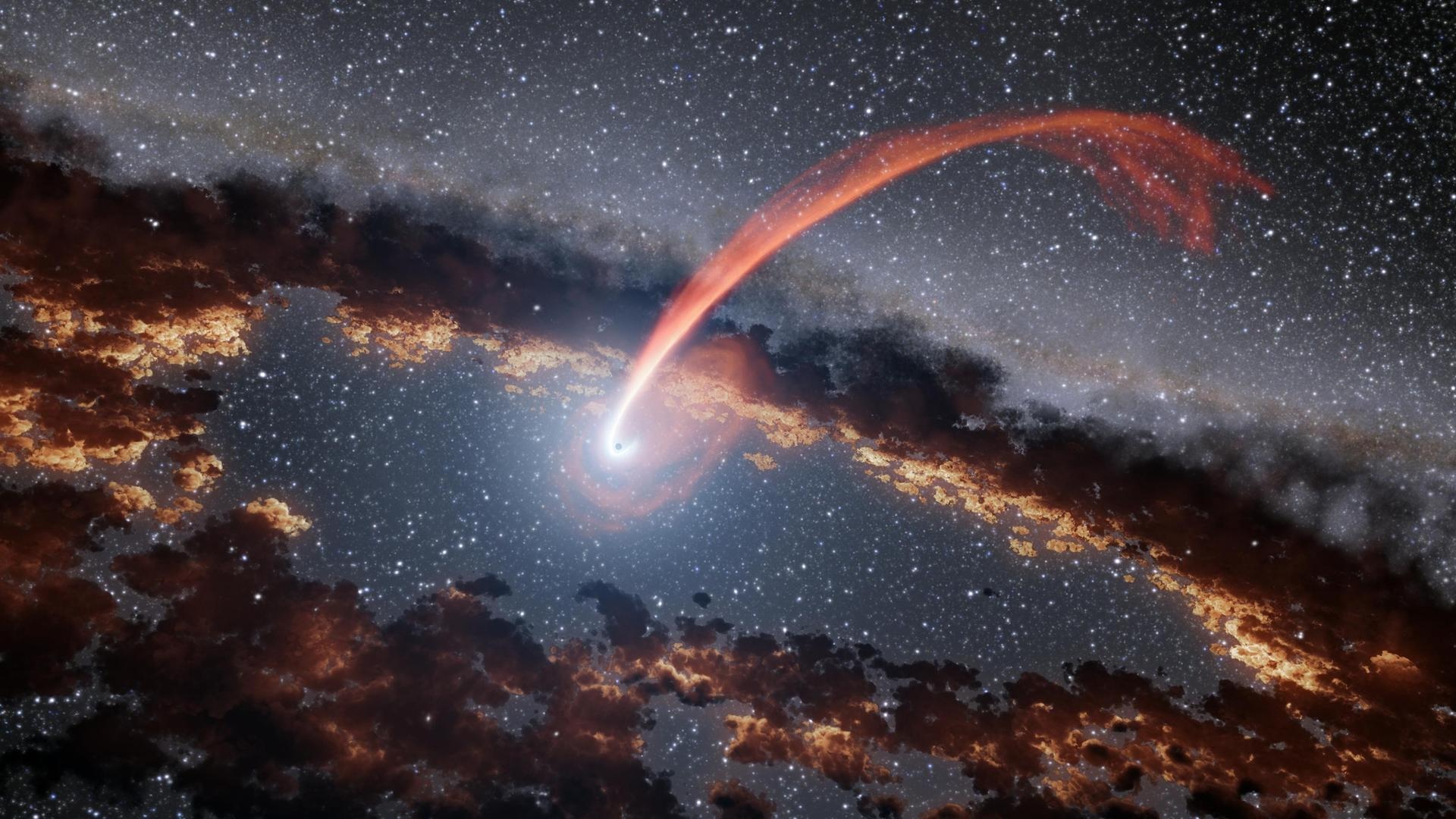
The Milky Way has millions of small black holes and one giant supermassive black hole at its center. But does the galaxy have any medium-sized black holes? New research suggests the answer is yes: Perhaps a dozen may inhabit the Milky Way, but they are wandering freely through space and are fiendishly difficult to detect.
For decades, researchers have wondered about the prevalence of intermediate-mass black holes (IMBHs). Certainly, every galaxy is capable of producing an enormous number — roughly a handful every century — of small black holes with masses of up to 100 or so times that of the sun. And it appears that when galaxies like the Milky Way first arrived on the cosmic scene, they already had companion supermassive black holes in their hearts. Our own supermassive black hole, Sagittarius A*, has a mass of 4.5 million suns.