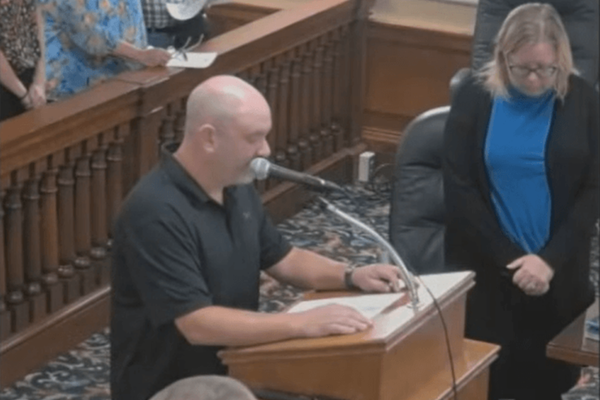
The California couple at the center of a three-state surrogacy fight told a Dallas courtroom on Tuesday that their newborn son has struggled since his first heart operation, testifying that he is having trouble breathing and has received a blood transfusion. Dallas County District Judge Ashley Wysocki heard testimony from the child's genetic mother and from the surrogate who gave birth to him, then extended for 14 days the temporary restraining order that bars the surrogate from seeing the child or making medical decisions for him. She is expected to rule within about two weeks, KERA News reported.
Nausheen Gilkar, 43, testifying publicly about the case for the first time, said she and her husband Omar Ahmed agreed to the operation as soon as they learned their son was a candidate for it, and that they are committed to the further surgeries he will need. "He's the love of our lives," she said of the baby.
The medical stakes have moved for a specific and predictable reason. The child has hypoplastic left heart syndrome, and the window he is in now, the weeks immediately following a first stage repair, is the single most dangerous stretch of the standard treatment path. That is the part of this story that reaches ordinary families, most of whom will never see a courtroom but many of whom will hear a version of this diagnosis at a routine mid-pregnancy ultrasound.
The Interstage Window Is Where Families Lose Ground
About 925 babies in the United States are born with hypoplastic left heart syndrome each year, roughly one in every 3,846 births, according to the CDC. The left ventricle, the mitral and aortic valves, and the ascending aorta are all underdeveloped, and the right side of the heart is left to do the work of both.
Treatment is not one operation. It is three, in sequence. The Norwood usually happens within the first two weeks of life and rebuilds the aorta so the right ventricle can supply the body. The bidirectional Glenn follows at roughly four to six months. The Fontan comes between about 18 months and three years of age. The CDC is explicit that none of this cures the condition.
The stretch between the first and second operations is what cardiac teams call the interstage period, and it carries the highest risk in the entire sequence. Circulation is fragile and finely balanced; small changes in feeding or oxygen levels matter, and complications can develop quickly. That is why families are usually sent home with structured monitoring, including daily weights, oxygen saturation checks, and firm thresholds for when to call the team.
That clinical reality is what makes an unresolved question of who may consent to treatment more than a legal abstraction. Decisions in this window are frequent and time-sensitive. An attorney for Children's Health, the Dallas system involved in the infant's care, told the court the hospital needs clarity on how to proceed given the competing orders.
What Changed Since MedicalDaily's Earlier Report
MedicalDaily previously reported that the infant underwent his first heart operation and that a Dallas judge had reinforced the genetic parents' authority to make medical decisions. At that point, the attorney for the couple said the family did not intend to share further updates on the child's health.
Tuesday's hearing changed that, because health details entered the record through sworn testimony rather than a family statement. Three things are new: the account of the infant's condition after surgery, the judge's decision to hold her ruling while keeping the restraining order in place, and a shift in what the surrogate says she wants.
McKenna West, 28, an Alaska nurse who relocated to Texas and gave birth on August 12, testified that she scheduled at least two abortion appointments after the diagnosis and canceled both because she could not go through with the procedure. She said at one point during the hearing that she would drop her parentage and custody claims, then later said she would keep fighting, telling the court she does not trust that the couple will continue seeking care. Gilkar acknowledged on the stand that she and Ahmed asked West to terminate the pregnancy, and West acknowledged withholding medical records from them. The surrogacy agreement the parties signed last year states that West would agree to terminate if a physician detected a fetal abnormality and the intended parents requested it.
Texas Attorney General Ken Paxton intervened days before the birth and secured a court order requiring a Dallas hospital to provide life-sustaining care, arguing that the question was not whether a gestational agreement is enforceable but whether any adult may decline life-saving surgery for a newborn who can live with disabilities, as CBS News reported. His office has since stepped back, filing a notice of nonsuit after saying it had achieved its goal. The restraining order Ahmed sought remains in force, and competing claims are still before courts in Texas and California.
The Ordinary Version of This Diagnosis
Most families reach this diagnosis through the anatomy ultrasound at 18 to 22 weeks, confirmed by fetal echocardiogram. That timing is deliberate. It exists so delivery can be planned at a hospital with a congenital heart surgery program and a cardiac intensive care unit.
For parents given this news, the most consequential decision in the first week is usually where the baby is born. Families can ask a referring obstetrician for a referral to a center with a dedicated congenital cardiac program, and can ask that center directly about its case volume and Norwood outcomes. Programs generally expect the question.
After discharge, the warning signs that warrant urgent evaluation include bluish or ashen skin, fast or labored breathing, a weak pulse, poor feeding or sweating during feeds, unusual sleepiness, and cold or mottled hands and feet. Newborn pulse oximetry screening helps catch critical heart defects not found before birth.
Cost help exists and is underused. Social workers inside congenital heart programs handle travel, lodging, and insurance authorization. Many children with complex congenital heart disease qualify for Medicaid through state disability pathways regardless of household income, and hospital financial counselors can start that application.
Still Unsettled in Both Courtrooms
The court has not decided who holds parental authority, and the judge's ruling is pending. The child's clinical status is known only through testimony from parties in active litigation, not from a treating physician or a hospital statement, and whether his difficulties are related to the operation itself has not been independently established. Surrogacy is not federally regulated, so the conflict between a California parentage order, Alaska proceedings, and Texas family law remains genuinely unresolved, not merely contested. Coverage also uses two different names for the child, Rumi and Gabriel, which reflects the dispute itself.
Key Questions Answered
What is the newest development? At an August 25 hearing in Dallas, the genetic parents testified that the infant is struggling after his first heart operation. The judge extended the restraining order for 14 days and is expected to rule within about two weeks.
What is hypoplastic left heart syndrome? A critical congenital heart defect in which the left side of the heart is too underdeveloped to pump blood to the body. About 925 US babies are born with it each year.
Why does the timing matter medically? The period between the first and second operations, known as the interstage window, carries the highest risk in the treatment sequence and requires close monitoring.
What does the surrogate want? She has sought parentage and custody. During the hearing, she said at one point that she would drop those claims, then said she would continue fighting because she doubts the couple will keep pursuing care.
Have doctors confirmed the child's condition? No. The available description comes from courtroom testimony by parties to the litigation, not from the treating hospital.
How is this diagnosis usually found? Most often, it's found at the anatomy ultrasound around 18 to 22 weeks and confirmed by fetal echocardiogram, so delivery can be planned at a center with pediatric cardiac surgery.
What newborn symptoms need emergency care? Bluish or ashen skin, fast or labored breathing, weak pulse, poor feeding or sweating during feeds, unusual sleepiness, and cold or mottled hands and feet.