A stunning view of the Milky Way in a 180 degree arc extending from the South to the North at the night sky in Hanle, Ladakh, India’s first dark sky reserve, is an unforgettable memory for a bunch of young students from Coimbatore. “Every inch of the dark sky was filled with stars, star clusters and constellations. It was magical,” recalls Akshay Sathish (18). A team of 11 children led by Obuli Chandran, founder of Mango Education and astronomy educator Mihir Athale are just back from their first expedition to Ladakh where they observed a spectacular view of the night sky at Hanle. “We teach astronomy to students who have a passion for it. Along with theory, we have done several star gazing trips in the South to places like Mudumalai, Hasanur and Udhagamandalam where the skies are clear and there is very less light pollution. This is our first trip with children to the Himalayas,” says Obuli.
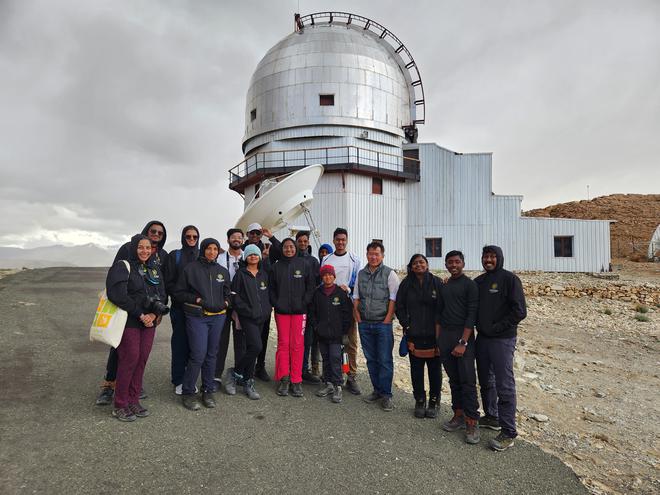
Much before it became a dark sky reserve, Hanle was picked by the Indian Institute of Astrophysics to set up an observatory owing to its dry and cold weather. The high-altitude Indian Astronomical Observatory (IAO) located there at 14,764 feet, is one of the highest observatories in the world. “The IAO is a field station of IIA, Bengaluru,” says Dorje Angchuk, chief engineer in-charge at IAO, Hanle. “Our agenda is scientific research for the professional astronomer. Lately, we have been venturing into outreach,” says Dorje adding that every year, students from schools in and around Leh visit the reserve as a part of field trips. Along with his team, he has spent time and effort in orienting the locals to the wonders of astronomy.