
Get all your news in one place.
100's of premium titles.
One app.
Start reading
Livingetc
Livingetc
Ellen Finch

7 Hard Landscaping Trends That'll Seriously Step Up the Way Your Outdoor Space Looks and Feels

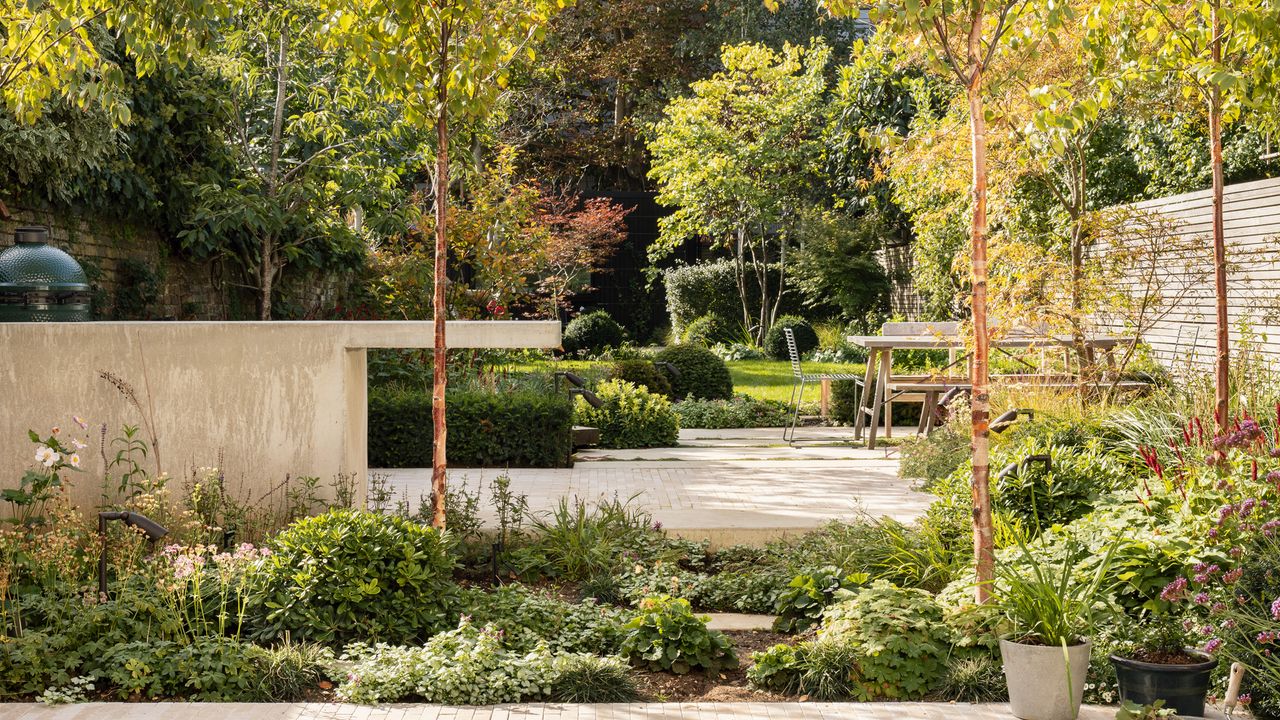
Tiered garden with pale stone and glass patio, pale brick steps and pale concrete outdoor kitchen.

This year, we're making the most of a (hopefully) warm summer by hosting all of our soirées al fresco. Before the invites get sent out, though, there's the small task of bringing the garden up to scratch — and that's where these hard landscaping trends can help.

Most of us dream of an outdoor space that lets guests mingle freely, but it's not always so easy to achieve. If you're taking on a garden renovation this year, don't be completely distracted by the flowers and furniture; thinking through your hardscaping materials as carefully as you would the fittings and finishes inside your home will have a greater impact on your outdoor area than you might realize.

So, take your cues from these modern garden ideas, which showcase some of the biggest hard-landscaping trends we've spotted coming into this season.

1. Curved Stone Seating

Curved seating hugs the perimeter of your garden, making it feel bigger in the process. (Image credit: Louisa Tratalos. Design by THISS Studio)

"In such a compact garden, outdoor seating was essential to the social life of the space, but it needed to feel placed as part of the landscape rather than instead of it," says Tamsin Hanke, founding director of THISS Studio, of this outdoor plot.

"The limestone was chosen for its tactility, so the seating reads more like ground than structure," she adds. "By sweeping the bench in a curved form, we were able to integrate generous planting behind it."

2. Indoor-Outdoor Material Palettes

Continuing a material palette helps blur the lines between indoors and out, making both feel bigger. (Image credit: Jim Stephenson. Design by Neil Dusheiko)

Architect Neil Dusheiko worked with landscape designer Sheila Jack to craft a house and garden that speak to each other.

"From the outset, the architecture and landscape were conceived as a single, continuous experience," Neil explains. "The palette of materials — brick, timber, concrete, gravel and planting — was carefully calibrated so that the garden feels like an extension of the house and the house feels anchored in the garden."

3. Areas for Reflection

A comfortable (and pretty) spot to sit gives you an excuse to get out into the garden more. (Image credit: Architecture for London/Christian Brailey)

A 1960s modernist house with two doors opening onto the garden called for a patio area that invites a moment of pause before moving into its wilder features.

"The key to this courtyard house is the relationship between the living spaces and the garden," says Ben Ridley, founder of Architecture for London. A stone bench, surrounded by low-level planting, offers space for reflection.

4. Landscaping Close to Home

We are always looking for ways to bring the feeling of nature inside, and this hard landscaping trend makes it more literal. (Image credit: Jim Stephenson. Design by Oliver Leech)

This project by architect Oliver Leech provides a solution for both compact gardens and homes that feel too separated from the outdoors.

"The planters sit right against the windows to bring the garden closer to the kitchen," explains Oliver. "In the summer, the doors can be opened up, and the dining area is transformed from a cozy nook to a part of the landscape."

5. Zoning Areas

A long, narrow garden can feel awkward, but zoning helps make it more practical. (Image credit: Ståle Eriksen. Design by Proctor & Shaw and Sara Jane Rothwell)

Long gardens can be tricky to work with, but in this project — a collaboration between architecture practice Proctor & Shaw and Sara Jane Rothwell of the London Garden Designer — zoning was the answer.

"A sequence of open spaces separated via planted thresholds disguises the generous length," explains architect John Proctor.

6. Terrace Gardens

Making an architectural feature out of garden steps makes them feel more design-y and not purely practical. (Image credit: Simon Bevan. Design by De Rosee Sa and Ula Maria)

A collaboration between architecture and interior design studio De Rosee Sa and garden designer Ula Maria, this project uses a terrace garden idea to connect house and landscape, addressing the change in level between the two.

"The upper terrace acts as a natural extension of the interior," explains Ula. "Below this, a second terrace offers a generous seating area, slightly elevated above the planting. The lowest terrace is dedicated to outdoor dining, nestled within the garden, creating an intimate space for outdoor meals."

7. Stepped Landscape Planters

Creating planter steps helped soften the appearance of the hardscaping required in this terraced garden. (Image credit: Kensington Leverne. Design by Cousins & Cousins and Climb Ldn)

A project with lower-ground-floor space left architecture studio Cousins & Cousins and landscape designer Climb Ldn with a quandary: how to connect it with the garden?

"Forming a stepped landscape planter opens up the view and removes the sense of enclosure, connecting the different levels and creating a lovely space to socialize and enjoy alfresco dining," says Jelena Cousins, co-founder and creative director of Cousins & Cousins.


Not planning a renovation any time soon? Take a look at how the latest garden furniture trends can completely change how you use your outdoor area.

And for more inspiration, be sure to subscribe to Livingetc's newsletter.

Sign up to read this article
Read news from 100's of titles, curated specifically for you.
Already a member? Sign in here
Related Stories
Top stories on inkl right now
One subscription that gives you access to news from hundreds of sites
Already a member? Sign in here
Our Picks
Fourteen days free
Download the app
One app. One membership.
100+ trusted global sources.