India's deceased donation rate is among the lowest in the world
India records fewer than 0.8 deceased donors per million population, according to data compiled by the National Organ and Tissue Transplant Organisation (NOTTO). Spain, by comparison, manages over 40 donors per million. The gap is not explained by religion, studies across Hindu, Muslim, Christian, and Sikh communities in India have found majority support for donation in principle. The gap is explained by what happens in the room when a family is asked to say yes.
A pledge card does not legally bind your family
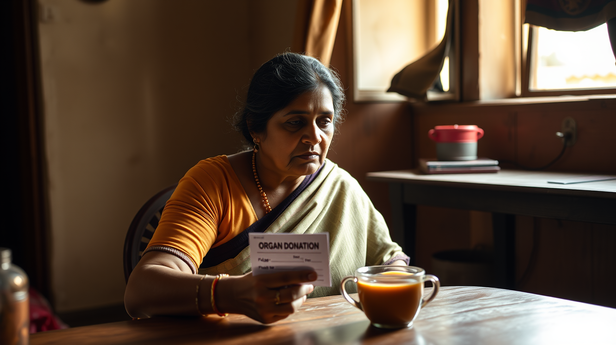
Signing a donor card or registering on the NOTTO registry does not authorise organ retrieval. Under the Transplantation of Human Organs and Tissues Act (THOTA), 1994, and its 2011 amendment, the family's consent at the time of death is still required for deceased donation. If your family refuses, the pledge is not enforceable. This is the fact that undoes the most good intentions. A person who has pledged their organs but never told their family has, in practical terms, not pledged anything.
Brain death is a specific legal and medical declaration, not a judgment call
Deceased organ donation in India is almost entirely dependent on brain death, not cardiac death. Brain death must be certified by a panel of four doctors, including a neurologist or neurosurgeon, none of whom can be part of the transplant team. This process takes time and requires the hospital to be registered under THOTA. Most district hospitals are not. Families in smaller cities who lose a relative to a road accident, one of the most common causes of brain death in India, are often in a facility where retrieval is legally impossible regardless of their wishes.
The NOTTO registry exists, but registration is not enough
The National Organ and Tissue Transplant Organisation maintains a central registry for donors and recipients. Registering takes under ten minutes online. What most families don't know is that registration places a person on a waiting list that is allocated by medical urgency and compatibility, not by how long someone has waited. A 2019 analysis published in the Indian Journal of Transplantation found that waiting times for a cadaveric kidney in India ranged from two to seven years, with outcomes varying sharply by state. Maharashtra and Tamil Nadu run among the most active deceased donor programmes; many other states have near-zero retrieval rates.
Living donation is legal, regulated, and more common than most people realise
India's transplant numbers are dominated by living donors, not deceased ones. A healthy adult can legally donate one kidney or a portion of their liver to a recipient. THOTA defines who qualifies as a living donor: near relatives (spouse, parents, siblings, children) can donate without a committee approval. Unrelated donors must be approved by an Authorisation Committee, which exists to prevent commercial organ trading. The law is strict on this, organ trading is a criminal offence carrying up to ten years in prison. The committee process can take weeks, which matters when a recipient's condition is deteriorating.
The family conversation is the intervention point, not the pledge
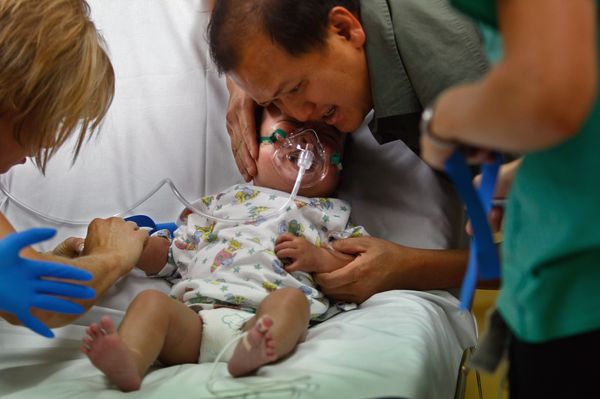
A 2022 study in the journal PLOS ONE examining organ donation hesitancy in South Asian families found that the single strongest predictor of family consent at the time of death was whether the deceased had explicitly discussed their wishes with a family member. Not a signed card. Not a registry entry. A conversation. Families who knew their relative's wishes consented at significantly higher rates than those who were informed only after brain death was declared. The medical team typically has a narrow window, sometimes under an hour, to approach the family. A family encountering the concept for the first time in a hospital corridor, in grief, almost never says yes.
The pledge and the conversation look like the same act, but they produce entirely different outcomes. What India's transplant system runs on is not a shortage of willing donors, surveys consistently show that willingness exists. It runs short on families who were prepared to act on a wish they actually knew about, in a registered hospital, with the right medical team present. Each of those conditions has to hold at once. Most of the time, at least one doesn't.