
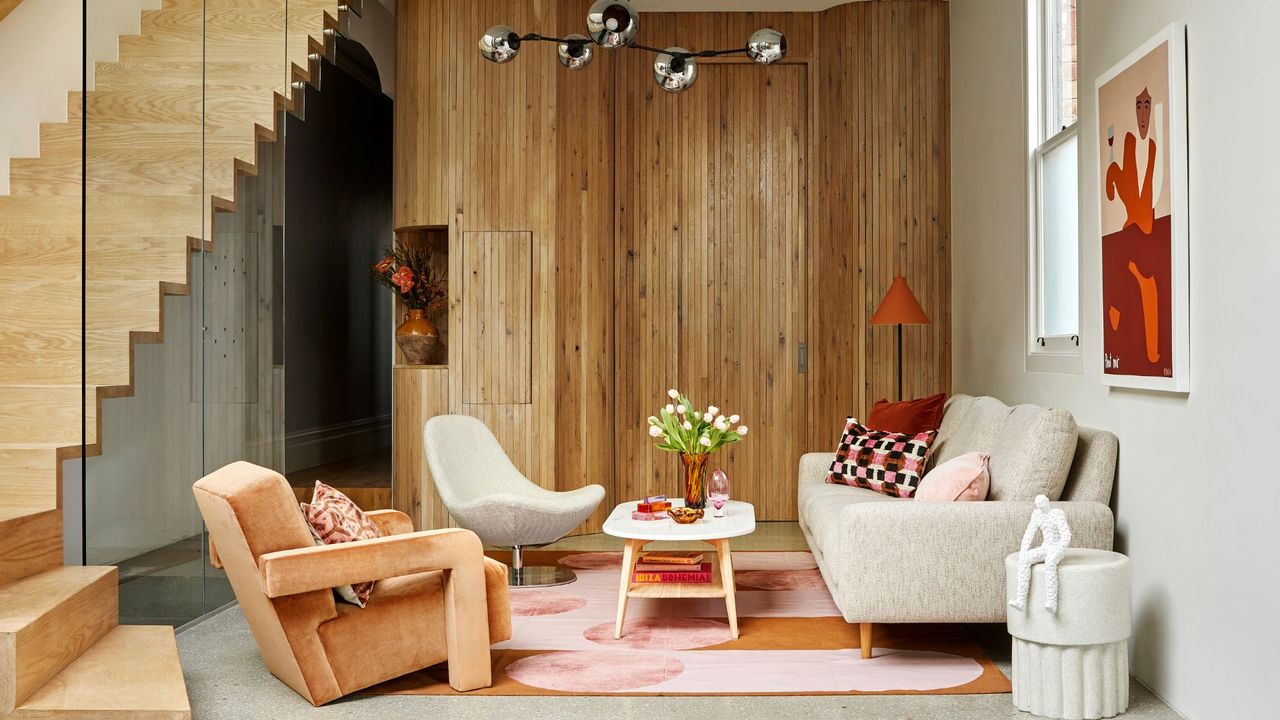
Sometimes even a living room clear of any clutter, with everything perfectly in place, can still feel stressful. So, while tidying your living room can definitely solve the visual chaos, there's more to it than just a space that is clean on paper.
Monotone palettes that feel rigid, loops of lamp cords and TV cables detracting from the beauty of the room, and thoughtlessly curated furniture are three key reasons this zone doesn't instantly settle your mind and body. So, I spoke to interior designers about fixing these mistakes to make your home feel calm.

One that feels peaceful, design-forward, and more like home. Here's what they had to say.
1. Monotone Palettes
Now, this might sound surprising, but contrary to popular belief, monotone palettes can actually make a living room feel stressful. It's the rigidity of a flat single-color space that might make you hyper-aware of your surroundings.
"Instead of using the same color for the walls, trim, ceiling, and furniture, introduce variation by creating tonal transitions," says Gina Elkins, principal designer at Studio Casa Vita.
"For example, if your wall is cream, try tinting the trim color up or down by 50%, and the same for the furniture. A monochromatic color scheme can be very sophisticated and clean, but monotone is not where it’s at."

A simple rug can ground your living room. And this olive green tufted rug from Ruggable is a beautiful accessory for the job.

I've been seeing gorgeous deep eggplant accents everywhere. And this paint proves that purple living room ideas don't have to be punchy, they can be romantic, too.

If you live with a light blue living room, an armchair like this is a nice way to bring the space together.
2. Cords
"I'll walk into a room where every decision has been agonized over. Someone spent weeks finding just the right sofa, arguing with themselves over paint colors, and moving the coffee table three inches in every direction. Then there's a lamp cord hanging down the side of the console, and suddenly that's all you see. That's what makes a room stressful," says John Maloney McNamara, principal designer at COOSA.
"Cords are visual static. I've never met a sofa good enough to outrun a power strip. The real solution happens long before furniture shows up, which is why the lighting plan is one of the least glamorous and most important documents in a new build or remodel."
But beyond renovating your power strips so they feel intentionally out of sight yet centrally accessible and organizing the remaining cords in a living room, John suggests switching to cordless features where you can. "Rechargeable lamps have gotten so much better. And if you already own lamps that aren't going anywhere, rechargeable light bulbs are a surprisingly good trick," he shares.
"Television cords are a different conversation, and here I'm begging. Put them in the wall. An electrician can sink them quickly, and a painter makes the patch disappear. It's not the cheapest fix on this list, but a television is already a visual compromise. The least you can do is not accessorize it with dangling cords."

Stylish cord organizers like this are a small addition that make even this eyesore a little prettier.

Speaking of portable table lamps, I can't stop thinking about this chrome number from H&M.

Even a chic set of storage boxes can help you hide cords and tech clutter when hosting.
3. Ill-Placed Furniture
Michelle Squire, founder of Studio SQUIRE, tells me that furniture of the wrong scale for the room or arranged without a clear sense of function is another stresser in this central space.
"Pieces that float in the middle of a room without purpose, or seating that is too small or too large for the space, create a subconscious sense of imbalance," she notes.
"Instead, anchor the room around how people actually move and gather in it, and choose pieces sized to the proportions of the space rather than what looked good in a showroom."
Considering furniture placement that fosters communication and avoids awkward angles is essential to a living room that often dons the hosting hat. And the four-inch seating rule is a genius helping hand for this sort of problem.

A side table to carry your morning coffee or your evening glass of red is a thoughtful accent. And this deep burgundy from H&M has my vote.

I love walking into a living room and having the choice between a sofa and an armchair. It allows for flexible formality.

But, of course, a good sofa is tough to beat. And if you're in a small living room, something as simple as this two-seater is a smart selection.
Now that the stress-causers have been banished, it's time to take inspiration from the things people with calming living rooms always have. And for more interior inspiration, the Livingetc newsletter is where it's at.