
Get all your news in one place.
100's of premium titles.
One app.
Start reading
InsideEVs
InsideEVs
Technology
Mack Hogan

2027 Mercedes GLC 400 Electric Review: The Best Mercedes EV Ever, And It’s Not Close

Mercedes may have made a hubbub about the ultra-efficient CLA EV it launched earlier this year, but don’t be fooled. This is its most important EV of 2026.

In fact, the new GLC Electric is Mercedes’ most important EV ever. And unlike with many of its previous attempts, this time Mercedes has stuck the landing.

(Full Disclosure: Mercedes loaned me a GLC 400 4Matic Electric for this review. The company dropped it off with a full battery and didn't ask questions about what I planned to do with it, so I drove it around 300 miles through mountains, dirt roads, and traffic.)

2027 Mercedes GLC 400 Electric: What Is It?

This is a year of EV renewal for Mercedes. Like crosstown rival BMW, the company is starting to launch its third generation of electric vehicles. The first ones were low-volume science experiments. The EQ models missed the mark on design and failed to move the needle on EV tech. Now the company is launching true software-defined, ultra-efficient, 800-volt EVs.

The GLC rides on the all-new MB.EA platform, which also underpins the upcoming C-Class EV. The CLA, which I previously reviewed, uses much of the same technology but rides on a platform shared with hybrid vehicles. Unlike the CLA and C, though, the GLC competes in a segment that matters to the American auto market. While buyers in this country have mostly abandoned luxury sedans, they can’t seem to get enough compact and midsize crossovers like the GLC.

Gallery: 2027 Mercedes-Benz GLC 400 4Matic Electric: First Drive Review

To win them over, the GLC offers just about every tech gadget you could hope for. My tester—loaded up from its $64,950 starting price to a whopping $89,270—had massaging seats, a self-parking system, video streaming, games, multicolor LED ambient lights, a massaging driver’s seat, a surround sound Burmester stereo with Dolby Atmos support, and a virtual assistant that can tap into AI agents from Google, OpenAI, and Microsoft to answer questions about your destination or vehicle.

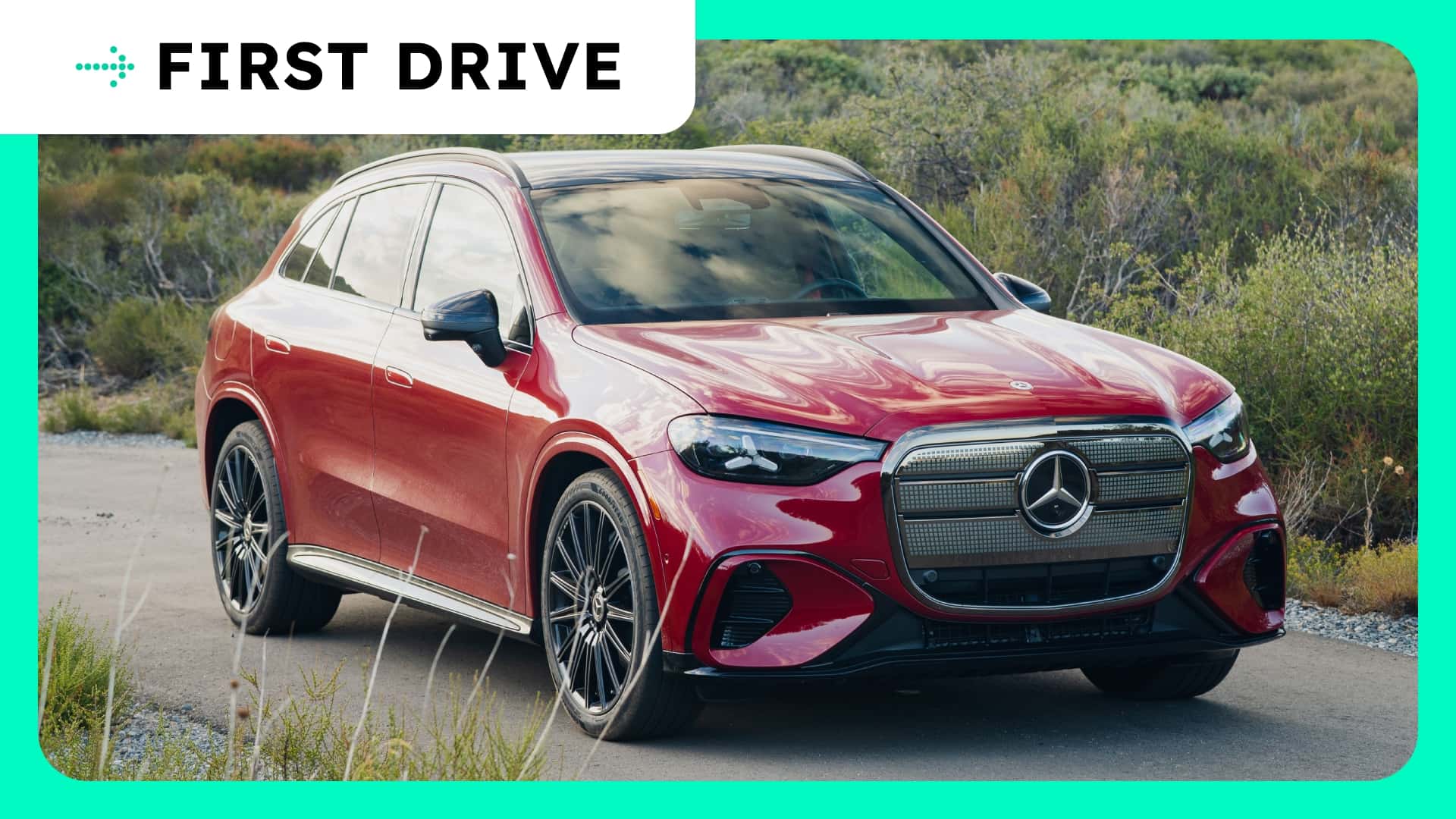
It’s all a bit overwhelming, but quite nice all the same. To remind you of how nice it is, Mercedes puts three-pointed stars everywhere. Every. Where. They are in the lights, front and back. There are three-pointed stars tucked all over the cabin, too, including dozens embedded in the roof glass that twinkle at night. Combined with the optional full LED grille—which broadcasts the Mercedes logo as if it were the return of Christ the King—the GLC ensures that nobody on Earth will forget that you’re loaded.

Bombastic design aside, the GLC is a thoroughly modern, thoroughly lovely EV. It now comes with one-pedal driving and ditches the on/off button, both relatively new for Mercedes EVs, and gets deeper software updates over the air. And, because it’s a luxury EV in 2026, it’s blindingly fast. The mid-range GLC 400 EV pushes 483 horsepower and 590 lb-ft to its four wheels. It’s effortlessly quick from any speed. It should also be efficient, too, thanks in part to a two-speed gearbox on the rear motor that enables more efficient highway cruising. The front motor can disconnect from the wheels at speed , too, also helping with energy efficiency.

Those highway slogs won’t be something you’ll have to manage on your own, either. The GLC gets Mercedes’ newest generation of advanced driver assistance systems, including MB.Drive, a new NVIDIA-powered suite that will eventually enable Tesla FSD-style point-to-point supervised driving. But Mercedes still won’t say when that capability is coming, and the current version of the system is much more limited.

2027 Mercedes GLC 400 Electric: Charging & Range

Here’s another lesson Mercedes learned in the premium EV business: big numbers matter. Buyers want a lot of range for their dollar, and the GLC provides. Even on massive 21-inch wheels shod in Goodyear Eagle F1 performance tires, my GLC 400 tester was rated for 350 miles of EPA range. Go smaller and you can get up to 380 miles of range.

But the all-wheel-drive GLC 400 isn’t the range king. Rear-wheel-drive GLC 300s should get over 400 miles of range when they arrive later on. I expect most buyers will still choose the pricier AWD trim, as luxury crossover buyers tend to, but it’ll still be good to offer such an incredible range figure.

On a long trip, you’re not going to be slowed down by the GLC 400. First, based on the efficiency I saw, I wouldn’t be surprised if real-world highway driving is friendly to the GLC. Its two-speed transmission should really help with efficiency at high speeds.

Second, the GLC 400 is a certified charging champ. I charged it from 15% to 80% in just 20 minutes and 30 seconds, with the car maxing out the 350 kW fast charger. The GLC can technically pull up to 360 kW, so faster times are possible. It charges quickly even as the battery fills up, and the thermal management system seems to have no problem with heat buildup.

There is one caveat, though, and it’s a big one. The GLC comes from the factory with a Tesla-style NACS port for native compatibility with Superchargers. I can confirm that it works with Superchargers, and that plug-in-charge works seamlessly, but that’s where the good news ends.

Because the vast majority of Superchargers are not 800V systems, the Mercedes has to use its on-board booster to step-up the voltage when plugging into one. This drastically limits your charging speed, however. I used a charger that could support 325 kW speeds and a car that could pull 360 kW of power, but my real-world max rate on that Supercharger was 83 kW. The car reported that a 12-80% charge would take 47 minutes at that speed.

I don’t like to roleplay as someone who paid ninety G’s for Chevy Bolt charging speeds, so I moved on to an EVGo station. But like most 350- and 400-kW stations these days, that one was CCS and required an adapter.

Another potentially frustrating charging quirk of the GLC: the NACS port only works for DC fast charging. All AC charging goes through the car’s legacy J1772 port, which is the same slow-charging receptacle that traditional CCS EVs use. The idea is that former Mercedes EV owners won’t need to mess around with adapters or a new charging setup at home, but the unfortunate consequence is that you’ll need an adapter to use Tesla Destination Chargers or any AC NACS infrastructure.

2027 Mercedes GLC 400 Electric: What’s Good

By God this is a lovely car to drive. From the poise it exhibits on a winding backroad to the satisfying heft of its steering wheel, the GLC just feels like a Mercedes in the best way. I’ve driven it hard on the highway, slow on dirt, and fast through giant sand dunes (in a prototype) at this point, and it feels utterly unflappable in all situations.

The four-wheel-steering system on my tester made it ultra nimble as I trundled through national forest roads looking for camping spots. When I rejoined the main road, the 483-hp powertrain blurred my vision without seeming to upset the chassis one bit. As far as handling, ride, and tuning go, the GLC has every single gas crossover on sale utterly licked. It is so much more graceful than a gas-powered car in this class, as the beautiful scenery and serene cabin are not desecrated by a puttering two-liter engine.

The only cars that hold a candle to the GLC are other modern software-defined luxury EVs. But competition there is getting stiff. Can I say the GLC is better on these roads than a Rivian R2, or more serene than a Volvo EX60, or as engaging as a BMW iX3? No, and not just because I haven’t driven the BMW, but because the Volvo and Rivian are also just shockingly great.

The GLC, R2, and EX60 have all blown me away in a way that few products have in my nine-year career testing cars. As fully rounded products, cars in this segment are just delightful in almost any context.

Mercedes tries to up the ante with more clever tech than its rivals, and in some ways is successful. The GLC is the first car I’ve driven to allow Dolby Atmos through Apple CarPlay, which really makes its beautiful Burmester stereo shine. Its electronically dimming roof is also thoughtfully divided, so you can “close” segments individually for a partially-opaque ceiling. There’s an AI-powered Hey Mercedes function, too, which uses ChatGPT, Gemini, Microsoft Bing AI, and the car’s internal AI agent to answer anything you ask. In my experience, it was pretty good at finding restaurants and charge stops, although it struggled if there were no results within a few miles.

Today’s car market is dominated by screens, and this is an area where Mercedes does not screw around. Basically the entire dashboard of my tester was taken up by the optional 39.1-inch Hyperscreen. It is a pillar-to-pillar unit that covers every surface in front of you, with a configurable, lovely little background animation that matches the ambient light profile.

The screen looks great, offers a ton of functionality, and is pretty intuitive to use. There are some limitations and caveats that I’ll get to in the section below, but as a whole, it’s Mercedes’ best system yet, and one that left me (mostly) ok with the lack of physical controls.

2027 Mercedes GLC 400 Electric: What’s Bad?

Every car company seems to be moving more controls to the screen. Tesla has always been the worst offender overall, while Mercedes has been among the most aggressive traditional automakers. Even the company’s CEO admits that the industry may have gone too far.

The GLC is a product of that age of the industry. Everything is accessed via the touchscreen. And I mean everything. There’s no way to skip a track from the steering wheel or the center stack; you must tap the screen. That means the icon in question moves and disappears depending on on-screen context. So if you turn the volume down and go to skip a song, too bad, because the volume pop-up covers the skip-track button.

The climate settings all live in the screen, too. I appreciated the persistent temperature controls pinned to the bottom rail , but my GLC tester was very slow to adjust fan speeds, so I found myself having to constantly dive into the climate menu to crank the A/C on hot days.

Those were the only real pain points during my week with the car. The GLC was otherwise lovely. Even those faults are easy to forgive. The only tough part is the pricing, because a lot of what I just described is optional.

Pile on the options, and the GLC can easily run you about as much as a Rivian R1S Premium Long Range ($90,990), as the my $89,270 tester demonstrated. Specs, size, and capability wise, though, it’s much closer in line to the R2 Performance ($59,485).

You can get a GLC 400 EV for a lot less than ninety grand. Pricing starts at just under $65,000, which still gives you those great range and charging figures, plus a nice interior and a few big screens. But a lot of the equipment is extra, and it adds up fast. My tester had the Pinnacle Plus Trim, which includes the light-up panoramic roof, the Digital Light virtual upgrade that enables matrix lights and projection capabilities in the headlights, cooled front seats, massaging front seats, the Hyperscreen, rear heated seats, and the Burmester stereo. But it costs a whopping $6,800, and is basically necessary if you want the GLC to feel a cut above a Rivian or a Tesla.

Indeed, my tester felt quieter, more luxurious, and more nicely appointed than a Tesla or Rivian, and in bright red looked more upscale, too. But it’s certainly not restrained, and it’s built for people who don’t mind spending more to get a luxury feel.

Finally, I’ll say that the GLC’s MB.Drive system is supposed to match what Tesla offers eventually, but it’s not close now. For now, it maintains your set speed and position in the lane, with with automatic lane changes to navigate around traffic. It’ll handle stop-and-go traffic without issue, but doesn’t quite keep you in the lane on high-speed bends in the freeway. THe current form of MB.Drive is noticeably less smooth and competent than the legacy Mercedes system on the EQE and EQS, and not nearly as capable as Tesla FSD or General Motors Super Cruise.

That’s fine—nobody but Tesla offers supervised point-to-point assistance right now, and I’m not even sure that they should. But it sucks that the cutting-edge Mercedes EV feels behind its predecessors in this way. The company says that this stack will enable a huge leap forward in capability, but I’m also waiting to see what Mercedes delivers on the over-the-air front.

2027 Mercedes GLC EV: Verdict

The Mercedes GLC 400 4Matic Electric is the best Mercedes EV yet. It’s more polished and upscale than the CLA while being more efficient and sophisticated than anything that’s come before. As this tech stack works its way into the E- and S-Class sedans and SUVs, Mercedes’ EVs are going to keep getting better.

This was an important one to get right. It lives at the heart of the luxury market, in a segment flush with new, strong competitors like the EX60, iX3, and R2. I can’t say it’s better than those cars, but with a great powertrain, a beautifully tuned chassis, excellent software, and solid tech, it’s another tremendous option in a class that’s quickly become a bright spot for the EV market. You may have to pay up for it, but you won’t regret it.

Click here to see all articles with lists of the best EVs

2027 Mercedes-Benz GLC 400 4Matic Electric

4.2 seconds (MFR estimate) Speed 0-60 MPH 483 hp / 590 lb-ft Output All-wheel-drive Drive Type 15-80% in 20 minutes 30 seconds (tested) Charge Time 94 kWh (usable) Battery 350 (as tested), 380 (max) EV Range $64,950 Base Price $89,270 As-Tested Price
Sign up to read this article
Read news from 100's of titles, curated specifically for you.
Already a member? Sign in here
Related Stories
Top stories on inkl right now
One subscription that gives you access to news from hundreds of sites
Already a member? Sign in here
Our Picks
Fourteen days free
Download the app
One app. One membership.
100+ trusted global sources.