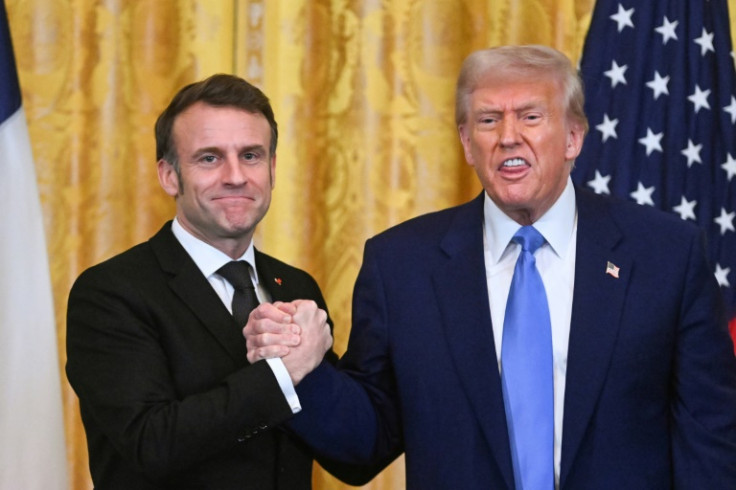
While speaking to reporters at the White House on Monday, President Donald Trump said France and President Emmanuel Macron are an "eight" out of 10 on their participation in backing his push for an international coalition to protect shipping in the Strait of Hormuz.
Trump made the comment as Washington scrambles to win support for a naval escort mission in one of the world's most important energy chokepoints. The comments came as Trump intensified pressure on allies and major oil importers to help reopen or secure transit through the narrow waterway after Iranian attacks, mines, and military escalation sharply disrupted shipping in retaliation for the airstrikes launched by the U.S. and Israel.
A French reporter asked Trump, "Have you been speaking with President Macron about the coalition to reopen the Strait of Hormuz?" The president replied, "Yeah, I have spoken to him. He's been, on a scale of 0-10, I'd say he's been an 8. Not perfect — but it's France. We don't expect perfect."
The reporter then asked, "Are you confident that France will help with the reopening of the Strait of Hormuz?" Trump then replied, "I think he's gonna help. I'll let you know. I spoke to him yesterday. I don't do a hard sell on them because my attitude is we don't need anybody. We're the strongest nation in the world."
Reporter: Have you been speaking with President Macron about the coalition to reopen the Strait of Hormuz?@POTUS: "Yeah, I have spoken to him. He's been, on a scale of 0-10, I'd say he's been an 8. Not perfect — but it's France." pic.twitter.com/VqCGUHUFDa
— Rapid Response 47 (@RapidResponse47) March 16, 2026
Trump has urged countries including China, Japan, South Korea, and Britain to contribute capabilities such as minesweepers and air defenses, warning that NATO faced a 'very bad' future if allies refused to help. The Strait of Hormuz normally handles about 20% of the world's oil and liquefied natural gas traffic, making any prolonged disruption a global economic threat.
France has tried to position itself differently from Washington's more confrontational line. Macron said on Sunday that France's military posture in the region was defensive and focused on protecting its interests, partners, and maritime navigation. He also urged Iran to halt regional attacks and restore freedom of navigation in the Strait of Hormuz.
That stance aligns with earlier Reuters reporting that Paris had already been exploring a broader coalition concept for Hormuz, though French officials stressed any mission would require diplomacy, wider buy-in, and less volatile conditions on the ground.
Macron wrote on social media in Persian that he "spoke with the President of the Islamic Republic of Iran, Masoud Pezeshkian," where he reportedly asked him "to immediately put an end to the unacceptable attacks that Iran is carrying out, whether directly or through proxy groups, including in Lebanon and Iraq, against countries in the region."
من چندی پیش با رئیس جمهور اسلامی ایران، مسعود پزشکیان، صحبت کردم.
— Emmanuel Macron (@EmmanuelMacron) March 15, 2026
از او خواستم فوراً به حملات غیرقابلقبولی که ایران، چه بهطور مستقیم و چه از طریق گروههای نیابتی، از جمله در لبنان و عراق، علیه کشورهای منطقه انجام میدهد، پایان دهد. به او یادآوری کردم که فرانسه در چارچوبی…
That hesitation reflects more than military caution. Many allies view the current Hormuz crisis as tied directly to the wider U.S.-Iran conflict and are wary of being drawn deeper into a confrontation they did not initiate. AP reported that several governments have resisted Trump's framing of the mission as a shared obligation, instead favoring diplomacy, defensive postures, or limited technical support over sending warships into a highly volatile theater.
The administration has argued that a convoy or escort arrangement is necessary because commercial vessels face threats from mines, drones, and attacks linked to Iran. Reuters reported Trump's claim that U.S. forces have already destroyed more than 30 mine-laying vessels, though that specific battlefield assertion has not been independently verified in the Reuters dispatch.