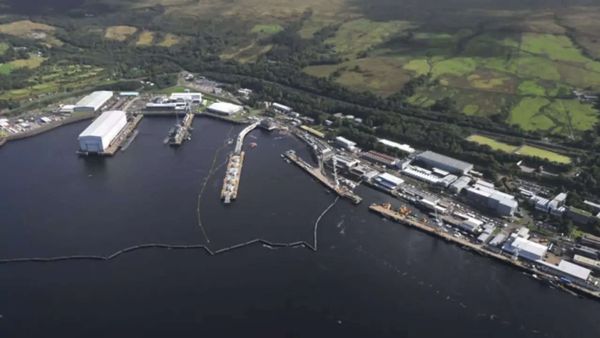
A British RAF base in Cyprus which was hit by a drone at the beginning of the Iran War will not be used by the US to retaliate against Iran's missiles sites, the UK Prime Minister has told his Cypriot counterpart.
In an extraordinary phone call today, Sir Keir Starmer told the President of Cyprus Nikos Christodoulides that RAF Akrotiri is not among the sites Britain intends to allow the US to launch strikes.
It comes hours after Iran targeted the joint US-UK Diego Garcia base in the Indian Ocean.
During today's call, Mr Christodoulides urged Sir Keir to enter into discussions about the future of the British bases on the island.
A Downing Street source said: “The Prime Minister began by underscoring that as close partners and friends, Cyprus’s security was of utmost importance to the UK.
“The Prime Minister reiterated that RAF Akrotiri would not be involved in the UK’s continuation of its agreement with the US to use UK bases in collective self-defence of the region, including for the degrading of Iranian missile capabilities.
“Discussing the economic impact of the ongoing conflict, the leaders agreed that de-escalation in the region was the priority.
“The leaders agreed to stay in close touch.”
Iran’s launch of two ballistic missiles at the Diego Garcia base has led to a dramatic escalation of tensions, US officials have said.
The missiles, fired towards the joint UK-US military facility in the Chagos Islands, both failed to hit their target. One is believed to have been intercepted by a US warship, while the other did not complete its flight.
The strike marks the first time Tehran has deployed intermediate-range ballistic missiles in the conflict, weapons capable of travelling far greater distances, and signals a significant step up in the confrontation.
Military analysts say the attempted strike on Diego Garcia, roughly 3,800km from Iran, could point to a longer-range capability than previously assessed.
If confirmed, the strike would signal a capability that extends well beyond the Gulf, with Paris in range and London no longer comfortably out of reach.
Iran just fired two missies at a target 4000 kilometers away. London is 4400 kilometers from Tehran.
— Ari Fleischer (@AriFleischer) March 21, 2026
Tell me Iran is not a threat to the world.
(Paris, Rome, Vienna and Berlin are closer…) https://t.co/yTVXK5Rejq
The attempted attack came as Iran’s foreign minister, Abbas Araghchi, issued a warning to the UK, accusing Sir Keir Starmer of “putting British lives at risk” by allowing US forces to operate from British bases. At the time of his remarks, it had not yet been made public that missiles had been fired towards Diego Garcia.
Downing Street has given the green light for the US to carry out defensive operations from British territory, including Diego Garcia, a key strategic base used for long-range military missions. The facility has long been seen as vital to Western operations in the Middle East and Asia.
Sir Keir has also faced scrutiny over plans to hand control of the Chagos Islands to Mauritius, a country that has sought to strengthen its relationship with Iran in recent years.
The missile launch was first reported by the Wall Street Journal, which said neither projectile struck the base but confirmed it was Iran’s first use of intermediate-range ballistic missiles since the conflict began. Iran’s Mehr news agency also reported that at least two missiles had been fired at the site.
It remains unclear exactly when the incident took place.
The development comes as the United States weighs its next steps in the conflict. On Friday, Donald Trump said he had been considering “winding down” the Iran war, claiming the US was “very close” to achieving its military objectives.
He also suggested that responsibility for keeping the Strait of Hormuz open could fall to other nations, despite the route carrying around 20 per cent of the world’s oil supply.
In a further sign of a possible shift in approach, the US Treasury has eased some pressure on Tehran, allowing the delivery and sale of Iranian-origin crude oil for 30 days in an apparent bid to stabilise global energy markets.
The UK Ministry of Defence has not yet commented on the reports.