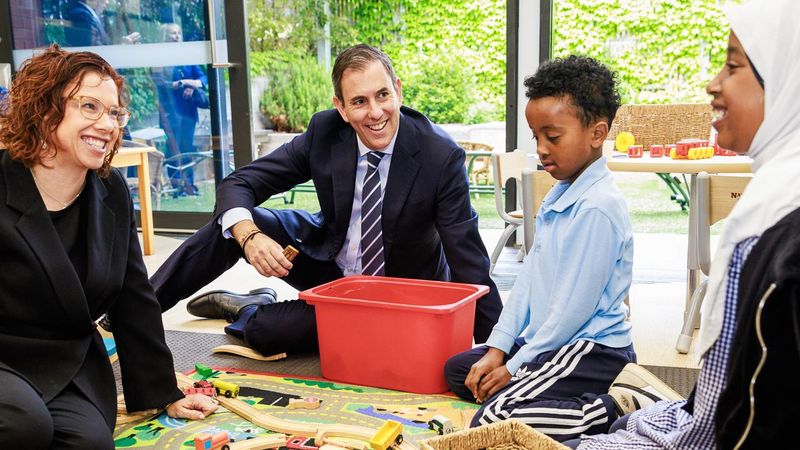
Community funding to help break disadvantage cycle Australia has a long way to go to eliminate disadvantage but partnerships with local groups can help to bridge the divide, the federal treasurer says. AAP · Oct 29, 2024
Teaching and research are the core functions of universities. But in Australia, we don't value teaching This article is part of our series on big ideas for the Universities Accord. The federal government is calling for ideas to “reshape and reimagine higher education, and set it up for the next decade and beyond”. A review team is due to finish a draft report in June and… The Conversation · May 3, 2023
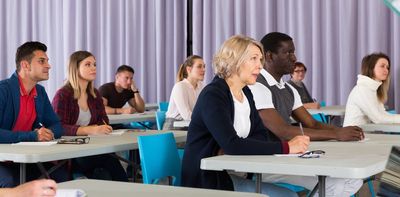
'Why would you go to uni?' A new study looks at what young Australians do after school This week, the federal government released a discussion paper for a Universities Accord, which it hopes will make a 30-year plan for the sector. The Conversation · Feb 23, 2023
Yes campaign for voice launches with $5m donation The "yes" campaign for an Indigenous Voice to Parliament has launched, receiving the single largest known donation for the case to be put to a referendum. AAP · Feb 23, 2023
Yes campaign for Indigenous Voice to Parliament launches with announcement of multi-million-dollar donation A multi-million-dollar donation will be used for resources and community events as the Yes campaign for an Indigenous Voice to Parliament gets underway. ABC News · Feb 23, 2023
Voice to parliament yes campaign launches with pledge to take conversation to the people Hundreds of advocates meet on Kaurna land in Adelaide to workshop referendum strategies The Guardian - AU · Feb 23, 2023
'Thinking about my future is really scary' – school leavers are not getting the careers support they need Australia’s class of 2022 is on the home stretch. Next month, more than 200,000 year 12 students will be sitting their final exams. In amongst this, they are making big decisions about their lives beyond school. The Conversation · Sep 15, 2022
We asked children how they experienced poverty. Here are 6 changes needed now An eight-year-old boy is often hungry, but knows if he tells his mum, she will eat less herself and go hungry. He hates the thought, so he stays quiet. The Conversation · Aug 18, 2022
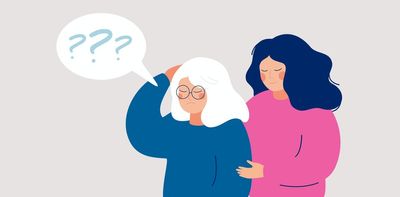
How your status, where you live and your family background affect your risk of dementia As part of a series on cycles of disadvantage, supported by a philanthropic grant from the Paul Ramsay Foundation, we’re publishing three articles on the social determinants of health. They look at how factors like income, where you live and your background affect your risk for cancer, dementia and heart… The Conversation · Jul 17, 2022
Don't expect schools to do all the heavy lifting to close the education divide between the big cities and the rest of Australia Students in regional, rural and remote Australia have been behind their urban counterparts on almost every recognised measure of successful schooling for decades. This is unacceptable and has to change. The Conversation · Jul 14, 2022
Labor promised a new committee of 15 young people to guide policy. So who gets picked, and how? The federal government has announced Anne Aly is Australia’s new minister for youth. This will restore youth consultation to government decision-making after the abolition in 2013 of the Youth Advisory Council and the Office for Youth. The Conversation · Jul 14, 2022
$1.5bn has gone into getting disadvantaged students into uni for very small gains. So what more can be done? The proportion of Australian university students from under-represented backgrounds has “barely moved” in more than a decade, federal Education Minister Jason Clare noted last week. About 15% of undergraduates came from low-socieconomic-status (SES) backgrounds in 2008, he said, and a target of 20% by 2020 was set. Today the figure… The Conversation · Jul 12, 2022
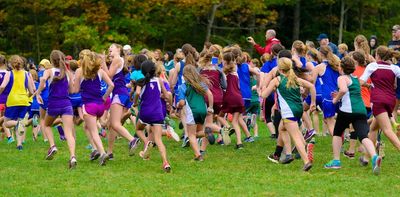
Richer schools' students run faster: how the inequality in sport flows through to health Cross-town sporting rivalry between the kids from the wealthy school and those from the country school – or the poorer suburbs – has been fodder for Hollywood movies such as Friday Night Lights, McFarland USA, Coach Carter, The Mighty Ducks and Hoosiers. We like to believe sport is the great… The Conversation · Jul 11, 2022
Your pay, postcode and parents affect your heart disease risk As part of a series on cycles of disadvantage, supported by a philanthropic grant from the Paul Ramsay Foundation, we’re publishing three articles on the social determinants of health. They look at how factors like income, where you live and your background affect your risk for cancer, dementia and heart… The Conversation · Jul 10, 2022
The Conversation · Jun 20, 2022 'Greatest transformation of early education in a generation'? Well, that depends on qualified, supported and thriving staff Australia’s two most populous states, New South Wales and Victoria, have set the target of delivering an extra year of learning for all children before they start school. Billed as “the greatest transformation of early education in a generation”, last Thursday’s announcement follows close on the heels of the new…
The Conversation · Jun 16, 2022 After years of COVID, fires and floods, kids' well-being now depends on better support Every student in every school in Australia has experienced unprecedented disruptions to their schooling over the past three years. On top of the disruptions and stress of COVID-19 lockdowns, isolation from their schools, their friends and (for many) their extended families, tens of thousands of Australian families have also seen…
The Conversation · Jun 8, 2022 Women’s probability of being in poverty more than doubles after separation When a heterosexual relationship breaks down, women are at a much higher risk of falling into poverty than men – especially if they have children to care for.
The Conversation · Jun 6, 2022 What's taking the biggest toll on our mental health? Disconnection, financial stress and long waits for care The new Labor government arrives at a time of mounting mental health strain: Australians have endured COVID, extreme weather events and financial stress from increased living costs.
The Conversation · May 30, 2022 The way we talk about First Nations issues is striking, as our analysis of 82 million words of Australian news and opinion shows “We say sorry”.
The Conversation · May 8, 2022 Poverty isn’t a temporary experience in Australia. We need urgent policy tackling persistent disadvantage We often hear a job is the best way to get someone out of poverty. In many cases this is true, and anti-poverty strategies should prioritise improving people’s access to jobs.
The Conversation · May 3, 2022 Giving ex-prisoners public housing cuts crime and re-incarceration – and saves money “Going home” is a classic metaphor for exiting prison. But most people exiting prison in Australia either expect to be homeless, or don’t know where they will be staying when released.
The Conversation · Apr 5, 2022 Natural disasters hit disadvantaged people the hardest, but we can lessen the impact Thousands of people have been displaced by the floods in New South Wales and Queensland. After the first flooding event in late February, over 5,000 homes were rendered uninhabitable across the two states.
The Conversation · Jan 27, 2022 Only 1 in 3 teachers use research evidence in the classroom – this is largely due to lack of time Even before the pandemic, recent research shows most Australian teachers worked an average of 140 to 150% (one-and-a-half times) of their paid hours in a typical week. And they’re not necessarily getting to focus on aspects of the job they believe are important, such as actual teaching. In fact, the…











 The Conversation
 AAP
AAP
 ABC News
 The Guardian - AU
