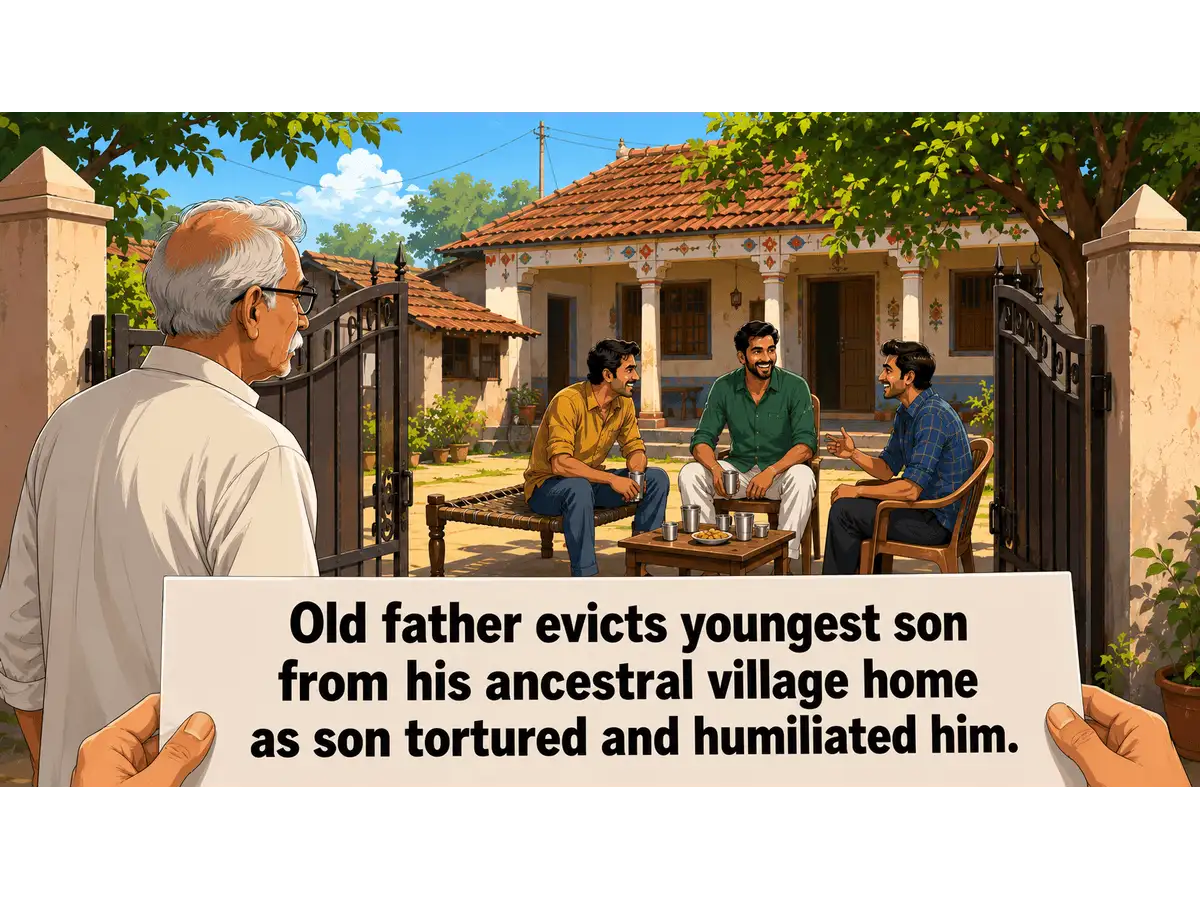
When 86-year-old Mr Sahoo purchased land in his youngest son's name and allowed him to live with him in the family's ancestral house in Baramunda, Bhubaneswar (Odisha), he never imagined that his son would torture and humiliate him. The situation, he claimed, became so unbearable that he was forced to leave his ancestral house and take shelter in his middle son's house in Pokhariput.
Mr Sahoo, a retired government serviceman, has three sons. A few years ago, his elder son and middle son moved out of the ancestral house at Baramunda and began living separately with their respective families. Mr Sahoo continued to live in the house with his youngest son, Sekhar.

Sahoo alleged that Sekhar forced him to leave his ancestral house with repeated torture and humiliation. After he moved out, Sekhar took exclusive possession of the Baramunda house. Initially, Sahoo stayed with his eldest son at Siripur in Bhubaneswar before moving to his middle son's home in Pokhariput, Bhubaneswar, where he has since been living.
According to Sahoo, his relationship with his son Sekhar was cordial in the initial years. Reposing faith in him, he had purchased several parcels of land in Sekhar's name in mouza Satyabhamapur, Lenkudi, Alarpur, Paikerapur, and Baramunda. However, after their relationship soured, Sahoo sought to reclaim the properties. Subsequently, he filed two court cases: one for Sekhar's eviction from his ancestral house (Sub-Collector, Bhubaneswar) and another in civil court for the revocation of Sekhar's name from the purchased land parcels.
Also read: Harassment of elderly parents costs son dear: Jharkhand HC orders eviction from self-acquired home
Meanwhile, after filing the court case, Sahoo approached the police station concerning the allegations of torture and humiliations he had raised, as well as the pending Appeal Case No.188/2024 before the sub-collector, Bhubaneswar.
On August 7, 2025, the sub-collector, Bhubaneswar-cum-presiding officer, Sub-Divisional Tribunal, Bhubaneswar, for MWPSC Act, 2007, passed the following order:
- The father and the son should stay peacefully at their residence.
- The son should stop abusing, threatening, and show immense respect to his father.
- The son should vacate the ground floor of the house at Baramunda village for safe living of his father and handover the same to his father by August 22, 2025, positively and report compliance.
- The property dispute matter is purely civil in nature, and an appeal case has been filed in the court of sub-collector, Bhubaneswar, vide No.188/2024, which is subjudice.
Feeling aggrieved, both Sahoo (the father) and Sekhar (the son) filed appeals before the Orissa High Court. On March 17, 2026, Sahoo partly won the case, as the high court ordered Sekhar to vacate his house. But regarding the revocation of Sekhar's name from the land parcels purchased by him, the high court said that it cannot pass any order, as that matter is being heard by the civil court.
Read below to know how Sahoo won this case:
Why Sahoo won this case?
Shrusti Shah, Associate Partner, King Stubb & Kasiva, said to ET Wealth Online: "The father "won" in the sense that the High Court refused to disturb the Tribunal's protective order safeguarding his right to live in his own home with dignity, a result the Court framed as consistent with the Act's welfare object, while the underlying property ownership dispute was left to be resolved separately through the pending appeal."
According to Shah what stands out in this order is that the High Court didn't just look at the law mechanically, it looked at the man. Here was an 86-year-old father, his wife gone, effectively pushed out of the very house his family had lived in, and the Court read the Maintenance and Welfare of Parents and Senior Citizens Act, 2007 the way it was meant to be read: as a welfare law, not a technical one.
Shah says: "The judgment is clear that beneficial legislation like this deserves a liberal, purpose-driven interpretation rather than a literal one, and that the whole point of the Act is to let elderly parents live out their years with security and dignity, that's almost lifted straight from Rule 19 of the state Rules."
What's interesting, though, is that the father didn't get a clean sweep. Shah says that the Court was careful to ring-fence the actual property dispute, who legally owns the land and left that alone because an appeal on that question was already pending elsewhere. So, this isn't a ruling that decides who owns what.
It's a ruling that said, regardless of how the ownership question eventually gets settled, an elderly parent cannot be made to live in fear or discomfort in his own home in the meantime. The son was directed to vacate the ground floor for his father's safe living and told, in effect, to stop the abuse and show respect.
Shah says that there's also a quieter but important point in here for anyone thinking of approaching the High Court directly in these matters, the father's own petition, which tried to get the property angle reopened, was thrown out because he skipped the appellate tribunal that the Act itself provides for.
Shah says: "So the takeaway is two fold - courts will lean in to protect a senior citizen's dignity and physical safety without hesitation, but they still expect people to use the appeal process the law has laid out for the property side of things."
Odisha High Court's order and analysis
Justice Ananda Chandra Behera gave this judgement (case no. WP(C) No.24893 of 2025) on March 17, 2026.
The Maintenance and Welfare of Parents and Senior Citizens Act, 2007, is a beneficial law
The intention of the legislature in enacting the Maintenance and Welfare of Parents and Senior Citizens Act, 2007, and its nature and manner of interpretations to be made by the tribunal and courts have already been clarified in the ratio of the following decisions:
- Philomina Vs. The Appellate Tribunal, Thiruvananthapuram, reported in 2021 (2) Civ.C.C. 806 (Kerala), held that the provisions of the Maintenance & Welfare of Parents and Citizens Act, 2007, are to give social justice to parents and senior citizens.
- Mrs. Rajani B. Somkuwar Vs. Ms. Sarita Somkuwar and Another reported in 2020 (2) CCC 100 (Bombay) held that, if children cannot take care of their parents and allow them to live in peace, they at least ought not to make their life a living hell.
- In a case between Urmila Dixit Vs. Sunil Sharan Dixit & Others reported in 2025 (3) Civ.L.J. 341 (SC) held that the Maintenance and Welfare of Parents and Senior Citizens Act, 2007, and rules thereof being beneficial statutes, the same must receive liberal construction in consonance with objects to be served by it. The court should adopt a purpose-oriented approach. Literal construction be avoided. It is the duty of the Court to discern the intention of the legislature, while enacting it. Beneficial statutes should be given purposive construction, which should be in line with their object.
The Orissa High Court said that when the present age of the father Mr Sahoo is 86 years and he is extremely old and his wife has passed away and when the primary object of the Maintenance and Welfare of Parents and Senior Citizens Act, 2007, is to give social justice to parents and senior citizens and when it is the duty of the tribunals and courts under the Act, 2007, to discern the above intention of the legislature.
Further, Rule 19 of the Orissa Maintenance of Parents and Senior Citizens Rules, 2009, provides that the orders under the Act, 2007, are to be passed, by which, the senior citizens shall be able to live with security and dignity.
Thus, the high court refused to interfere with the order of the sub-collector, Bhubaneswar.
Land property case is separate from this
The Orissa High Court said that the Act only allows a forum for senior citizens and can't be used to settle civil court issues. Thus, the high court dismissed the land revocation case, as it is pending with the civil court already.
Judgement:
- As per the discussions and observations made above, both the writ petitions vide WPC Nos.23193 and 24893 of 2025 filed by the son (Sekhar) and father (Mr Sahoo) are liable to be dismissed.
- In result, both the writ petitions filed by the respective parties against each other are dismissed on contest. As such, both the writ petitions are disposed of finally.