
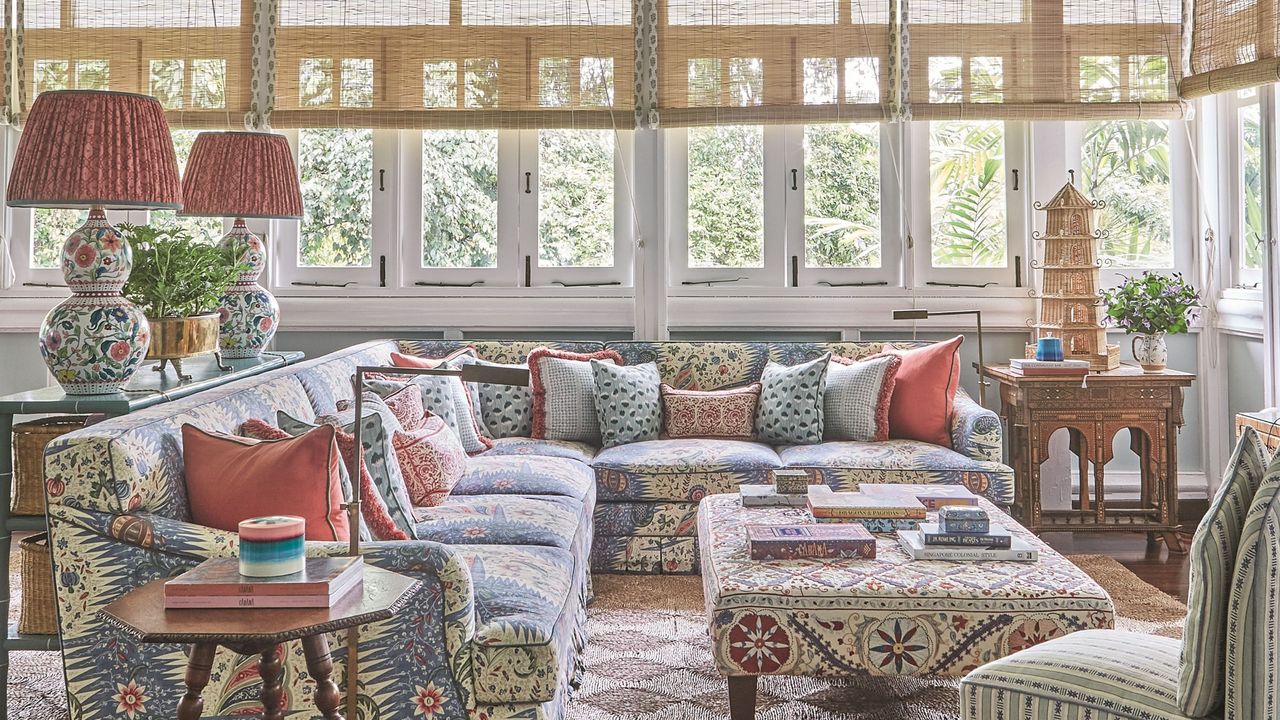
Relaxing on the chintz sofa in this vast living space in Singapore, you could be fooled into thinking you were sitting inside an English country home, and that is fundamentally the point. ‘My clients are British, so I wanted that sense of familiarity and a home-from-home feel,’ says interior designer Elizabeth Hay.
The exterior, too, has a vaguely British feel to it, with its mock-Tudor-style black-stained timber and whitewashed walls. ‘These historical houses really lend themselves to that classic country look for that reason,’ explains Elizabeth. Colloquially known as ‘black-and-whites’, these late 19th-century properties, built during British colonial rule, have an English aesthetic blended with Malay house design features, including wide verandas, tall shutters, and a topsy-turvy layout that prioritizes living spaces on the top floor.

Despite this rich history, the interiors lacked the same charm as the exterior when Elizabeth first visited. ‘It was a complete blank canvas in the literal sense, white tiled floors, white walls… it all felt quite sterile.’ Elizabeth had previously worked with the couple and their two young children on various projects, and the clients had always admired Elizabeth’s own black-and-white home. ‘They liked my east-meets-west approach and cozy English style,’ Elizabeth says.
Given it was a rental property (the vast majority of black-and-whites are leased by the Singapore Land Authority), structural changes were limited, so Elizabeth focused her attention and budget on soft furnishings, while making modest yet impactful changes to the kitchen and bathrooms.
In the kitchen, the clients wanted a monochrome theme to maintain a sense of tradition. ‘The kitchens in these houses are usually black and white, so we went for a more modern interpretation that was still sympathetic to the house, but fresher,’ says Elizabeth.
To keep things cost-effective, she added new cabinet fronts to the existing frames, as well as overlaying the old tiles to form a new splashback. On top of the wall cabinets sit two huge Spanish lidded jars, another piece of visual trickery. ‘The ceilings are almost four meters high, and the rooms feel vast, so you need bigger pieces to fill them, too many small fiddly things can feel a bit off,’ says Elizabeth

The ground-floor spaces, which are typically designated for formal entertaining. ‘These rooms are inherently darker due to the balconies above, so it makes sense to use them in the evenings,’ explains Elizabeth. In the sitting room, Elizabeth used a richer color palette of rhubarb red and cerulean blue, re-covering the family’s existing sofa and adding a striking pelmet to frame the tall windows.
A mirrored cabinet cleverly conceals the television, a design device Elizabeth frequently uses. ‘I’ll often find antique pieces and convert them into media units,’ reveals Elizabeth. ‘In Singapore, you don’t have fireplaces as you do in British homes, so there’s no central feature to the room. Including a piece like this can help to give it a focal point.'
Upstairs, the main living space became the priority of phase two, which needed to work as a multifunctional space for the parents to relax in, while also providing a play area for their youngest daughter. The L-shaped sofa became the linchpin of the design, upholstered in a bold floral. ‘I like to select one key pattern first, then build up the scheme from there,’ says Elizabeth. ‘The secret to mixing patterns is to be mindful of the scale of your secondary fabrics. Tone is also important; the colors have to be harmonious to the eye.’


Because the living area was so large, Elizabeth partitioned off a corner and turned it into a guest bedroom. ‘It’s a real jewel box, with wallpaper that reminds me of the inlay work in the palaces of Rajasthan,’ she says. ‘It feels very special and cozy.’ In fact, the designer's favourite room is the tiniest space – the couple's long, skinny study. Elizabeth added wall-to-wall shelving, backed with the client's much-loved Antoinette Poisson wallpaper and rug from Elizabeth's own collection pulling the scheme together.

The clients regularly remind Elizabeth of how the work has enhanced day-to-day living. ‘It’s lovely to get positive feedback and feel you’ve made a difference.’