Get all your news in one place.
100's of premium titles.
One app.
Start reading
T3
T3
Technology
Chris Hall

You can turn your analogue watch smart with a Fitbit Air, even a Rolex or Omega – here's how

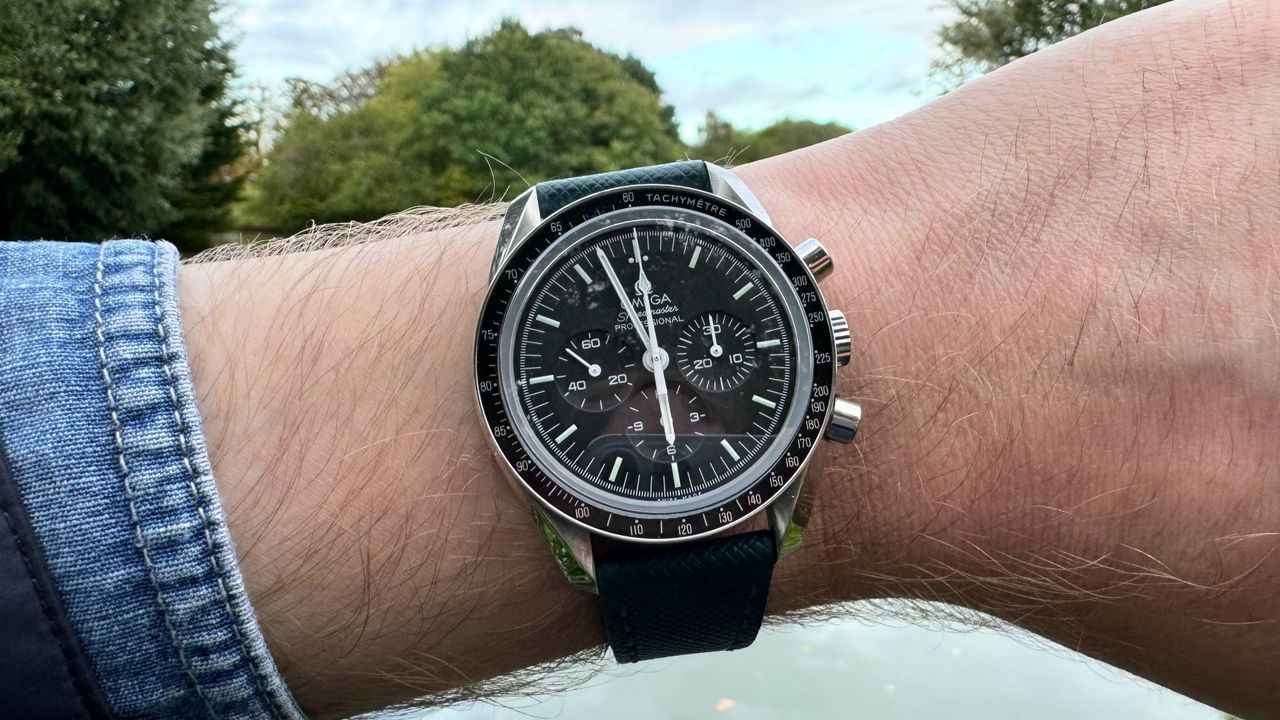
OMEGA Speedmaster Professional.

Quick Summary

Fitbit Air owners are adding traditional watches to the strap to make a hybrid solution.

It allows Fitbit to gather data, while the wearer continues to wear their preferred watch, such as an Omega or Rolex.

The Fitbit Air has only just launched, but it's already being hacked and getting the attention that some wearables can only dream of. The tracker is a Whoop challenger, ditching the display for a simpler data-gathering wearable – but it's proving to be really flexible in how you wear it.

Because of the simple design, with a small sensor in a band, it's easy to adapt and that's seen a solution to double wristing, with an enthusiastic Reddit thread pulling in plenty of fans.

In this case, the owner has added an Omega Seamaster to the Fitbit Air strap, with the sensor placed on the underside of the wrist. That avoids wearing the mechanical watch on one wrist and a digital device on the other. It's simple and obvious.

It's something of a trend in fact, with owners sharing their own solutions – like this pairing with a Casio F-91W, this MoonSwatch 1965, or even this Rolex Submariner.

[Double wristing] Is the Fitbit air the solution to this problem? from r/Watches

It's long been a problem and something that's given rise to devices like the Fitbit Air: there's no shortage of smartwatches that gather data, but if you want to wear something more classical, you might end up wearing two devices.

The appeal of a fitness band (or smart ring) is that you don't have two displays duplicating functions. If you already have a preferred watch, you can just wear a band on the other wrist. That will always lead to calls to "just get an Apple Watch", but that's not a solution that works for everyone.

The Fitbit Air has an 18mm strap which is a little on the slim side for many watches where 20mm or 22mm is more common, but if you have a dress watch or something older, then the 18mm strap might fit nicely.

Just slipping your mechanical watch onto the Fitbit strap isn't going to be the end of the story: Google has already released the CAD files to encourage a thriving accessory ecosystem, so there's likely to be plenty of accessories coming in the future – perhaps some more elegant replacement straps.

(Image credit: Google)

The revival of screenless devices is mostly thanks to Whoop, where the holistic approach to data gathering has found a lot of fans, while avoiding something that looks like another smartwatch.

The advantage of screenless devices is that the battery life is generally good, but most importantly, they're easy to sleep in. With sleep data being a key measure for daily readiness and recovery tracking, it's no surprise that these types of devices are proving popular.

Whether those wearing Frankenstein Fitbit Airs will then sleep in them too remains to be seen – I suspect not.

Whoop rules the roost for current fitness bands, but the subscription is expensive and that's seen Fitbit returning to its roots, with the Fitbit Air harking back to the original Flex fitness band.

It's likely to be joined by the Garmin Cirqa soon, which will appeal to huge userbase of Garmin wearers who want to keep data in the Garmin ecosystem when not wearing their main device.

Sign up to read this article
Read news from 100's of titles, curated specifically for you.
Already a member? Sign in here
Related Stories
Top stories on inkl right now
One subscription that gives you access to news from hundreds of sites
Already a member? Sign in here
Our Picks
Fourteen days free
Download the app
One app. One membership.
100+ trusted global sources.