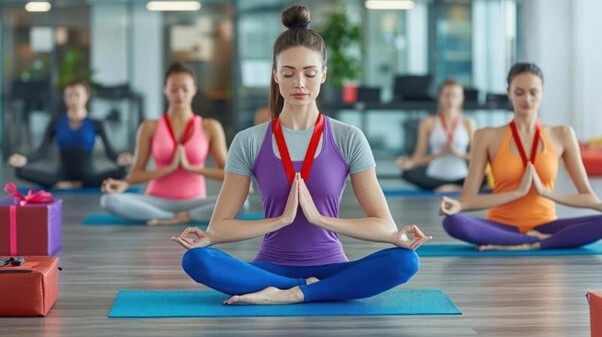
Most people come to yoga looking for a better stretch or a calmer mind. But there is another benefit that rarely makes the brochure which is body awareness.
Scientists call this sense proprioception. Specialised nerve cells (proprioceptors) sit inside your muscles & joints, constantly sending the brain updates about limb position.
If you close your eyes and touch the tip of your nose. That ability is called Proprioception. In a yoga class, where you hold unusual shapes while paying attention to your breathing and gaze, those receptors get a serious workout. Week after week the signal between body and brain gets cleaner.
A systematic review in the journal Yoga Mimamsa looked at studies measuring joint position sense (a clinical test for proprioceptive accuracy) and found that regular yoga practice improved scores in both healthy people and those with neurological conditions such as Parkinson’s disease.
Poses That Can Train Your Internal GPS
Tree Pose (Vrksasana)
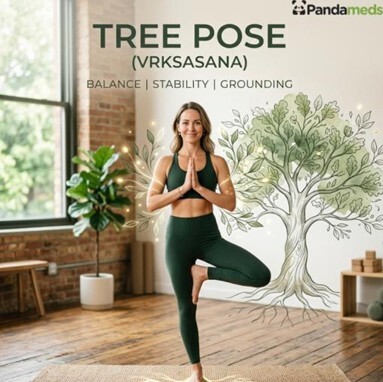
Tree Pose is usually the first balancing posture beginners try and it stays useful no matter how long you’ve been practising.
Stand on one leg with the opposite foot pressed into your inner thigh and the proprioceptors in your standing ankle and hip have to fire constantly to keep you upright.
To make it more challenging you can close your eyes. Without visual reference points, your nervous system has no backup. You can also try practising on grass or a folded blanket because the uneven surface forces your stabiliser muscles to adapt in real time.
Warrior I (Virabhadrasana I)
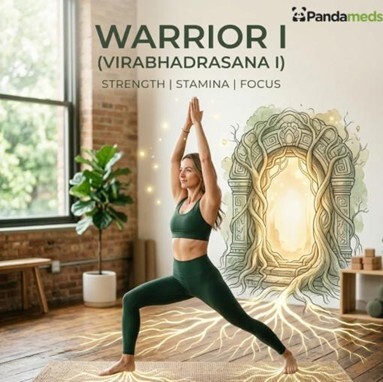
Warrior I looks easy but it is not. Your back foot turns inward, your hips square toward the front of the mat and your arms reach overhead. This all happens at once.
These competing alignment cues make it hard to cheat: you can feel immediately whether your pelvis has twisted, whether your back hip flexor is tight and whether your front knee has drifted past your ankle.
A lot of practitioners say Warrior I was the first pose where they realised the position they imagined they were in and the position they were actually in were two different things. That gap is where real body awareness starts.
Warrior II (Virabhadrasana II)
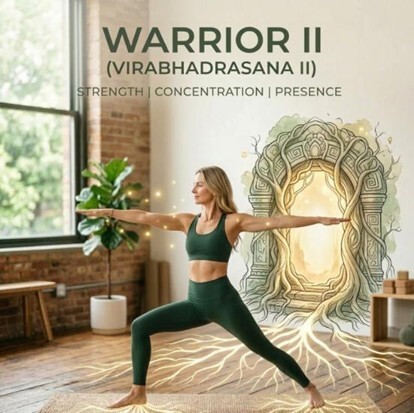
If Warrior I faces you forward, Warrior II opens you sideways. Your arms extend parallel to the floor, your hips widen and your back leg straightens.
The pose is stable enough to hold for a while, which is part of the point: it gives you time to notice small things. Is your neck clenching? Has your front knee collapsed inward? Are you leaning your torso over your front thigh without realizing it?
If you are able to catch and correct these small misalignments while holding a position then it is body awareness in its most practical form.
Warrior III (Virabhadrasana III)
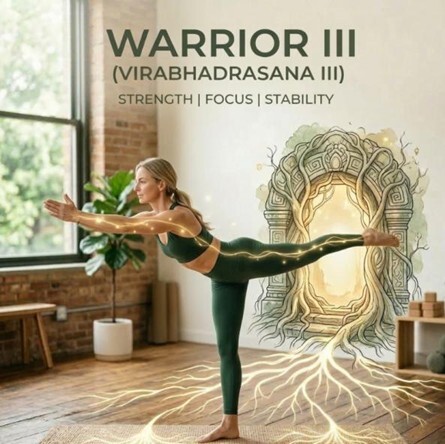
Balance on one leg, hinge forward and lift your back leg until both are roughly parallel to the floor. Your core and all the small stabiliser muscles around your standing ankle are working hard.
The pose also tests dynamic proprioception which is your body ability to sense where your body is while it’s under load and shifting. Most people tense everything at first. The real lesson is figuring out which muscles actually need to work and letting go of the rest.
Half Moon Pose (Ardha Chandrasana)
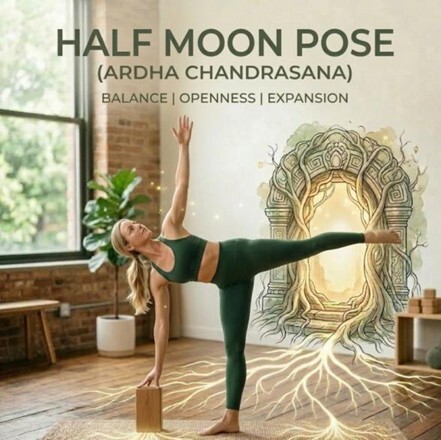
Half Moon throws rotation into mix. One hand touches the ground (or a block), your top hip stacks above the bottom one and your upper leg lifts behind you.
The combination of lateral tilt and single-leg balance exposes asymmetries fast. A lot of people find out here that one side of their body is weaker or less coordinated than the other. That’s useful information and it should shape what you work on next.
An 8-Week Practice Framework
Doing these poses once in a while is fine, but if you want measurable progress, a structured plan helps. The table below breaks the work into four two-week phases, moving from basic grounding to multi-directional balance.
|
Phase |
Focus |
Key Poses |
|
Weeks 1–2 |
Grounding basics |
Mountain Pose, Tree Pose (wall-assisted), Warrior I |
|
Weeks 3–4 |
Sideways balance |
Warrior II, Triangle Pose, Extended Side Angle |
|
Weeks 5–6 |
Moving balance |
Warrior III, Half Moon, Eagle Pose |
|
Weeks 7–8 |
Putting it together |
Full Warrior series in a Vinyasa flow, eyes-closed balance work |
Write down how long you held each balancing pose, whether you needed a wall or a block, and any differences between sides. By the end, most people can hold poses longer, need fewer props and stand with better alignment in everyday life.
Track Your Progress
Before you start, it’s worth getting a baseline number or two. Your Body Mass Index won’t tell you everything about your health, but it gives you a quick reference point that you can compare over time. Pair it with qualitative notes from your journal (balance times, stiffness levels, posture changes) and you have a much fuller picture.
A BMI & Health Risk calculator tool can make it easy for you. You just have to enter your height and weight, save your result and check back at four-week and eight-week marks. You should watch your numbers alongside your journal entries to keep feedback loop tight. Also, you can use the TDEE Calculator to track your total daily energy expenditure (TDEE), which will tell you the number of calories your body burns each day.
How to Get More Out of Each Session
- Begin with a body scan. Before you move, spend two minutes working your attention from your feet to the top of your head. Note what feels tight, numb, or sore.
- Close your eyes in poses you already know well. It is the single fastest way to make a familiar pose challenging again.
- Change your surface. Grass, sand, a folded towel: anything that shifts slightly underfoot will wake up the small muscles that a firm studio floor lets sleep.
- Use a block or a wall whenever you need one. Props don’t reduce the proprioceptive benefit; they make the pose safe enough for you to actually explore your limits instead of just surviving.
- Slow your breathing down. Studies have linked slower breath rates during yoga with better interoception, the internal sense that tells you when you’re hungry, tired, or stressed before those signals become overwhelming.
Where This Leads
The flashy side of yoga gets all the attention but the quieter skill, knowing where your body is and what it can honestly do today is the one that changes how you move through ordinary life. You sit better at your desk. You catch a stumble before it turns into a fall. You notice a sore knee before it becomes chronic. Tree Pose, the Warrior series, and Half Moon are good places to start.