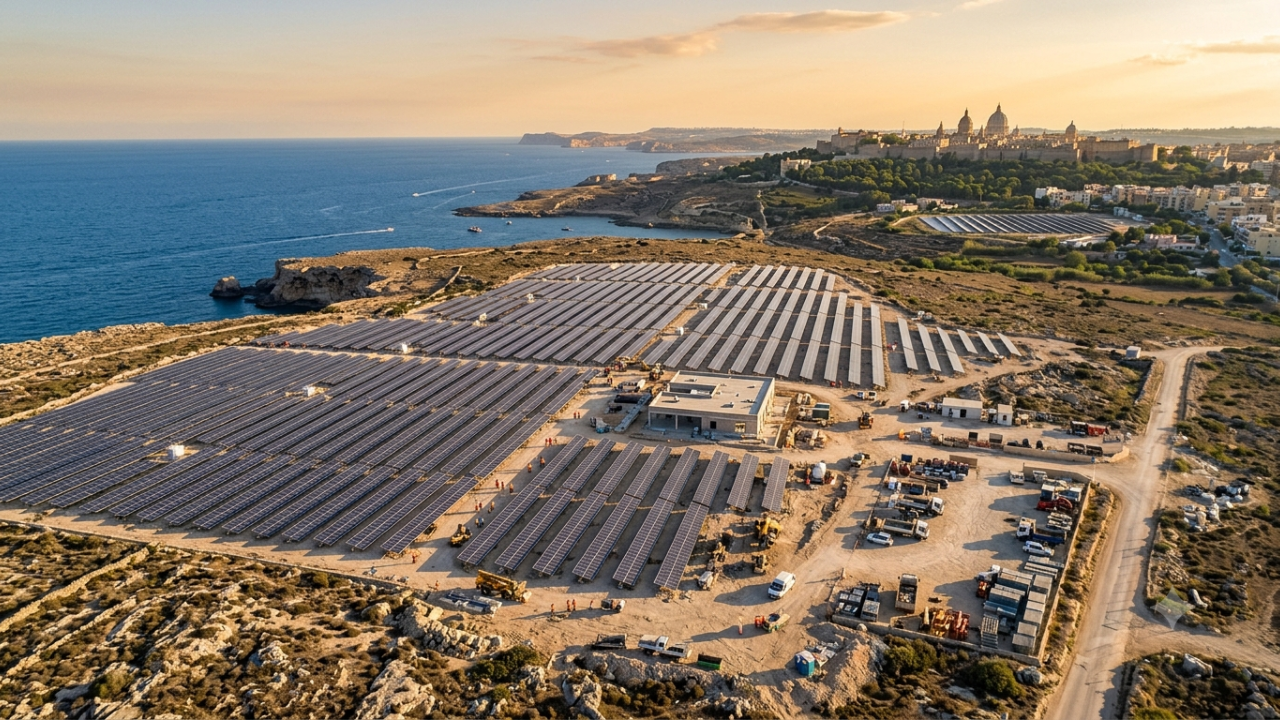
Vatican City occupies only about 44 hectares, making it the smallest independent state in the world. Its population is around 800 people, with thousands more travelling into the territory each day to work. Yet the tiny state is preparing for an energy project on a very different scale. The Vatican plans to invest about €100 million, or $117 million, in an agrivoltaic plant intended to supply its electricity needs and move it towards carbon neutrality. The facility will not be built inside Vatican City itself. Instead, solar generation is planned for a much larger piece of Vatican-owned land outside Rome, where the project is expected to take between 18 and 24 months to complete.
Get breaking news anytime, anywhere. Download the TOI app now!

The Vatican is smaller than its planned solar site outside Rome
The Vatican's territory is simply too small for the planned installation. As reported by Fortune, the solar and agricultural project is being developed at the Santa Maria di Galeria estate, a Vatican-owned property roughly 1,050 to 1,100 acres in size outside Rome.
The difference between the two sites is striking. Vatican City covers about 109 acres, while the estate where the new facility is planned is close to ten times larger. The project is expected to provide between 80 and 90 megawatts of generating capacity.
The plant is not being designed for a major industrial operation or a huge computing campus. It is intended to meet the energy requirements of the Vatican, including electricity used by its buildings and a radio transmitter.
The scale of the land also makes for an unusual comparison with the rapidly expanding data centre industry. A site of similar acreage is being used for OpenAI's Stargate project in Abilene, Texas, where the planned infrastructure is intended to support around 1.2 gigawatts of AI computing capacity.
The Vatican's proposed installation would generate a fraction of that amount. Its purpose is very different.
From 2,394 rooftop panels to an 80MW solar project
This would not be the Vatican's first move into solar power. In 2008, 2,394 solar panels were installed on the roof of the Paul VI Audience Hall. That system produces around 300 megawatt-hours of electricity each year.
The new facility would represent a substantial expansion of that existing capacity. Its planned 80 to 90 megawatts would be several hundred times greater than the capacity represented by the audience hall installation.
The project is also intended to combine energy generation with agricultural use, rather than simply covering the estate with conventional solar infrastructure. That approach is reflected in the term agrivoltaic, which describes systems where solar generation and agricultural activity share the same land.
For the Vatican, the project is part of a longer climate programme rather than an isolated investment.
The plan began under Pope Francis
The roots of the project go back to Pope Francis. In June 2024, he formally set out the Vatican's plans in a letter known as “Fratello Sole”. Pope Leo XIV has continued the project since becoming pope. He visited the Santa Maria di Galeria site in June 2025 and described the development as a significant opportunity. Italy agreed to the project the following month.
The institutional arrangements then took further shape. In June 2026, the Vatican formalised its relationship with Italian utility company ACEA, with both sides involved in developing the renewable-energy facility.
The latest step is the financial commitment. Around €100 million has now been attached to the project, giving a clearer indication of the scale of the investment. As reported by Reuters, construction is expected to take between 18 and 24 months.
A small country with a much larger energy comparison
Vatican City's physical size makes comparisons with modern infrastructure particularly striking. The country is roughly one-eighth the area of New York's Central Park. Its population is only around 800 residents, while close to 3,000 lay workers commute into the Vatican.
That makes its electricity requirements tiny compared with those of the enormous data centres now being planned across the United States. Some individual AI facilities are expected to require electricity on a scale comparable with that used by tens of thousands of households or an entire small city.
The Hyperion data centre project in Louisiana, for example, is expected to draw as much as 5 gigawatts of power by 2030. Against that figure, the Vatican's planned 80 to 90 megawatts is modest.
The comparison is useful for another reason. Both projects involve large amounts of land and electricity infrastructure, but they are being built for completely different purposes. One supports intensive computing operations. The other is intended to power a small sovereign state.
The wider pressure on electricity supplies
The Vatican's project comes as electricity demand from data centres is rising sharply. Data centres accounted for roughly half of new US electricity demand in 2025, according to figures cited by Fortune. Global data centre electricity consumption is also projected to more than double by 2030, reaching about 945 terawatt-hours.
The growth is beginning to influence the wider power industry. Utilities are planning major investments to accommodate additional demand, particularly in areas where clusters of AI data centres are being developed.
The comparison with the Vatican is therefore less about the absolute amount of electricity involved and more about the very different scales of modern energy demand. The Vatican's planned plant is large relative to what the state currently generates, but small beside the facilities being built to supply the computing industry.
A carbon-neutral goal by 2050
The Vatican has already committed itself to reducing emissions. Its 2023 climate pledge to the United Nations set a target of cutting emissions by 20% from 2011 levels by 2030, alongside a longer-term goal of reaching zero emissions by 2050. The renewable-energy project is intended to help with that transition.
The climate position of the Catholic Church became particularly prominent during Francis's papacy. His 2015 encyclical, Laudato Si', addressed environmental protection and climate change as issues with moral as well as scientific dimensions. It also argued that wealthier countries carry a greater share of responsibility for greenhouse-gas emissions.
Leo XIV has maintained a similar position. During a United Nations climate conference in 2026, he called for urgent action on climate change and referred to creation as “crying out”.