Get all your news in one place.
100's of premium titles.
One app.
Start reading
The Economic Times
The Economic Times
Piyush Shukla

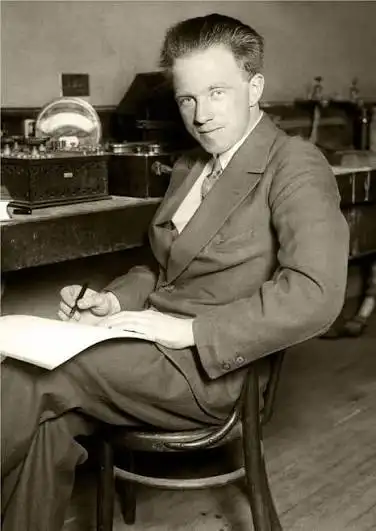
Word of wisdom by Werner Heisenberg: "Not only is the Universe stranger than we think, it is stranger than we can..." - What did the quantum physics pioneer and Nobel Prize winner really mean? His famous quote reveals a powerful truth about knowledge and human curiosity

Word of wisdom: “ Not only is the Universe stranger than we think, it is stranger than we can think. ” - German physicist and Nobel Prize winner Werner Heisenberg

In 1925, a twenty-three-year-old German physicist escaped to a small island in the North Sea to clear a fever. He stayed up until three in the morning working through equations. When they finally balanced, he said he was so startled he nearly fell off his chair. What he had just discovered would permanently change how humans understand reality—and permanently limit how well we ever could.

Werner Heisenberg left that island with the mathematics of quantum mechanics. He also left with a suspicion he would spend the rest of his life turning into a conviction: that the universe is not simply complicated. It is built in a way the human mind cannot fully picture.

He eventually put it plainly: "Not only is the Universe stranger than we think, it is stranger than we can think." That sentence has outlasted almost everything written in the twentieth century. Not because it is poetic, but because every generation of scientists since has kept finding out it is true.

A powerful word of wisdom by Werner Heisenberg: Scientists keep discovering he was right—why his famous quote matters more than ever

Isaac Newton watched an apple fall and extracted laws that predicted planetary motion for two centuries. He was not wrong—he was magnificently right, right enough to land humans on the moon. But his laws quietly broke down at very high speeds and very small scales. The universe had agreed to follow Newton's rules only in the neighbourhood he was looking at.

Einstein corrected Newton and revealed something deeper. Space bends. Time slows. The faster you move, the heavier you become. It took genius to see this, and the mathematics is beautiful. But Einstein himself never accepted what quantum mechanics implied. He spent the last thirty years of his life trying to disprove it. He failed. The universe, again, was operating by rules that made no visual sense whatsoever.

The experiment that broke intuition

Fire a single electron at a wall with two slits. The electron—a single particle—passes through both slits simultaneously and interferes with itself. When you try to watch which slit it uses, it stops doing this and behaves normally. The act of observing changes what is being observed. This is not a flaw in our instruments. It is how the universe works.

This is what Heisenberg formalised in 1927: his uncertainty principle. The more precisely you know a particle's position, the less you can know its momentum—not because our tools aren't good enough, but because both properties do not have definite values at the same time. The information doesn't exist in the way we expect information to exist.

Why does certainty stop discovery?

There is a recurring pattern in the history of science. A brilliant mind develops a framework that explains almost everything. That framework becomes the consensus. Bright students are trained to master it. And then something small—a number that won't quite fit, an experiment with an anomalous result—begins to pull at the thread.

The people most attached to the existing framework are usually the last to pull it. Not because they are unintelligent. Because certainty is cognitively expensive to abandon. The more you have built on a foundation, the more threatening it is to question it. Einstein's resistance to quantum mechanics is not a footnote—it is a warning. Even the greatest minds calcify around their best ideas.

In 2022, the James Webb Space Telescope began returning images of galaxies that should not exist under the current model of cosmology. They are too large, too mature, too early. Physicists are not panicking. But they are asking questions the standard model cannot yet answer. Heisenberg would not have been surprised.

What Heisenberg understood—and what his quote encodes—is that this is not a temporary problem. It is a permanent feature. Human cognition evolved to navigate a world of medium-sized objects at medium speeds. Our brains are superb instruments for that world. They are genuinely poor instruments for worlds where particles tunnel through walls, where time runs at different speeds, and where eleven dimensions may exist but cannot be visualised in any direction.

What this means beyond physics

Heisenberg was not only talking about electrons. His insight maps cleanly onto psychology, economics, and everyday decisions. We construct mental models of the systems we live inside—our workplaces, our relationships, our economies—and we mistake the model for the thing itself. The map becomes the territory. And then reality delivers the same surprise it always has.

Psychologists call this the curse of knowledge: the more expert you become in a domain, the harder it is to imagine not understanding it. Economists call it model risk: the danger of trusting a simplified version of the world so completely that you stop questioning its assumptions. Heisenberg called it the structure of reality. All three are describing the same ceiling.

The people who have historically made the largest advances—in any field—tend to share one trait. They hold their models loosely. They distinguish between "this explains what I've seen so far" and "this is how things actually are." That gap is where discovery lives.

Every generation believes it understands the world better than the one before it. And every generation is right—for a while. Then the James Webb returns an image that breaks the model, or a particle behaves in a way that shouldn't be possible, and the frontier moves again. Perhaps Heisenberg's greatest gift wasn't the uncertainty principle itself. It was the intellectual permission to stop pretending certainty is the goal. The universe is stranger than we can think. That is not a failure of science. It is science's most honest finding—and its most powerful invitation.

Born in 1901, Werner Heisenberg was a German theoretical physicist who became one of the founding figures of quantum mechanics, a revolutionary theory that transformed modern physics. He received the 1932 Nobel Prize in Physics for creating quantum mechanics and is best known for formulating the Uncertainty Principle , which showed fundamental limits to measuring certain properties of particles simultaneously.

During World War II, he led Germany's nuclear research program, a role that remains the subject of historical debate. Beyond physics, Heisenberg wrote extensively on science, philosophy, and the relationship between human knowledge and reality.

His pioneering work laid the foundation for technologies such as semiconductors, lasers, magnetic resonance imaging (MRI), and quantum computing, while his philosophical reflections continue to influence scientists, philosophers, and educators worldwide.

Sign up to read this article
Read news from 100's of titles, curated specifically for you.
Already a member? Sign in here
Related Stories
Top stories on inkl right now
One subscription that gives you access to news from hundreds of sites
Already a member? Sign in here
Our Picks
Fourteen days free
Download the app
One app. One membership.
100+ trusted global sources.