Word of the day: Some words seem less like entries in a dictionary and more like doors into unfamiliar worlds. English is full of dramatic, overlooked terms that describe emotions, experiences, and states of mind for which everyday language often falls short. While many people enjoy learning new vocabulary to improve communication, certain rare words offer something deeper: a glimpse into how earlier generations tried to explain the mysteries of human thought and perception. Today's word belongs to that category. It sounds poetic, almost mythological, yet it emerged from scientific inquiry. With its unusual rhythm and dreamlike quality, it captures a phenomenon that sits somewhere between imagination and reality, making it one of the most fascinating obscure words in the English language.
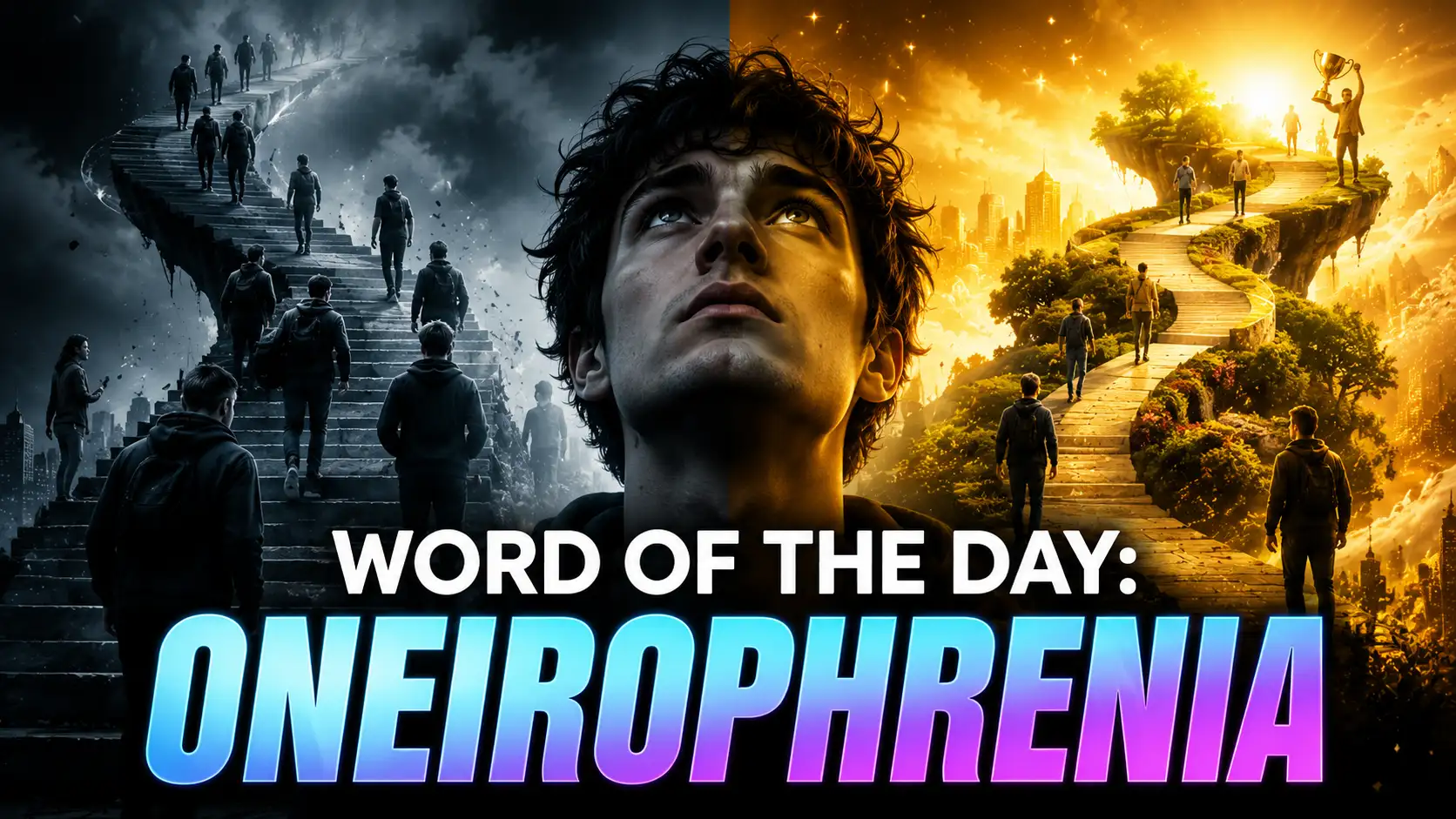
Word of the Day Today: Oneirophrenia
Oneirophrenia (noun)
Pronunciation: oh-NYE-roh-FREE-nee-uh
Meaning: A dream-like mental state in which a person experiences confusion between reality and fantasy, often accompanied by vivid imagination, altered perception, or hallucination-like experiences.
The term is rare in modern conversation but remains intriguing because it describes a condition where waking life begins to resemble a dream. While originally used in psychiatric research, it has since gained attention among language enthusiasts because of its evocative imagery and unusual sound.
READ ALSO: Word of the Day: Cathexis
What does Oneirophrenia mean?
At its core, oneirophrenia refers to a state of consciousness that resembles dreaming while awake. Someone experiencing oneirophrenia may feel detached from ordinary reality, perceive events as surreal, or struggle to distinguish between actual experiences and imagined ones.
The word does not necessarily imply a permanent condition. Instead, it describes a temporary dream-like state characterized by distorted perception and heightened imagination.
Imagine waking from a vivid dream and spending several moments unsure whether it really happened. That blurred boundary between reality and fantasy offers a glimpse of what oneirophrenia seeks to describe.
Origin of Oneirophrenia
Oneirophrenia has roots in ancient Greek.
- Oneiros = dream
- Phren = mind or mental activity
The term was coined in the mid-20th century by psychiatrists studying altered states of consciousness. Researchers used it to describe mental experiences that shared characteristics with dreaming despite occurring during wakefulness.
Its etymology literally translates to something close to "dream-mindedness" or "a dreaming mind."
READ ALSO: Word of the Day: Paracosm
The Greek origins help explain why the word sounds both scholarly and poetic. Even without knowing its definition, many people can sense its connection to dreams simply from its structure.
Synonyms of Oneirophrenia
While no synonym perfectly captures the exact meaning, several related words express similar ideas:
- Dreaminess
- Reverie
- Delirium
- Fantasy
- Hallucination
- Trance
- Dissociation
- Surrealism
- Daydreaming
- Altered consciousness
Antonyms of Oneirophrenia
Words representing clarity and grounded awareness include:
- Alertness
- Awareness
- Lucidity
- Clarity
- Rationality
- Realism
- Focus
- Mindfulness
- Perception
- Attentiveness
How to use Oneirophrenia in a sentence
Everyday conversation
- After staying awake for nearly two days, he drifted into a state of oneirophrenia, unsure whether the conversation had actually happened.
Literary writing
- The protagonist wandered through the misty city in a haze of oneirophrenia, where every shadow seemed alive with memory.
Journalism
- Witnesses described the aftermath of the disaster as a period of collective oneirophrenia, with reality feeling strangely distant.
Academic writing
- Researchers examined whether sleep deprivation could induce symptoms resembling oneirophrenia in healthy subjects.
Creative storytelling
- The enchanted forest cast a spell of oneirophrenia, causing travelers to question the boundary between dreams and waking life.
Oneirophrenia in different genres
Fiction
Novelists often create scenes that evoke oneirophrenia without explicitly naming it. Dream sequences, magical realism, and surreal narratives frequently explore this state.
Example:
"The hallway stretched endlessly before her, and with every step her certainty dissolved into oneirophrenia."
Horror
Horror writers use dream-like confusion to build suspense and uncertainty.
Example:
"His oneirophrenia deepened as familiar faces appeared where no one should have been."
Poetry
Poets may employ the concept to explore imagination and emotional ambiguity.
Example:
"Between moonlight and memory, oneirophrenia carried her thoughts beyond reason."
Science and Psychology
In academic contexts, the term reflects attempts to understand altered states of consciousness and perception.
Example:
"The study investigated oneirophrenia-like symptoms among participants experiencing sensory deprivation."
Why Oneirophrenia is worth learning
Many unusual words survive because they capture experiences that ordinary vocabulary cannot fully express. Oneirophrenia is one such term. Most people have encountered moments when reality felt strangely unreal—a period after a vivid dream, a sleepless night, a long journey, or an emotionally overwhelming event.
Common words like "confusion" or "daydreaming" only partially describe those experiences. Oneirophrenia offers a more precise and vivid alternative. It paints a picture of a mind drifting between two worlds, neither fully awake nor fully dreaming.
For writers, the word can add atmosphere and psychological depth. For readers, it provides a fascinating example of how language evolves to describe the complexities of human consciousness.
The English language contains countless hidden treasures, and oneirophrenia is among its most captivating. With roots in ancient Greek and connections to psychology, literature, and imagination, the word describes a dream-like state where reality and fantasy intermingle. Its unusual sound, rich history, and evocative meaning make it a memorable addition to any vocabulary collection.
Whether you're a writer seeking a dramatic term, a student fascinated by rare language, or simply someone who enjoys discovering extraordinary words, oneirophrenia offers a reminder that some of the most intriguing corners of language exist where science, imagination, and human experience meet.