Get all your news in one place.
100's of premium titles.
One app.
Start reading
The Economic Times
The Economic Times

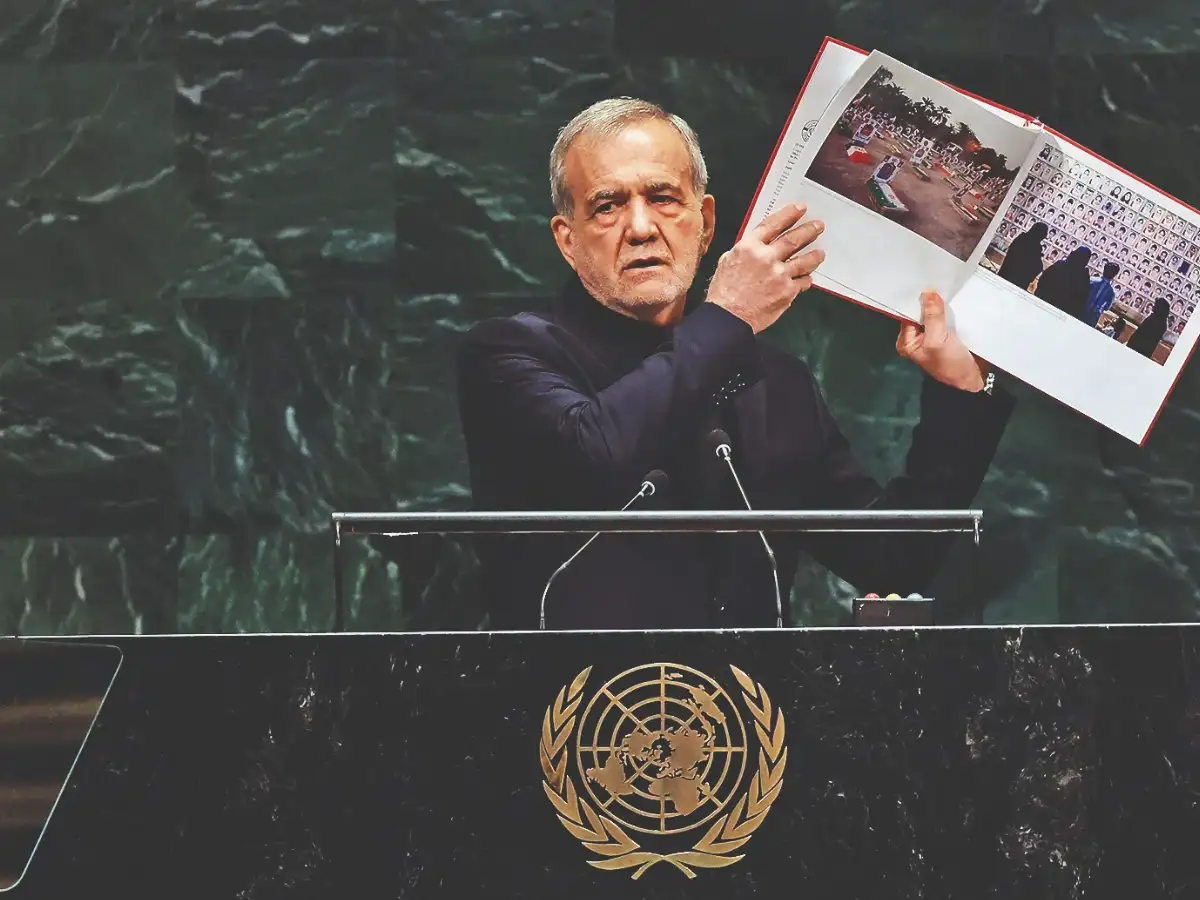
Won't surrender, Iran's Pezeshkian tells UNGA; indirect talks bring hope

United Nations | Dubai: Iran and the United States remain far apart on how to end their war but diplomacy must continue, a senior Iranian official said on Wednesday, after Iran's President told the UN General Assembly that Tehran would never surrender to US pressure.

Masoud Pezeshkian, in his speech in New York, condemned what he called "signs of a bullying mentality" from the US and said that Iran would never surrender. On Tuesday, US President Donald Trump, had used the same forum to threaten to "annihilate" Iran.
The duelling speeches at the annual UN gathering bookended the first shuttle talks between the US and Iran for months, though they appeared to have yielded no concessions in the public stance of either side towards ending the war.

The senior Iranian official, speaking on condition of anonymity, said Tehran was reviewing Washington's response to its peace proposals, which prioritise lifting a US naval blockade on Iranian ports and reopening the Strait of Hormuz.

Also read | In defiant speech, Iran's Pezeshkian lashes at Trump & Co, calls out "cowardly attacks, aggression

"There are still many differences between the Iranian and US positions, but diplomacy is continuing," the official said.

US Secretary of State Marco Rubio told reporters on Wednesday that a deal with Iran would involve hard work over a period of time, adding that Trump also had military options.

The US has also said it will impose so-called secondary sanctions against any country that allows Iranian flights after Wednesday. Mohsen Rezaei, secretary of Iran's Supreme National Security Council, told state TV Iran would ensure neighbouring countries' airports could not function if they stop Iranian flights.

'Remove shipping blockade'

In his address to the 193-member General Assembly, Pezeshkian homed in on the US blockade of Iranian ports and on the Strait of Hormuz, conduit for a fifth of global oil and liquefied natural gas shipments before the war.

"It cannot be the case that everyone benefits from the Strait of Hormuz while we are denied access to shipping through this waterway. The permanent deployment of hostile fleets and the expansion of the war will not lead to peace," he said.

"The Iranian people will not bow to pressure," he added.

Also read | US-China AI talks: A two-power bargain that could leave others out

Trump on Tuesday argued that he had prevented Tehran from obtaining a nuclear weapon and could "annihilate the Islamic Republic" if no deal is reached to end the conflict.

Pezeshkian on Wednesday reiterated Iran's line that it is not seeking nuclear weapons.

Iranian and US officials held their first known indirect talks on Tuesday since a ceasefire collapsed in July, with Iran's Foreign Minister Abbas Araqchi and US envoys Steve Witkoff and Jared Kushner communicating through mediators.

Iranian Foreign Ministry spokesperson Esmail Baghaei said Tehran had conveyed conditions during a two-hour exchange of messages with Washington via a Qatari mediator. These included an end to the war on all fronts, a halt to US "acts of aggression" and the release of frozen Iranian assets.

HARDLINERS RESIST MOVES

The diplomatic contact in New York caused a backlash in Iranian media associated with hardliners. An opinion piece run by the semi-official Tasnim news agency, associated with the Revolutionary Guards, said Araqchi was wrong to have contacts with Witkoff and Kushner, "a major gift to Trump", as Iran had conveyed its terms. Reuters

Sign up to read this article
Read news from 100's of titles, curated specifically for you.
Already a member? Sign in here
Related Stories
Top stories on inkl right now
One subscription that gives you access to news from hundreds of sites
Already a member? Sign in here
Our Picks
Fourteen days free
Download the app
One app. One membership.
100+ trusted global sources.