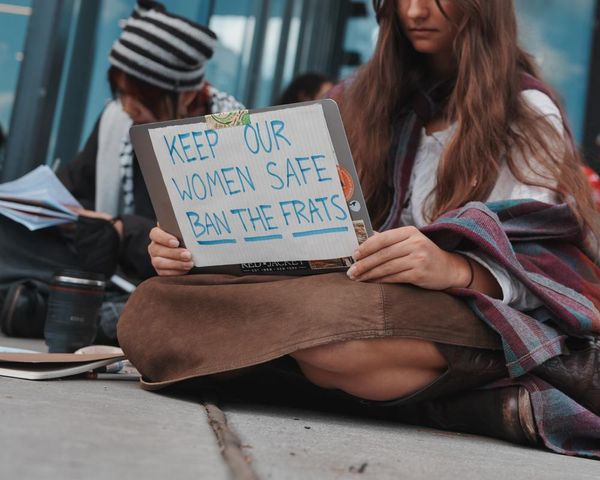
A Brazilian woman reported that she was told to cover up at the gym for her “own safety,” as there were “married men” present.
The incident, which sparked outrage in the country, prompted an apology and an internal investigation from the gym. In response, a lawyer spoke with Bored Panda to better understand the case and clarify whether the establishment’s request was lawful.
A gym sparked outrage after telling a woman to cover her sports top “for her own safety,” citing the presence of married men

In a video, Poliana Frigi said she was wearing a normal sports top when she was approached by a gym employee.
“I was wearing a sports top from a well-known fitness brand when the worker approached me and asked if I was wearing [underwear]. I immediately explained that it was a sports top, showed her the logo and the fabric, and she said that some people had complained because the straps were too thin,” she recounted, according to Globo.
Poliana, an engineer from São Paulo, said the unnamed worker instructed her to cover up, citing the discomfort of other gym-goers.

“She asked if I didn’t have a t-shirt to put on, something to cover myself with, because ‘there are married men here and it wouldn’t look good for me, especially for my own safety.’ I was shocked. I said I didn’t have a t-shirt and that I wouldn’t put one on because I was wearing a sports top.”
Poliana complained to the worker, who insisted that the rule had management’s approval

The woman said the request left her feeling uncomfortable and embarrassed during her training.
“I started looking at myself in the mirror and thinking, ‘Am I wearing a top that’s too small? Is something showing?’ I started to feel bad.”
Poliana and her boyfriend then asked for the manager’s contact information to file a formal complaint, but she was allegedly told that the conduct “was authorized by the manager” and “that everything was within the gym’s procedure.”

The response confused Poliana; she wasn’t sure whether the worker had falsely told the manager that she was wearing underwear, or whether she had taken a picture of her without her consent.
“They wouldn’t give me his contact information. I left there stressed, never wanting to go back again,” Poliana shared.
The incident reportedly occurred at a John Boy Academia location in late March.
“How far will they continue to reprimand women for their clothing’” Poliana asked

In her Instagram video, the engineer questioned the worker’s request and the justification that it was for her own “safety,” rather than ensuring that everyone behaved respectfully at the gym.
“How far will this be considered normal? How far will they continue to reprimand women for their clothing? I was wearing a normal sports top.
It seems the problem will always be the woman, and not the married men, the environment, or the behavior of others.”
Poliana said she’s speaking with a lawyer to decide how to proceed.

According to Dr. Eduardo Tomasevicius Filho, lawyer and professor at the University of São Paulo, it is possible to establish dress code rules for a specific place through a service contract or posted notices—what the law refers to as “general conditions”—as long as those rules are clearly stated.
“Issues like this often arise in the judiciary, where a judge may prohibit someone from entering a courtroom wearing flip-flops, only to later find out that those were the person’s only shoes—cases that can gain significant attention.
“There are also debates about whether lawyers and judges can go to court without wearing a tie.
“In some coastal cities, people can enter public places—banks, supermarkets—wearing beachwear, while in others this is not allowed. These rules are typically posted at the entrance as general conditions and must be followed by everyone.
Eduardo Tomasevicius Filho explained that gyms can only enforce dress codes if clearly posted or stated in contracts

“In the case of a gym, if there are no explicit legal rules in a contract or posted notices regarding appropriate attire, then the moral dress code applies.”
The “moral dress code” refers to the rules that govern what we wear in public places. For instance, in many Western cultures, wearing a sports top to the gym like the one worn by Poliana is considered appropriate.
“However, if the gym wishes to establish a different dress code through a contract or general conditions, it is up to each member—after being informed through the contract or clearly posted rules—to decide whether or not to enroll in that establishment.”

Therefore, whether the request at Poliana’s gym was illegal depends on the existence (or absence) of clearly stated rules, as well as on whether there was unequal treatment, the lawyer explained.
“I assume this gym does not have clearly defined rules about attire; in that case, the moral dress code applies, which generally allows the use of a sports top or similar clothing.
“Additionally, it must be verified whether only this person was barred while others were not, or whether all women wearing sports tops were prevented from entering.”
In Poliana’s video, she included a screenshot of the gym’s dress code, claiming that at no point does it state that workout tops are forbidden.
The gym launched an internal investigation and apologized to Poliana in a statement

In a statement, John Boy Academy said it had launched an internal investigation and emphasized its commitment to maintaining a “respectful, safe, and welcoming” environment.
“We have already begun reviewing our service and communication protocols, including training focused on respect, diversity, and inclusion for the entire team,” the gym said, according to Globo.
“We apologize to the gym member and to everyone who felt affected by this episode. We acknowledge that mistakes can happen, but what defines an organization is how they are dealt with — and we are committed to evolving with responsibility and respect.”
The case ignited a debate over gym dress codes and gender roles