Get all your news in one place.
100's of premium titles.
One app.
Start reading
Newslaundry
Newslaundry
National
Suhasini Biswas

‘With Wangchuk gone, cops thought hope would die’: The weekend that changed the CJP protest

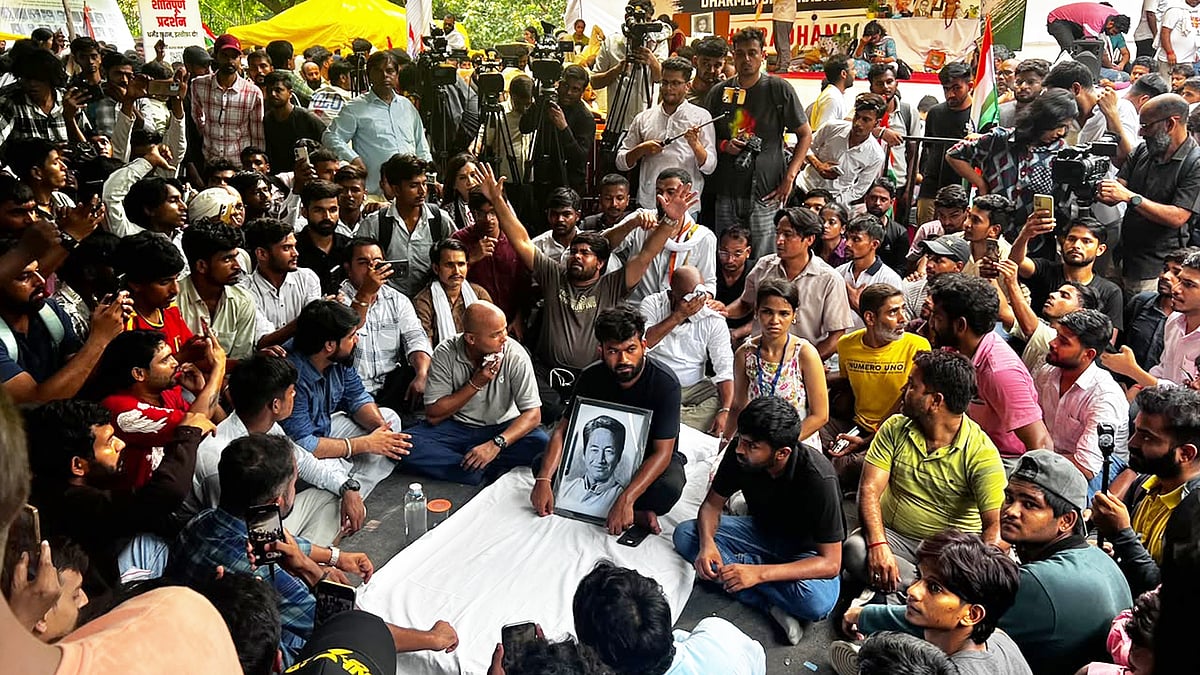
Thousands have turned up for the Cockroach Janta Party’s march to Parliament on Monday, filling the road from Jantar Mantar to the Tolstoy Marg–Sansad Marg intersection. Police are trying to block the march with barricades and used batons after some protesters tried to push through.

The size of the crowd marks a dramatic shift from just days earlier, before Sonam Wangchuk’s forcible removal to hospital on Saturday morning galvanised the protest.
Whatever the intent of the police action on Saturday, the effect was to bring people in. Neha Rajouria was one of them – a biology tutor originally from Rajasthan, she reached Jantar Mantar on July 18, in the hours after Wangchuk was driven away, and stayed the night. She carried with her a decade-old grouse.

“My father’s close friend’s son had committed suicide by self immolating himself back in 2016 after the All India Pre-Medical Entrance Test paper leak,” she said. “It has been a decade since then, there is still no accountability regarding such incidents.”

Neha had herself appeared for the AIPMT test in 2016, and being a teacher now made her feel it was her moral duty to be there. She wanted to do it for her friend who had died, and for the students who gave their lives this year. She felt this was the bare minimum one could do.

Neha is a biology teacher from Rajasthan.

Another young protester, 20-year-old Delhi University student Devesh, made the same decision that day after witnessing what had transpired that morning. “Police is deliberately provoking people…they thought if they take away Sonam Wangchuk, the hope will die but more people are coming here. I am staying overnight because of this,” he said.

Devesh’s own parents remain unaware of his participation, but despite that – and the constant threat of police brutality – he had come to support voices raising concerns well beyond education, including E20 and workers’ unlawful abductions. “I think participating in this protest comes from a moral responsibility. You suddenly see this collective consciousness, it is blooming. People are actually finding courage,” he added.

Thousands have continued to camp on the spot.

While the NEET paper leak and failing education system may have been the igniting spark, the crowd gathered at Jantar Mantar made it clear the protest had come to hold something larger – a decade of accumulated grievances against institutional failure, corruption, and eroding accountability.

‘The paper leak is just the symptom’

Prerna, 52, a founding member of a Gandhian youth organisation, had travelled to Delhi with a group of young volunteers from Madhya Pradesh, Gujarat, Maharashtra, and Uttar Pradesh. For her, the paper leak was never really the main issue. “The paper leak is a symptom, not the root cause. The root cause is corruption. It runs through everything be it in the Ram Mandir donations or vote chori during elections. All of this flows from the same river of corruption, and the more corrupt those at the top are, the more it seeps down. Education is just one part of it,” she said.

Swarupadevi Hajare, 49, had travelled by train from Wardha, Maharashtra, arriving July 18. Unlike many around her, she was uneasy with hunger strikes as a method. “This isn’t sustainable for your health,” she said. “How will you fight if your body gives out halfway?” She had planned to stay until Monday – for the march.

Her fight began over a decade ago at a government scheme meant to help women. As an accountant at a local centre distributing funds under Maharashtra’s Women’s Economic Development Corporation – money meant, in part, for women farmers – she was removed from her post in 2013 after refusing to approve bills she believed were fraudulent. Fed up with the judiciary and years of court battles, she found the CJP protest a small opening to vent her frustration with the government.

Swarupadevi Hajare travelled by train from Maharashtra's Wardha.

Narayan Prasad Kesharwani, 63, had arrived from Chhattisgarh. A journalist, social worker, and NGO founder, he claimed thirteen years spent fighting corruption out of Korba district. Two days into his own hunger strike, his blood pressure had already dropped.

Years ago, he said, the local electricity board cut his power and hit him with a huge bill; when he objected, officials allegedly tried to get him arrested instead. He fought it in court and lost, in 2022, all the way up to India’s top consumer court. “As long as there is life left in this body, I’ll keep protesting.”

Widowed – his wife died of cancer fighting alongside him – he has a 16-year-old son at home who calls him daily. “I haven’t just come here for the children,” he said. “I’ve come to stand with all 140 crore people of this country.”

Narayan Prasad Kesharwani, 63, had arrived on July 16 from Chhattisgarh.

Kesharwani had come on Thursday though, unlike the others mentioned in this report.

By Sunday afternoon, thousands were flowing through both entries to the protest site, the crowd having grown dramatically since the protest began on June 20. Regulars at the site said the surge became unmistakable after Saturday’s removal of Wangchuk.

At any given time, queues formed at both entries; once inside, protesters doubled as crowd managers, and volunteers fanned others in the heat as people moved through the lines.

By Monday, the same protest had pulled in more than 10,000, many of them into the street, marching toward Parliament and into a police blockade.


Small teams can do great things. All it takes is a subscription. Subscribe now and power Newslaundry’s work.

Newslaundry is a reader-supported, ad-free, independent news outlet based out of New Delhi. Support their journalism, here.

Sign up to read this article
Read news from 100's of titles, curated specifically for you.
Already a member? Sign in here
Related Stories
Top stories on inkl right now
One subscription that gives you access to news from hundreds of sites
Already a member? Sign in here
Our Picks
Fourteen days free
Download the app
One app. One membership.
100+ trusted global sources.