
Get all your news in one place.
100’s of premium titles.
One app.
Start reading
Cycling News
Cycling News
Sport
Will Jones

Wireless shoes and a PlayStation cockpit - Van Rysel has just launched the maddest bike of 2026, and we're only two weeks in

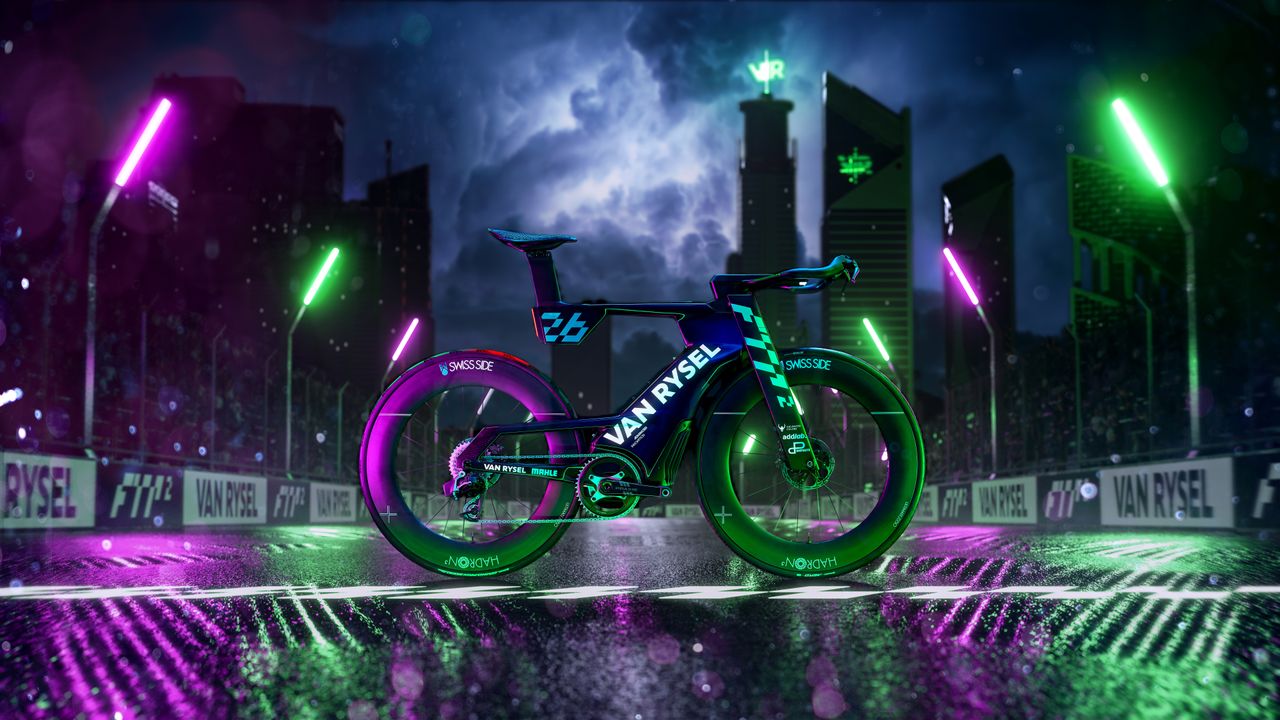
Van Rysel concept bike.

Each year, there is The Bike. Last year The Bike was the crazy Factor One that I spotted at the Dauphiné, with its wild fork and unusual… well, everything. The year before, we waited until late in the day, but The Bike was the leaked Colnago Y1Rs, with a radical seat cluster. Van Rysel, debuting at the Velofollies trade show in Belgium – which we will be bringing you a tech gallery from – has launched an early bid to become The Bike for 2026 with an undoubtedly crazy, non-production concept machine.

Dubbed the FTP^2, this bike is an e-assisted machine designed to double the rider’s FTP and allow them to reach previously unattainable speeds using a combination of added power and aerodynamic efficiency. It’s clearly a very striking machine, but is derived from some tried and tested trends. Beyond the bike, there is a total system involving ‘wireless shoes’, a new skinsuit, and a modular aero helmet, all of which very much sit outside the framework of the UCI’s technical regulations.

The bike

Are wide forks the latest trend nowadays for aero? (Image credit: Van Rysel)
At the base of the down tube the cooling fins for the motor can be seen. (Image credit: Van Rysel)
No seat tube, as is often seen in triathlon bikes. (Image credit: Van Rysel)
The cockpit is where things are really wild. (Image credit: Van Rysel)

The core of this suite of conceptual products is of course the bike. The FTP^2 itself looks utterly wild compared to UCI-constrained road bikes, but by the standards of the machines piloted in the comparatively unregulated triathlon scene, it’s not all that crazy.

Up front the forks follow in the footsteps of the now legendary Hope x Lotus track bike, and the fresh-in-the-memory Factor One, with wide-set and extremely deep legs. Curiously, unlike the most aero bikes we’ve tested in the wind tunnel, which all have a bayonet fork, the FTP^2 opts for a traditional tapered head tube, which will have undoubtedly increased the frontal area of the machine.

The downtube is positively enormous, holding as it does the battery and Mahle M40 motor assembly to “multiply the input effort by up to four”. Cooling fins at the bottom bracket are the only initial indication that this is an e-bike, until you reach the cockpit, which to my mind is the most interesting part of the whole setup.

Riders seeking an aero advantage nowadays are rarely ever seen in the drops, the traditional go-fast hand position of old, with it normally reserved for sprinting currently. Clearly the Van Rysel team was wondering whether it would be advantageous, albeit distinctly illegal, to dispense with the lower portion of the bars anyway and create a bar that meshes with the hoods-in trend of recent seasons. The result is part TT base bar, part old school bullhorn, and part PlayStation controller, allowing the rider to control their gears, motor, computer, and (I can’t believe I’m saying this) shoes.

Naturally, a futuristic aero machine needs some deep wheels, and it feels somewhat fitting that a bike with a fake UCI sticker with the word ‘NO’ on it is kitted out with 85mm deep Swiss Side wheels, as it was the brand to write an open letter of complaint to the UCI following its ruling on maximum rim depths last year.

Unsurprisingly, with so many added bells and whistles, the FTP^2 is no featherweight, tipping the scales at 15kg in a size M.

Wireless, radio controlled shoes

The shoes, which bolt directly to the bike, dispense with the pedal in the traditional sense. (Image credit: Van Rysel)
Vents cool the feet and the wireless motor, which is controlled from the cockpit to tighten or loosen your shoes. (Image credit: Van Rysel)

I’ve teased this long enough, so let’s dig into the first part of the total system concept, which takes the form of shoes that replace both the pedal and shoe in a bid to improve aerodynamics.

The heavily sculpted body of the shoe bolts directly to the carbon Praxis cranks, making them a permanent feature. Powered by a SRAM battery, usually designed to power SRAM’s wireless shifting derailleurs, it instead powers a motor within the shoe to loosen and tighten the lacing, and is radio controlled via the aforementioned cockpit.

The deep shape and gaping vents, designed to provide foot ventilation and motor cooling, have a certain Gundam vibe to them, but also would likely increase the risk of pedal strike if used in the real world.

Questions arise also about foot release, both in the event of a crash, or should you forget to charge your shoes, leaving you bound to your machine at the end of a ride, which I put to Van Rysel:

"We are currently working on this topic. For the moment we cannot show you this part but, for sure, the aim of this project is to have a foot-release mechanism for a better safety."

To be fair, it is just a concept, so one mustn't be too picky.

A modular helmet and full-body skinsuit

Modular helmets aren't a new concept, but they are a lot more illegal than they used to be. (Image credit: Van Rysel)
The standard skinsuit uses padding to allegedly improve both safety and aero performance. (Image credit: Van Rysel)

To bring the full system together, Van Rysel has paired the FTP^2 with a modular helmet that clips onto the brand’s RCR-R road helmet and a total coverage skinsuit, utilising padding in an attempt to improve both aerodynamics and safety in one fell swoop.

Removable helmet shells were at one point an incredibly popular trend, brought about perhaps most famously when Mark Cavendish won his world road race title using one in 2011. Naturally, these were subsequently banned by the UCI, but the concept is sound; why buy two helmets when one modular one would do? Van Rysel has just upped the ante on the aero fairing from solid shell to full, visored TT helmet, complete in this case with rear light which should excite those governed by British time trial regulations.

Finally, the skinsuit. At the time of writing the page containing the relevant information was unavailable, but from what I managed to glean the brand's complimentary skinsuit, which appeared to come in either a traditional shoes and short sleeves variety and in a full length, long legs, long sleeves and gloves model, utilises padding in areas commonly associated with impact and road rash to improve safety, but also to act as fairings, improving the aerodynamic package in a two-fold “win-win” situation, according to the brand.

Not part of the press release, but the skinsuit product page also has this full body option with integrated gloves. Presumably the rider has to should "Honey, where is my super suit?!" whenever they get dressed. (Image credit: Van Rysel)

Haven't we seen this before?

(Image credit: Specialized)

This isn’t the first time a brand has released an extremely out there concept bike to cock a snook at the governing body’s rulebook; Specialized famously released the aptly named fUCI ten years ago, and much of what was unorthodox then remains so now thanks to the UCI’s aversion to change. That, too, was an e-assisted machine, complete with illegal fairings, unorthodox trispoke wheels of non-standard size, no seat tube, and additional electronic cockpit integration via the housing of a smartphone.

I think it’s perhaps unfair to say the FTP^2 is a derivative concept machine, though there is a clear lineage between the two, but it is definitely noteworthy that much of what was deemed controversial, illegal, and unorthodox in competitive bicycle design a full decade ago remains as such today, such is the stagnating effect of the UCI on racing bicycle development.

I have long been a proponent of the pros having their own race machines, separate from the commercial options you or I get to ride (and no, for the avoidance of doubt I don't think the pro's should be on e-bikes). I think it’d make for better race bikes, and better consumer bikes, and I think with bikes like the Factor One, Ridley Noah Fast 3.0, and Colnago Y1Rs we are approaching that point already to some degree.

It’s clear, with concepts like these, that there is a pretty major gulf between what is possible and what is commercially viable, thanks to the UCI rulebook, even if I’m not personally sold on the thought of having to charge my shoes.

Sign up to read this article
Read news from 100’s of titles, curated specifically for you.
Already a member? Sign in here
Related Stories
Top stories on inkl right now
One subscription that gives you access to news from hundreds of sites
Already a member? Sign in here
Our Picks
Fourteen days free
Download the app
One app. One membership.
100+ trusted global sources.







