
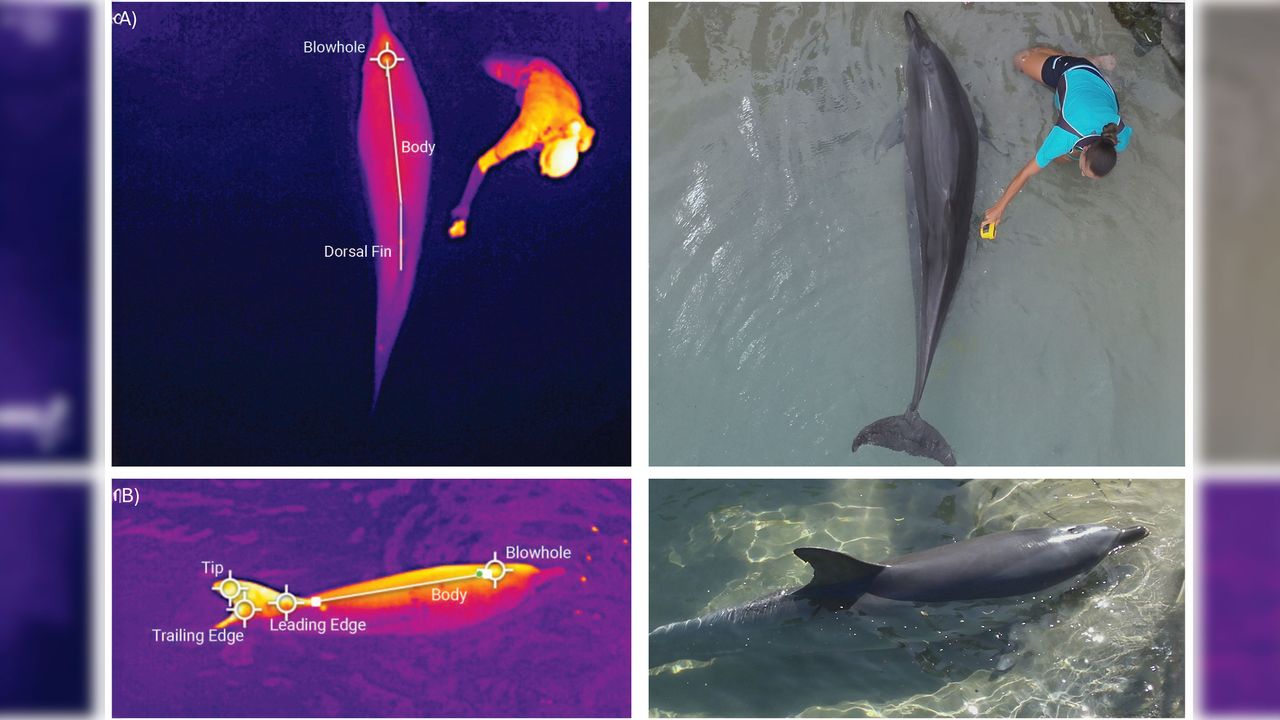
The thermal cameras in a DJI Matrice 30T are cited in a scientific research document as the tech used for monitoring vital signs in dolphins which can dramatically reduce stress for the creatures, while helping us
The team behind the paper, Charlie White, Andrew P. Colefax, and Guido J. Parra, discuss the advantages of using remote devices to monitor the health of dolphins rather than traditional "invasive" methods of temporarily catching the creatures and measuring them.

Those measurement methods are not just taking temperature on the surface, either – many researchers conduct rectal probes, make the dolphins ingest radio-telemetry pills and internal data loggers, and conduct electrocardiograms.
If breathing and temperature can be monitored remotely, dolphins and humans can live together more easily.
DJI's precision is ±2 °C when the measurements are taken at relatively close-range (though 10 meters is still considerably less close than the above), but given scientists had already determined that the stress was creating a ±4 °C variance in the data, it's arguably better to use the drones according to the data collected.

The DJI Matrice 30T boasts a thermal camera with 640 x 512 pixels and a refresh of 30 fps. The two traditional cameras are 12 MP wide and and a zoom with 48 MP too.
Dolphins images were taken at or near the surface, so the optical cameras could be used for feature identification, helping know which dolphin was which.
Interestingly, the experimenters still felt that drones might bother the dolphins, so ther were given fly-bys to help acclimatize them first.
The experimenters also took flights at a number of different altitudes – specifically 30m, 15m, 10m and 5m. These are scientists, of course, but 30m is 98ft. Only lower down were the dolphin's individual personalities clearer enough, and, importantly for the scientists, the details of the dolphins.

Measurements that are telling include the blowhole and dorsal fin temperature, and these need to be out of the water the moment the thermogram (temperature photo) is captured.
In what might be bad news for dolphins, the report concluded that the use of drones is feasible, but didn't find a connection with the other measurement that has traditionally been collected for dolphin group health studies – rectal temperature.
Despite this weakness, there is definitely the option to gather data more efficiently and cause less irritation to dolphin populations. For now, though, it looks more likely to be done in places like Australia where there are no limitations on the equipment choices.
Choices of the best thermal drones in the USA are now distinctly limited by the ban on new DJI drones, at least while it is still being challenged in the courts.