Get all your news in one place.
100's of premium titles.
One app.
Start reading
The Economic Times
The Economic Times

Will lactose-free products be the next booming frontier in India’s dairy industry?

In India, milk has traditionally occupied a sociocultural place of pride, whether it is mothers insisting children to finish a glass of milk, families preparing dairy-based dishes at festivals, or the vast chain of countrywide sweet shops giving it a unique place in the Indian food economy. It has been both a nutritional staple and one of the country’s most successful agricultural value chains.

Yet, between 60 and 74% of Indians are lactose mal-absorbers, according to a 2015 study by the Sanjay Gandhi Post Graduate Institute of Medical Sciences (SGPGI). This biological reality, long treated as an individual problem rather than as a public health hazard, even less as a market gap, is now providing a fresh impetus to the country’s dairy industry to reimagine milk.

“Lactose-free dairy has moved well past niche status; it’s one of the fastest-growing segments in Indian dairy today. This isn’t surprising when you consider that an estimated 60-70% of India’s population is lactose-intolerant, with South Indian populations showing rates as high as 66.6%. That’s a massive underserved base, and for years the category simply didn’t have products built for it,” says Thapasya Vijayaraghavan, Co-Founder and CEO, Beanery Foods.

How consumer preference presents a business opportunity

Lactose-free milk is now beginning to evolve into a broader value-added dairy proposition. For dairy companies navigating slower growth in traditional categories and increasing competition in commoditised milk markets, lactose-free products represent an opportunity to move up the value chain while addressing changing consumer expectations around health, nutrition, and convenience.

“In India, lactose-free milk is moving beyond a narrow ‘intolerance-only’ conversation. Consumers are not walking away from dairy; they are looking for dairy that fits modern wellness expectations: easier digestion, trusted nutrition, familiar taste, and convenience. That is why we are seeing lactose-free move from a metro-led niche toward a more mainstream value-added dairy opportunity,” says Saurabh Sinha, Marketing Director, Tetra Pak.

The shift reflects a larger transformation underway in India’s food and beverage market. Across categories, consumers are increasingly seeking products that offer functional benefits beyond basic nutrition. The trend is powered by rising health awareness, wider recognition of digestive discomfort, a preventive-nutrition mindset, and better availability via organised retail and digital-first channels, especially pertinent in a market where lactose malabsorption affects a large share of the population, according to Sinha. Dairy, traditionally positioned as a source of calcium and protein, is now being reimagined through this lens.

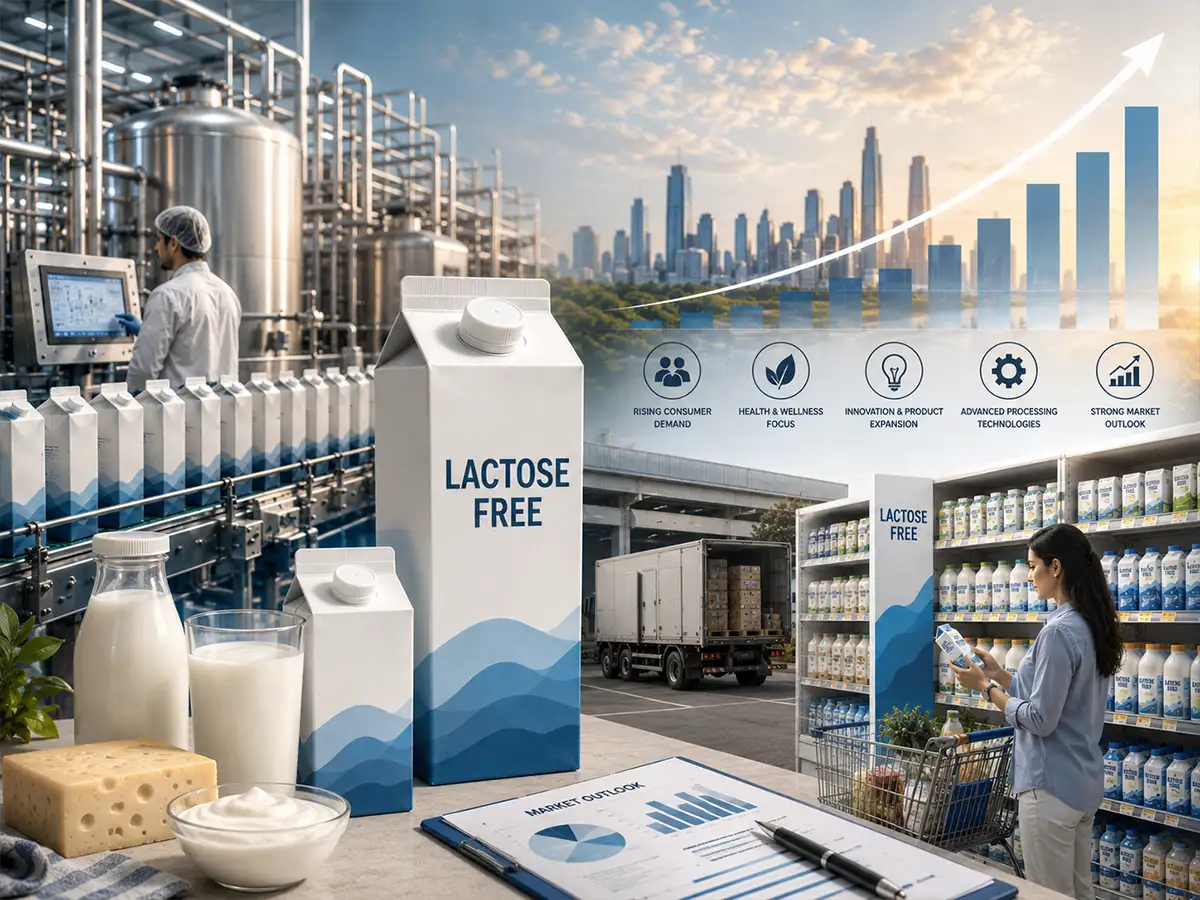
The market reflects that shift, with the lactose-free milk category alone projected to grow from roughly $13.8 billion to $21.6 billion globally by 2031, at over 9% compound annual growth rate (CAGR), and in India specifically, as Vijayaraghavan notes, the segment is forecast to grow at a 7% CAGR through 2027, led by milk as the largest sub-category.

This trend is creating new opportunities for organised dairy brands. Unlike conventional milk, lactose-free products command a premium positioning, allowing companies to differentiate themselves in a highly competitive market. More importantly, they create opportunities for portfolio expansion into adjacent categories such as high-protein dairy, fortified milk, flavoured beverages, and specialised nutrition products. “What's telling is that even as the broader Indian dairy industry crosses $30 billion-plus, categories such as lactose-free, organic, and fortified products remain under-penetrated at below 4% share; that's the real opportunity. It's early innings for a category with structural demand already in place,” adds Vijayaraghavan.

The business potential lies not merely in addressing lactose intolerance but in responding to a broader consumer desire for products that combine nutrition, convenience, and digestibility. It is also aiding in dismantling popular misconceptions surrounding lactose-free milk.

“The biggest misconception is that lactose-free milk is somehow artificial, which might mean less natural, or nutritionally inferior. The reality is much simpler: it starts as real dairy milk, and the lactose is broken down with the help of lactase so that it is easier to digest for people with lactose intolerance. The core nutritional value of milk, including protein, calcium, and other key micronutrients, remains unchanged. Another common misconception is that the slightly sweeter taste means sugar has been added. In fact, that sweetness comes naturally from lactose being split into glucose and galactose, which are perceived as sweeter on the palate,” Sinha explains. As awareness increases, industry stakeholders are finding that demand is extending beyond consumers with diagnosed lactose intolerance to include health-conscious households, fitness-focused consumers, and food-service businesses seeking more inclusive offerings.

As Siddharth Runwal, CEO of Provilac, puts it, “For a long time, lactose-free dairy was seen as a niche category, but we’re seeing that change quickly. At Provilac, we launched fresh lactose-free milk in response to repeated customer requests. What surprised us was how rapidly demand grew after launch. Adoption wasn’t limited to households, we also saw cafes increasingly choosing lactose-free milk for their menus. That shift tells us consumers today are looking for dairy products that are easier to digest without compromising on freshness, taste, or nutrition. We believe this presents a strong opportunity for the dairy industry to innovate, not only through better products but also through packaging and formats that make lactose-free dairy more accessible and convenient. It’s also why our high-protein milk is lactose-free, allowing more people to enjoy the nutritional benefits of dairy.”

There’s also a deeper nuance to the demand that people miss: the lactose-free wave is intertwining with the broader shift away from added sugar,Vijayaraghavan notes.

“Lactose-free milk is naturally sweeter than regular milk, because the enzyme breaks lactose down into glucose and galactose, simple sugars that taste sweeter, so it fits a diet that's cutting refined sugar without giving up on taste. It’s also easier on the gut, and with the rise in protein intake and gut-health awareness among Indian consumers, lactose-free products, such as ZUMI’s lactose-free milkshakes, are landing at exactly the right cultural momentum,” she adds.

The growing interest from cafés and food-service operators is particularly significant. Historically, specialised dairy products often struggled to move beyond retail shelves. However, as restaurants, cafés, and hospitality businesses increasingly cater to consumers seeking customised dietary options, lactose-free dairy is finding demand across multiple consumption occasions. This broadening of the consumer base strengthens the commercial viability of the category and encourages greater investment in product development.

Factors aiding this premiumisation shift

Technology is playing a crucial role in enabling this transition. The expansion of lactose-free dairy would have been difficult without advancements in dairy processing and packaging that allow manufacturers to preserve freshness, nutritional quality, and product safety while reaching consumers across wider geographies.

Ultra-high temperature (UHT) processing has emerged as one of the key enablers. By extending shelf life without the need for continuous refrigeration before opening, UHT technology allows manufacturers to distribute specialised dairy products beyond metropolitan markets and into regions where cold-chain infrastructure remains limited. For lactose-free products, which often begin as premium offerings with lower production volumes, extended shelf life helps improve supply-chain efficiency while reducing wastage.

Packaging innovation is becoming equally important. As value-added dairy categories expand, packaging is no longer simply a protective layer but an integral part of product accessibility and consumer convenience. Shelf-stable formats, single-serve packs, on-the-go consumption options, and packaging solutions that preserve nutritional integrity are helping manufacturers expand the occasions and channels through which lactose-free products can be consumed.

“This is exactly where processing innovation matters. Modern lactose-free production—where lactase enzyme is dosed and hydrolysed under controlled conditions—is far more precise than traditional dairy processing, with far less room for human error. It’s a repeatable, calibrated process rather than a manual one, and that consistency is what lets it adapt across formats—milk, milkshakes, yogurt, paneer—without compromising taste or shelf stability each time. Tetra Pak's UHT processing and aseptic packaging play a big role here too; they let us lock in that precision at scale, giving lactose-free products ambient shelf life without preservatives, which is what actually makes a clean-label product commercially viable and shelf-stable outside the cold chain. That combination of precise processing plus the right packaging technology is what turns lactose-free from a lab-accurate product into a scalable one,” Vijayaraghavan explains.

What makes the category particularly compelling from a business perspective is that it aligns multiple industry priorities simultaneously. It supports premiumisation, addresses evolving consumer health preferences, creates opportunities for product differentiation, and benefits from advances in processing and packaging technologies. Few emerging food categories currently offer such a convergence of consumer demand and operational feasibility.

Lactose-free milk’s naturally sweeter taste, resulting from lactase splitting lactose into glucose and galactose, also helps it fit seamlessly into Indian kitchens. “That opens up very practical everyday uses: consumers can use lactose-free milk in chai, coffee, smoothies, kheer, payasam, phirni, custards or milkshakes, where the gentle sweetness can help deliver indulgence without changing the core dairy experience. For India, the opportunity is not only to make milk easier on the gut for those who need it, but also to make familiar recipes feel lighter, smarter and more aligned with today’s wellness-conscious consumer,” Sinha surmises.

This article is part of an ET Spotlight Special series.

Sign up to read this article
Read news from 100's of titles, curated specifically for you.
Already a member? Sign in here
Related Stories
Top stories on inkl right now
One subscription that gives you access to news from hundreds of sites
Already a member? Sign in here
Our Picks
Fourteen days free
Download the app
One app. One membership.
100+ trusted global sources.