Get all your news in one place.
100's of premium titles.
One app.
Start reading
The Economic Times
The Economic Times
Shaghil Bilali

Will fixed deposit interest rates go up in October as inflation rises?

After the government announced that the Consumer Price Index (CPI) inflation for August 2026 increased to 4.8% year-on-year (YoY), HSBC Global Investment Research, in its forecast, predicted that the Reserve Bank of India (RBI) would raise policy rates (repo rate) by 25 bps twice, once during its October meeting and again in December, through its Monetary Policy Committee (MPC), pushing up the overall rate to 5.75% from 5.25%.

That said, a 4.8% inflation rate is still far below the RBI’s upper tolerance limit of 6%, which could be a factor prompting the RBI to increase the repo rate. The fact that inflation has been rising consistently for the last few months, makes it increasingly likely that the RBI will decide to hike the repo rate.

Can continuously rising inflation and a high repo rate compel banks to increase their fixed deposit (FD) interest rates? What do other key indicators, such as the high credit-growth ratio, high 10-year G-Securities yield, and high interest rates of small savings schemes suggest about the possibility of high FD rates in the near future?

Also Read: 8th Pay Commission: Can Level 10 employees get up to Rs 57,000/month HRA?

Rising inflation’s relation with FD interest rates

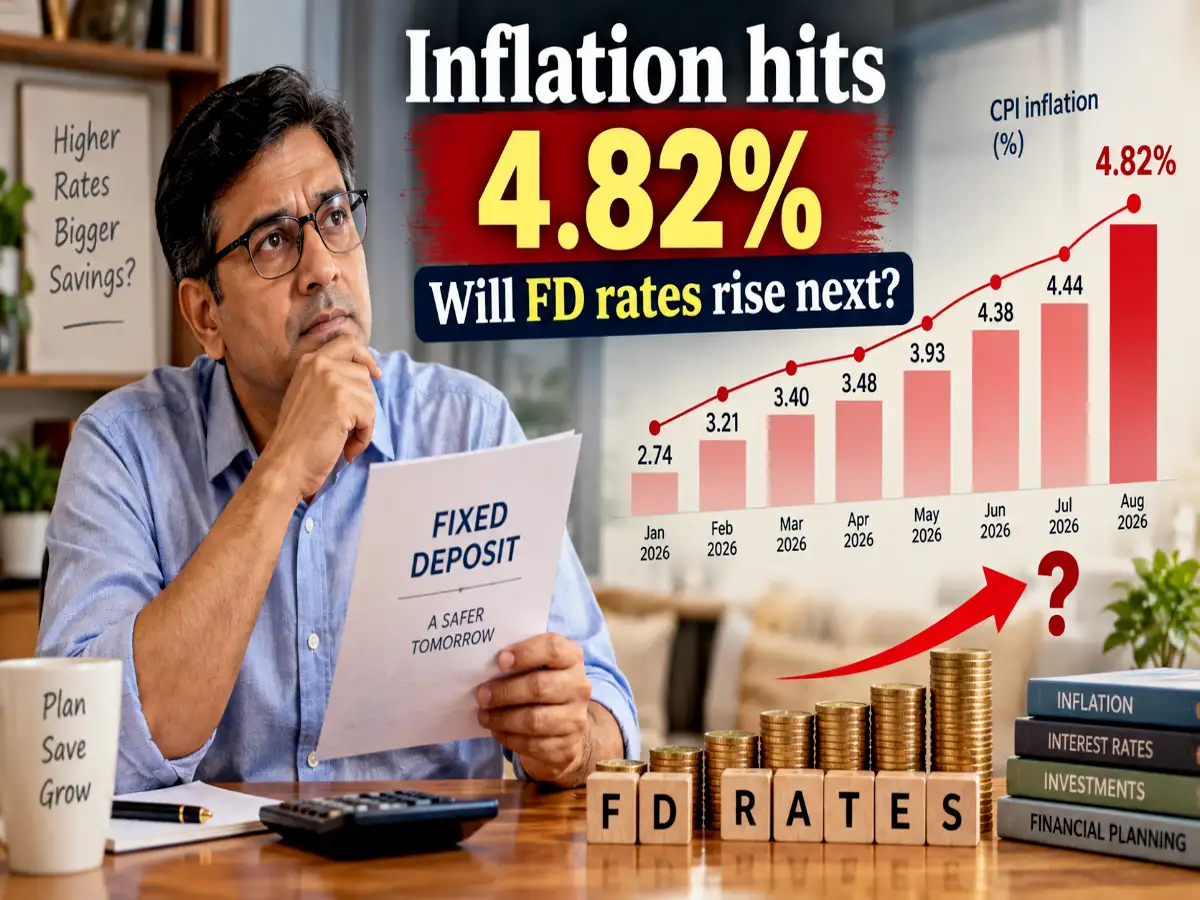
Inflation has been rising since October 2025, when it was at a low of 0.25%. In 2026, it rose from 2.74% in January to 4.82% in August. The US-Iran conflict, rising crude prices and increasing transport costs suggest that inflation may continue rising for the next few months. Once it moves closer to the 6% upper tolerance limit, the RBI may react by increasing the rate. If that happens, banks may find an opportunity to bump up interest rates.

I nflation rate since December 2025

Month CPI inflation (%)
Dec-25 1.33%
Jan-26 2.74%
Feb-26 3.21%
Mar-26 3.40%
Apr-26 3.48%
May-26 3.93%
Jun-26 4.38%
Jul-26 4.44%
Aug-26 4.82%

Adhil Shetty, CEO, Bankbazaar, told ET Wealth Online that banks also consider the RBI’s interest-rate stance, liquidity in the financial system and demand for loans before determining FD rates.

“If inflation stays elevated, it could put upward pressure on interest rates. In such a situation, deposit rates may rise to attract funds, particularly when loan demand is strong, and banks need more deposits. However, if deposit growth is adequate and liquidity remains comfortable, there may be little need to raise FD rates even if inflation rises. The outlook will therefore depend on how inflation affects RBI policy and interest rates, along with funding requirements across the financial system."

Also Read: Rs 2.5 crore retirement corpus: Can you get Rs 2 lakh monthly income for 25 years?

Thomas Stephen, director & head preferred, Anand Rathi Shares and Stock Brokers, told ET Wealth Online that overall, the combination of persistent inflation, elevated food and oil prices, changing rate expectations and banks’ own funding requirements suggests that the probability of higher FD rates is increasing.

"However, a sustained move higher would depend on whether these pressures persist and how the RBI responds," says Stephen.

Deposit-credit growth is high

For banks, liquidity is a key factor for running their business. Before deciding on FD rates, banks also monitor deposit growth and credit demand.

As per the RBI data for July 31, 2026, banks’ credit grew by 19.3% (at Rs 220.78 lakh crore) year-on-year, while deposit growth was 15.4% (at Rs 269.41 crore).

The credit-deposit ratio for the banking sector stood at 81.96% as on July 31.

The credit growth on March 31, 2026, was 15.9%, while the deposit growth on the same date was 13.5%.

It shows that the gap between credit and deposit growth has widened in recent months, meaning banks are lending faster than they are mobilising deposits.

Also Read: 8th Pay Commission news: Pensioners' body in Chennai recommends 3.83 fitment factor; but can 8th CPC deliver it?

When such a gap persists for a long time, banks may need to attract more deposits to support future lending, and hence, they may offer higher FD rates to attract that.

While the credit-deposit ratio is a broader parameter, liquidity conditions and each bank’s funding position also influence how quickly FD rates move.

High 10-year G-Sec yield provides stiff competition to FD rates

Bank deposit rates compete with rates of government securities (G-Secs). So, banks need to keep FD rates higher than G-Secs to attract more deposits. G-Secs are of various tenures and may offer different rates, but the 10-year G-Sec is considered a prominent benchmark for various interest rates in India.

The three-month average interest rate for the 10-year G-Sec is 6.890%, with 7.142% being the highest and 6.675% being the lowest. In contrast, for many public sector banks, the highest interest rates are below 7%. The highest 10-year FD interest rate among prominent public sector banks is 6.25% at Canara Bank.

A high G-Sec yield can create pressure on banks to increase FD rates to attract deposits.

Highest 5-year FD interest rates from public sector, private sector and small finance banks

Public sector banks Private sector banks Small finance banks
Punjab National Bank (6.35%) DCB Bank (7.50%) Suryoday Small Finance Bank (8.25%)
Bank of Baroda (6.30%) IDFC FIRST Bank (6.75%) Jana Small Finance Bank (7.77%)
Canara Bank (6.25%) YES Bank (6.75%) Ujjivan Small Finance Bank (7.20%)
Indian Overseas Bank (6.10%) RBL Bank (6.70%) Equitas Small Finance Bank (7.00%)
State Bank of India (6.05%) Tamilnad Mercantile Bank (6.70%) slice Small Finance Bank (7.00%)
FD Rate source: Paisabazaar

High interest rates of small savings schemes

Small savings schemes such as the Public Provident Fund (PPF), the National Savings Certificate (NSC), and the Senior Citizen Savings Scheme (SCSS) provide an opportunity to crores of Indians to invest their money. At the same time, their rates are in intense competition with FD rates of banks.

At present, many small savings schemes are offering interest rates higher than 7%. Schemes like the SCSS and Sukanya Samriddhi Scheme (SCSS) offer 8.2% each. The government has not decreased small savings scheme rates for nearly two years, despite many indicators suggesting the possibility of rate hikes.

If banks keep their FD rates low for a long time, more investors may prefer investing in small savings schemes to bank deposits.

In order to avoid that possibility, banks may also increase FD rates.

Post Office small savings interest rates: July–September 2026

Small savings scheme Interest rate Interest/payment frequency
Post Office Savings Account 4.00% Annual
National Savings Recurring Deposit (5-year RD) 6.70% Quarterly compounded
National Savings Time Deposit – 1 year 6.90% Quarterly compounded
National Savings Time Deposit – 2 years 7.00% Quarterly compounded
National Savings Time Deposit – 3 years 7.10% Quarterly compounded
National Savings Time Deposit – 5 years 7.50% Quarterly compounded
National Savings Monthly Income Account (MIS) 7.40% Monthly
Senior Citizens Savings Scheme (SCSS) 8.20% Quarterly
Public Provident Fund (PPF) 7.10% Annual compounding
National Savings Certificate (NSC) 7.70% Annual compounding
Kisan Vikas Patra (KVP) 7.50% Compounded annually
Sukanya Samriddhi Account (SSA) 8.20% Annual compounding
Can banks increase FD interest rates in October?

Stephen says the RBI’s October 5–7 MPC meeting will be important.

“If inflation remains elevated and prompts the central bank to consider a rate hike or adopt a more hawkish stance, banks could subsequently raise FD rates to strengthen deposit mobilisation.”

But Stephen also says that if the RBI continues to view the recent inflation spike as temporary and keeps the policy rate unchanged in October, FD rates are likely to remain broadly stable.

“Any meaningful increase could then be deferred to December 2026 or even into 2027, depending on the evolution of inflation, liquidity and credit demand,” says Stephen.

Sign up to read this article
Read news from 100's of titles, curated specifically for you.
Already a member? Sign in here
Related Stories
Top stories on inkl right now
One subscription that gives you access to news from hundreds of sites
Already a member? Sign in here
Our Picks
Fourteen days free
Download the app
One app. One membership.
100+ trusted global sources.